


Originally published in The Whirl of ReOrientation on February 28, 2025.

Artificial Intelligence is at a defining moment. Microsoft’s recent cancellation of numerous data center leases, flagged by TD Cowen analysts, transcends a mere financial adjustment—it signals a seismic shift in AI’s evolution. The dominant paradigm, driven by power-hungry Large Language Models (LLMs), is nearing its breaking point. Emerging as a contender is Active Inference AI, a more efficient and adaptive framework. This transition can be understood through John Boyd’s OODA loop—contrasting its oversimplified linear variant with its authentic dynamic form—and the Apex Predator Theory, as explored in a recent discussion with Keith McCullough on Hedgeye’s Real Conversations. This isn’t a passing trend; it’s a contest for technological dominance.
The Pitfall of “Bad OODA”: LLMs and Linear Constraints
The widely adopted version of Boyd’s OODA loop—Observe, Orient, Decide, Act—has been reduced to a simplistic, linear process often showcased in corporate boardrooms. This “Bad OODA” underpins today’s LLMs, such as ChatGPT and Claude. These systems operate in a closed cycle: they observe a prompt, orient using pre-trained weights from extensive datasets, decide on a response, and act by producing text. The sequence ends there—devoid of real-time feedback or adaptive learning. Deep reinforcement learning enhances this by optimizing outputs through rewards, but it remains locked in a static structure, unable to engage dynamically with an evolving environment.
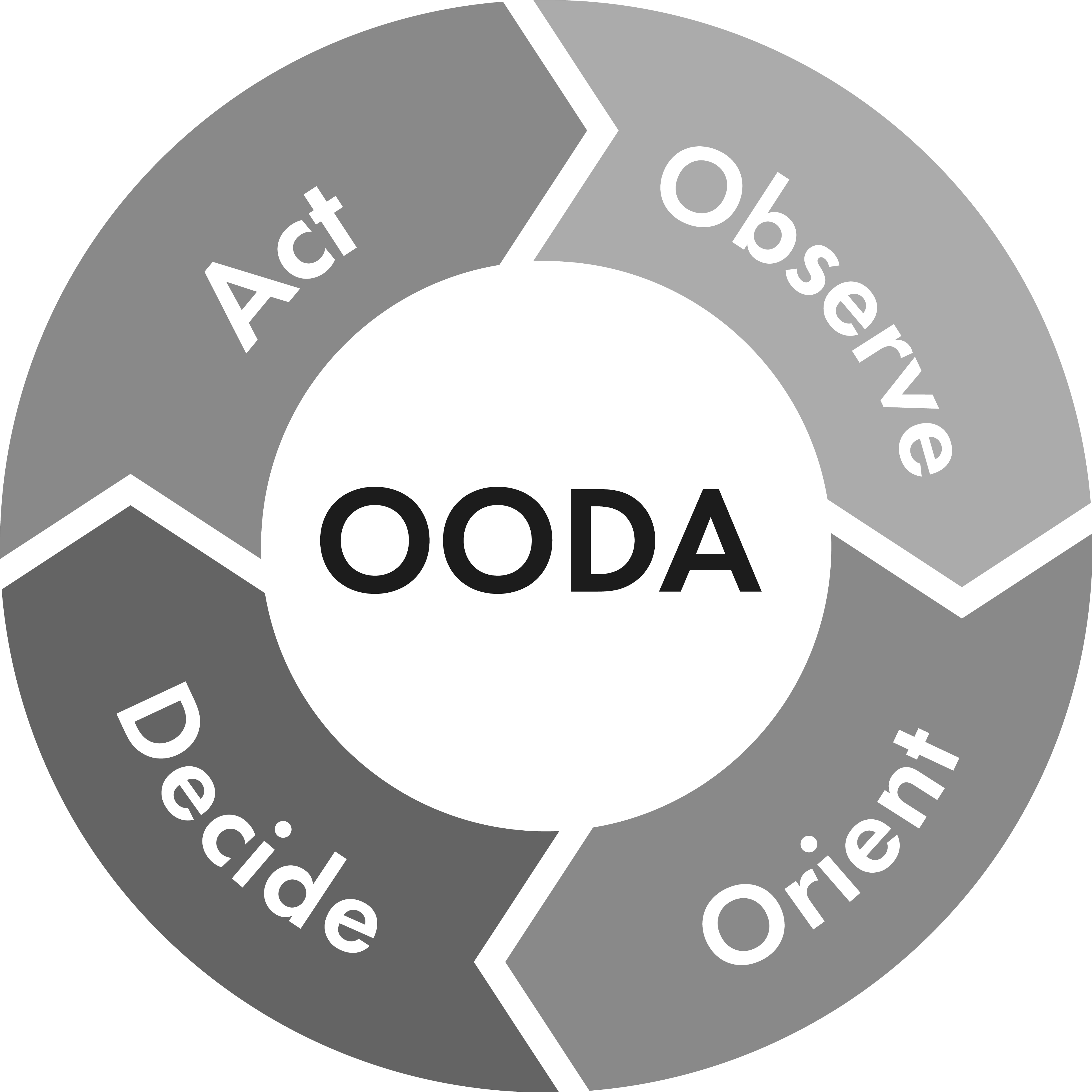
This model fuels the current AI boom, supported by hyperscale data centers—Microsoft’s among them—equipped with Nvidia GPUs consuming over 100 megawatts each. Investors have hailed the trillions in capital expenditure as a sign of unbounded potential. Yet, the approach reveals critical flaws: LLMs demand unsustainable energy, struggle with reliability, and falter when faced with unexpected variables. Their “Bad OODA” lacks an evolving generative model, leaving them vulnerable in a world of volatility and uncertainty—a limitation that threatens their longevity.
The “Real OODA”: Active Inference and Adaptive Systems
Boyd’s true OODA loop is a fractal, nonlinear, adaptive cycle rooted in natural sciences and complex adaptive systems. Picture it within a Markov blanket: sensory states (Observe) collect environmental data—market signals, operational shifts—relaying sensory signals (new information) to a generative model (Orient) that produces probabilistic predictions based on past experiences, culture, and biology. These predictions flow through the Decide-to-Observe feedback pathway, forming an Observe-Orient-Decide-Observe (OODO) loop. This loop embodies Bayesian inference, aiming to minimize the gap between what the system predicts and what is sensed—a discrepancy known as variational free energy (surprise). Act plays dual roles: internal simulations, plans, and counterfactuals aim to reduce expected free energy (future surprise, risk, and uncertainty) through the internal Act-to-Observe pathway, while external actions modify the environment. Implicit pathways—good practices and intuition from Orient to Act, perception from Orient to Observe—provide flexibility, ensuring predictions align with reality.
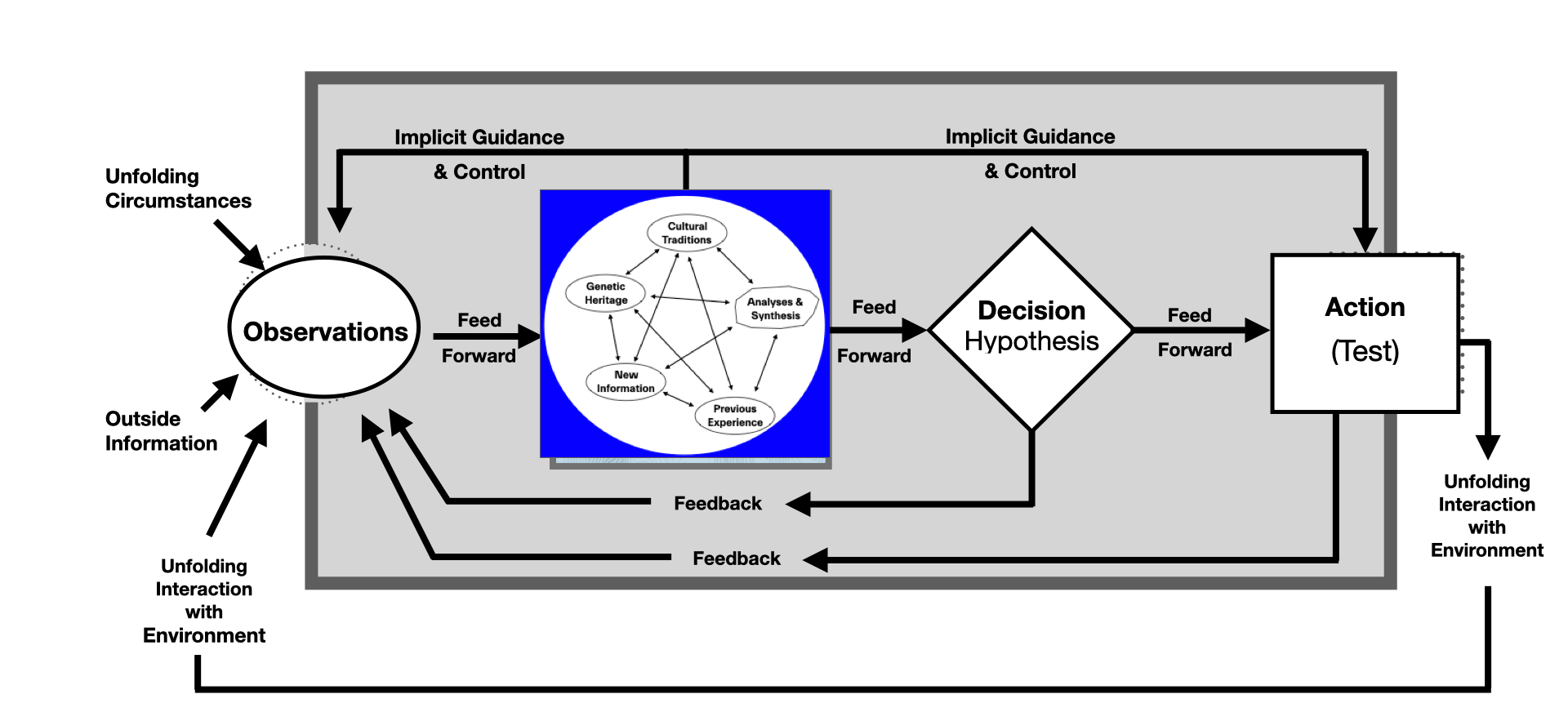
This “Real OODA” forms the foundation of Active Inference AI, based on Karl Friston’s Free Energy Principle. Unlike LLMs, these systems interact with the world in real time, sensing, predicting, and adapting efficiently. Fighter pilots, for instance, integrate radar and sensor data to outpace adversaries with precision, not excess resources. In business, it’s akin to a trading firm anticipating and recalibrating strategies before the market shift. Active Inference prioritizes cognitive complexity over computational scale, presenting a sustainable, low-energy alternative to the prevailing paradigm.
Apex Predator Theory: The Evolutionary Turning Point
The Apex Predator Theory, inspired by Dave Snowden and discussed with McCullough, casts this shift as an evolutionary imperative. Technological paradigms follow S-curves: rule-based AI progressed to machine learning, now giving way to LLMs. At each peak, entrenched systems encounter competency-induced failure—Kodak’s downfall with film, Blockbuster’s collapse with physical rentals. LLMs, despite commanding trillions in market value, are approaching this tipping point, strained by escalating energy costs and limited adaptability.
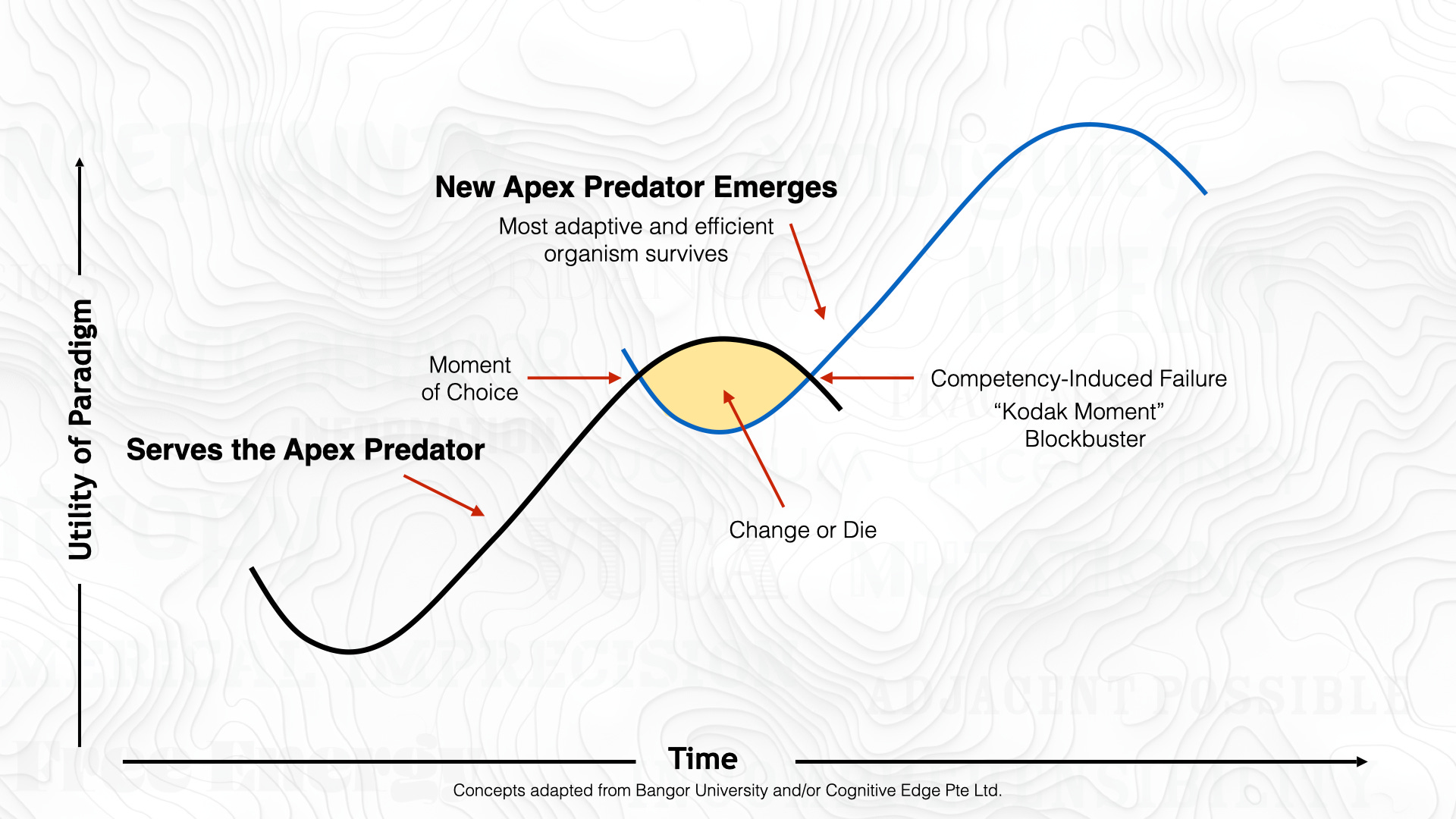
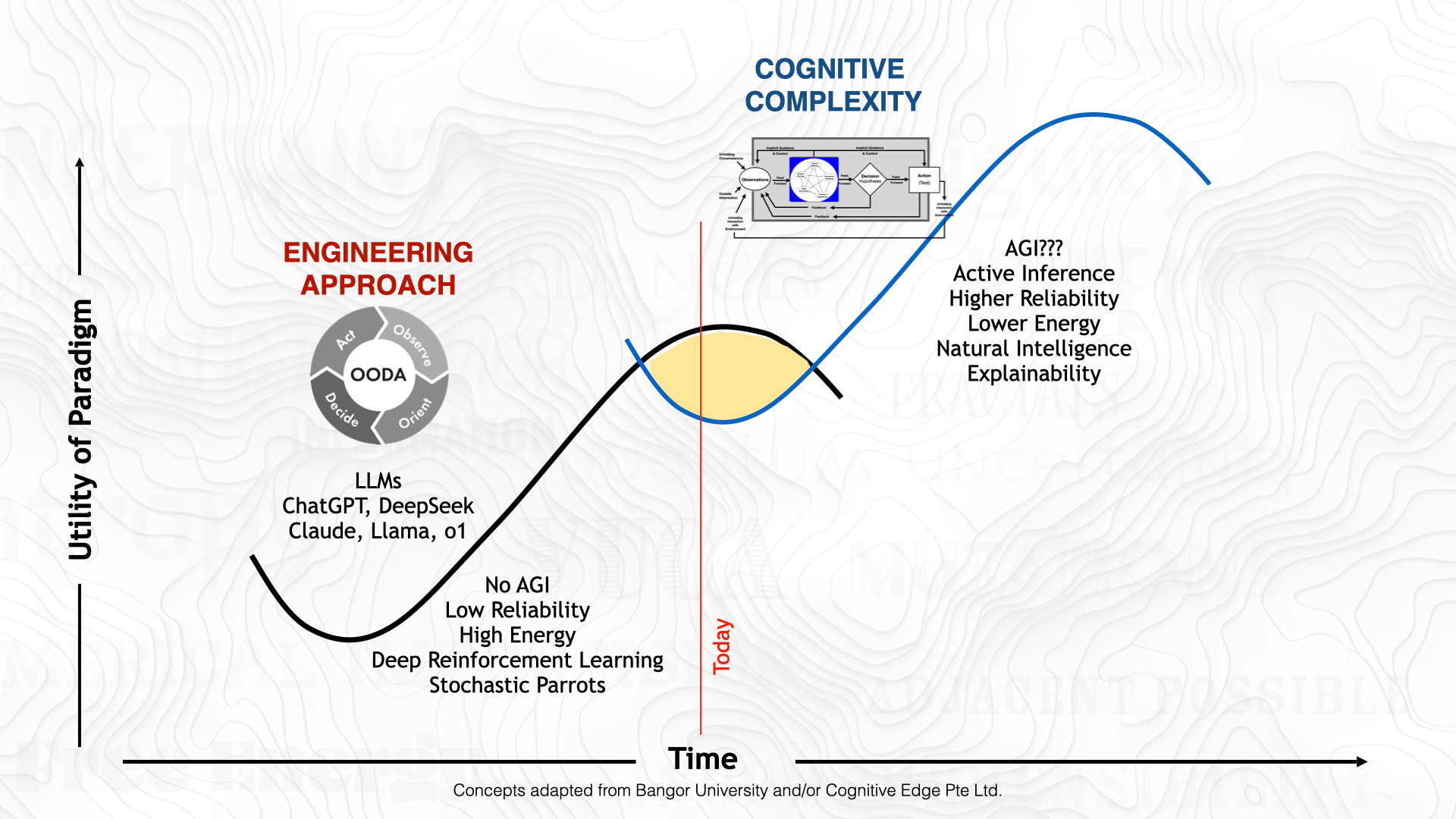
The strategic decision looms: adhere to the waning LLM model or transition to the ascending curve of Active Inference AI. This rising predator leverages the “Real OODA” loop, mirroring biological systems that excel in chaotic conditions. It emphasizes continuous adaptation—think autonomous drones adjusting to flight variables, or financial models anticipating economic pivots—over static outputs. Microsoft’s lease cancellations indicate a calculated reorientation, sidestepping the LLM energy burden to position for a future where adaptability surpasses scale. Other hyperscalers—Google, AWS—face parallel challenges as energy economics and technological constraints converge.
Efficiency as Advantage: Lessons from Adaptive Systems
This evolution mirrors principles seen across contexts. Fighter pilots secure victories by outmaneuvering opponents through strategic precision, not overwhelming force. Businesses gain edges by swiftly adapting supply chains to disruptions, not merely expanding infrastructure. Microsoft’s Azure platform, a technological heavyweight, could shift toward Active Inference applications—real-time analytics, industrial optimization—reducing reliance on LLM-driven outputs. Nvidia’s current dominance, anchored in GPU-intensive setups, risks fading if the paradigm favors leaner, more adaptive architectures.
The Imperative of Adaptation
The AI sector’s fervor—propelled by vast investments and soaring valuations—obscures a pressing reality: the LLM model is unsustainable. Its energy demands are prohibitive, its reliability inconsistent, and its adaptability inadequate. Active Inference AI, grounded in the “Real OODA” loop, offers a viable path forward, merging natural science with technological advancement. Microsoft’s data center pivot is not a retreat but a proactive adjustment, recognizing that the next competitive advantage lies in systems that learn and evolve, not just process.
In an age of complexity and disruption, the most adaptive systems—not the largest or costliest—will lead. The “Bad OODA” of LLMs is losing momentum; the “Real OODA” of Active Inference is gaining ground. For corporations, investors, and innovators, the directive is unmistakable: reorient to this emerging paradigm, or risk being eclipsed by those who do.