


Originally published in The Whirl of ReOrientation on October 19, 2024.

Jim Rutt, a recent guest on No Way Out, recently tweeted that Brendan Graham Dempsey’s A Universal Learning Process: The Evolution of Meaning is “a must-read for everybody seriously interested in the nature of reality and man’s place in it.”
After immersing myself in Dempsey’s new book, I wholeheartedly agree, especially in relation to one particular insight: this book is crucial for anyone seeking a deeper understanding of John Boyd’s OODA loop, particularly the concept of Orientation.
Dempsey’s Learning Framework Deepens Boyd’s OODA Loop
Dempsey’s exploration of learning—Ontogenetic, Phylogenetic, and Symbolic—provides a profound enhancement to Boyd’s idea of Orientation, expanding our understanding of how this central component operates within the OODA loop (Observe, Orient, Decide, Act).
Orientation: The Core of the OODA Loop
In Boyd’s work, Orientation is not merely a phase in decision-making; it is the core element that shapes how we perceive, decide, and act. Orientation integrates genetic heritage, cultural traditions, and personal experiences, shaping our mental models or cognitive frameworks. Boyd famously described Orientation as the “Schwerpunkt” (focal point) of the OODA loop, determining how effectively we can observe, decide, and act in a rapidly changing environment.
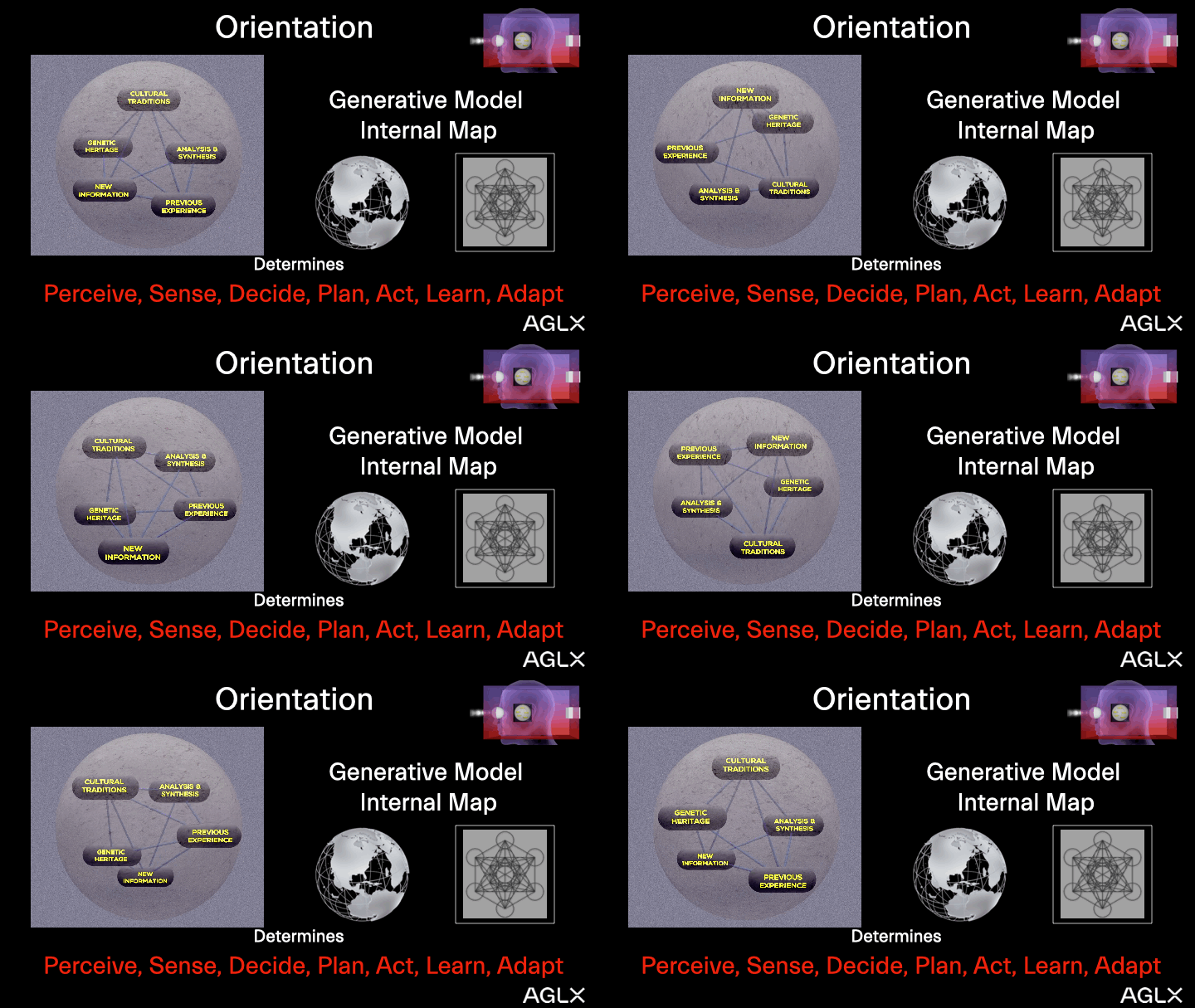
What Dempsey adds to this understanding is a detailed exploration of how Orientation is not a static condition but a dynamic, evolving process. By connecting this to the three types of learning, we can see how Orientation continuously adapts to new stimuli and challenges, deepening our capacity to respond effectively.
Phylogenetic Learning: The Genetic Foundation of Orientation
Dempsey’s exploration of Phylogenetic Learning—the evolutionary process of genetic adaptation—corresponds to the genetic heritage Boyd identifies in Orientation. Over generations, species accumulate adaptations that help them resist entropy and survive within their environments. This evolutionary learning encodes solutions to the challenge of entropy within DNA, forming the deep biological basis for how organisms orient themselves to survive.
In the OODA loop, Phylogenetic Learning shapes how we inherently react to threats and opportunities. Our genetic makeup, shaped by evolutionary processes, provides the foundation for our instinctual responses, affecting everything from perception to decision-making. Boyd’s insight into the genetic component of Orientation aligns directly with Dempsey’s recognition of how evolutionary adaptations influence our mental models.
Ontogenetic Learning: Adapting Through Personal Experience
Ontogenetic Learning, as Dempsey explains, happens at the individual level, where personal experiences continually reshape one’s internal models. In Boyd’s OODA loop, this aligns with the previous experience component of Orientation, emphasizing how we update our mental frameworks through direct interaction with the environment.
Every experience—whether success or failure—feeds back into the OODA loop, refining how we observe and make decisions. This learning process is more immediate and flexible than phylogenetic learning, allowing individuals to adapt to current circumstances in real-time. An experienced strategist, for example, draws on a lifetime of observations and decisions, refining their Orientation to make better, quicker choices in the face of uncertainty.
Symbolic Learning: Collective Wisdom and Cultural Orientation
Where Dempsey’s work especially shines is in his exploration of Symbolic Learning—the uniquely human ability to transmit knowledge, values, and norms through symbols such as language and art. This form of learning shapes Orientation at the collective level, aligning with Boyd’s emphasis on cultural traditions.
Symbolic Learning allows societies to encode knowledge in a way that transcends individual experience, creating shared frameworks of meaning that guide collective action. In Boyd’s OODA loop, cultural traditions form a collective Orientation, influencing how societies observe, decide, and act. These traditions are passed down through generations, adapting over time while preserving core values, which in turn shape collective responses to environmental challenges.
For example, a culture’s symbolic values around cooperation or competition will deeply influence how its members interpret threats and opportunities, ultimately shaping their collective Orientation. Dempsey’s insight into how Symbolic Learning evolves over time adds nuance to Boyd’s idea of cultural traditions within Orientation.
Energy, Information, and Entropy in Learning and Orientation
At the heart of all learning—whether ontogenetic (previous experience / individual development), phylogenetic (genetic heritage), or symbolic (cultural traditions)—is the dynamic interplay between energy, information, and entropy. Dempsey’s treatment of these forces further clarifies Boyd’s OODA loop, particularly when Markov blanket is used to separate internal and external states, by demonstrating how systems use energy to extract and process information to resist entropy and maintain complexity.
Energy fuels learning at all levels, allowing systems to counteract entropy—the tendency toward disorder. Without energy, systems collapse into chaos, losing the ability to adapt. Boyd himself understood this relationship well, as demonstrated in his co-development of the energy-maneuverability (E-M) theory for aerial combat. Energy, in this sense, is the fuel that drives the learning processes.
Information, on the other hand, is the medium or currency that gives structure to learning. In the OODA loop, New Information fed-forward from Observation shapes how we orient ourselves. Whether it’s genetic (phylogenetic), experiential (ontogenetic), or cultural (symbolic), information helps systems make sense of their environments, resist entropy, and apply energy in meaningful ways.
Entropy represents the natural drift toward disorder that systems must continuously resist. By processing information through learning mechanisms, organisms and societies maintain their structure and functionality, pushing back against entropy. Boyd’s OODA loop reflects this struggle, as Orientation allows us to use information to act decisively in ways that preserve order and achieve goals.
Conclusion: A New Lens on Boyd’s OODA Loop
Brendan Graham Dempsey’s A Universal Learning Process provides profound insights into the mechanisms of learning and meaning. By exploring Phylogenetic, Ontogenetic, and Symbolic Learning, Dempsey deepens our understanding of Boyd’s OODA loop, particularly the central role of Orientation. His work helps us see how learning processes powered by energy and information allow systems to resist entropy and maintain their complexity over time.
In short, Dempsey’s book offers a new lens through which to view Boyd’s ideas, making it essential reading for anyone serious about exploring the nature of Orientation, learning, and adaptation within the OODA loop. Orientation: The Core of the OODA Loop