
Originally published in The Whirl of ReOrientation on November 5, 2025.
“You not only want to have individual fingerspitzengefühl… you want to have organizational fingerspitzengefühl.”
— John Boyd, Patterns of Conflict (1986)

In the high-stakes arena of professional sports, where milliseconds separate championships from heartbreak, coaching methodologies are evolving faster than ever. Enter the Constraints-Led Approach (CLA)—a paradigm shift no longer confined to academic journals and bookshelves. It’s storming the pros, backed by ecological dynamics and poised to redefine talent development.
Just last month, the New York Times spotlighted CLA in two must-read pieces: one unpacking its decade-long impact on NBA player development (featuring insights from former trainers with the Timberwolves), and another diving into its revolutionary application with stars like Victor Wembanyama. The Spurs’ phenom honed his edge this offseason with skills trainer Noah LaRoche, embedding CLA principles into his routine. Meanwhile, whispers from league sources suggest that franchises like the Oklahoma City Thunder and the Memphis Grizzlies have explored and adapted CLA elements—focusing on variability in drills to foster adaptive decision-making under pressure. And in a seismic WNBA move, Alex Sarama—champion of CLA’s holistic, athlete-environment focus—was named head coach of the expansion Portland Fire on October 17, signaling that the new WNBA team’s front office favors flow over automaticity.
As No Way Out drops its latest episode today—Episode 134 with Dr. Rob Gray—this briefing unpacks CLA’s DNA and its uncanny alignment with John Boyd’s OODA loop—a timeless exploration of how novelty emerges from living systems. For executives eyeing roster longevity and coaches scaling CLA implementations, here’s the playbook: CLA isn’t just a drill set. It’s Boyd’s Organic Design for Command and Control translated to the hardwood, fused with Mission Command principles for decentralized decision-making and adaptive teams.
What Is the Constraints-Led Approach?
At its core, CLA flips traditional coaching on its head. Instead of prescriptive drills (“Do it this way, 100 reps”), it manipulates constraints—task, environment, and individual—to guide emergent skill acquisition. Rooted in ecological dynamics, CLA views athletes not as isolated executors but as coupled systems with their surroundings. Skills emerge from perception-action loops: perceiving affordances (action opportunities like a “passable lane”) and acting to explore them, fostering intuition and adaptive capacity over rote execution.
As Adrian Bejan (Ep 14, No Way Out) —former Romanian national basketball player and Duke physicist who formulated the Constructal Law—explains, every moving system is a flow system bounded by space and time, with inlets and outlets. Design and currency are its two inseparable features.

“Design is a phenomenon. It is what we see everywhere—configuration, pattern, rhythm, drawing. Design is not something we add. Design is the configuration that emerges when flow systems evolve under constraints to provide easier access.”
— Design in Nature (2012), The Physics of Life (2016)
The court is a living laboratory: players are engines, the ball and information are currencies, the painted area is the high-resistance zone. A 1v3 small-sided game restricted from the top of the key to inside the paint—where shots only count if made inside the second hash mark—isn’t punishment. It’s a set of interconnected enabling constraints that invites players to discover opportunities for low and high pick-ups in traffic, coupling individual design to team design. This is not about repeatedly practicing low and high-pickups, its about making contact and recognizing opportunities for scoring in contested areas.
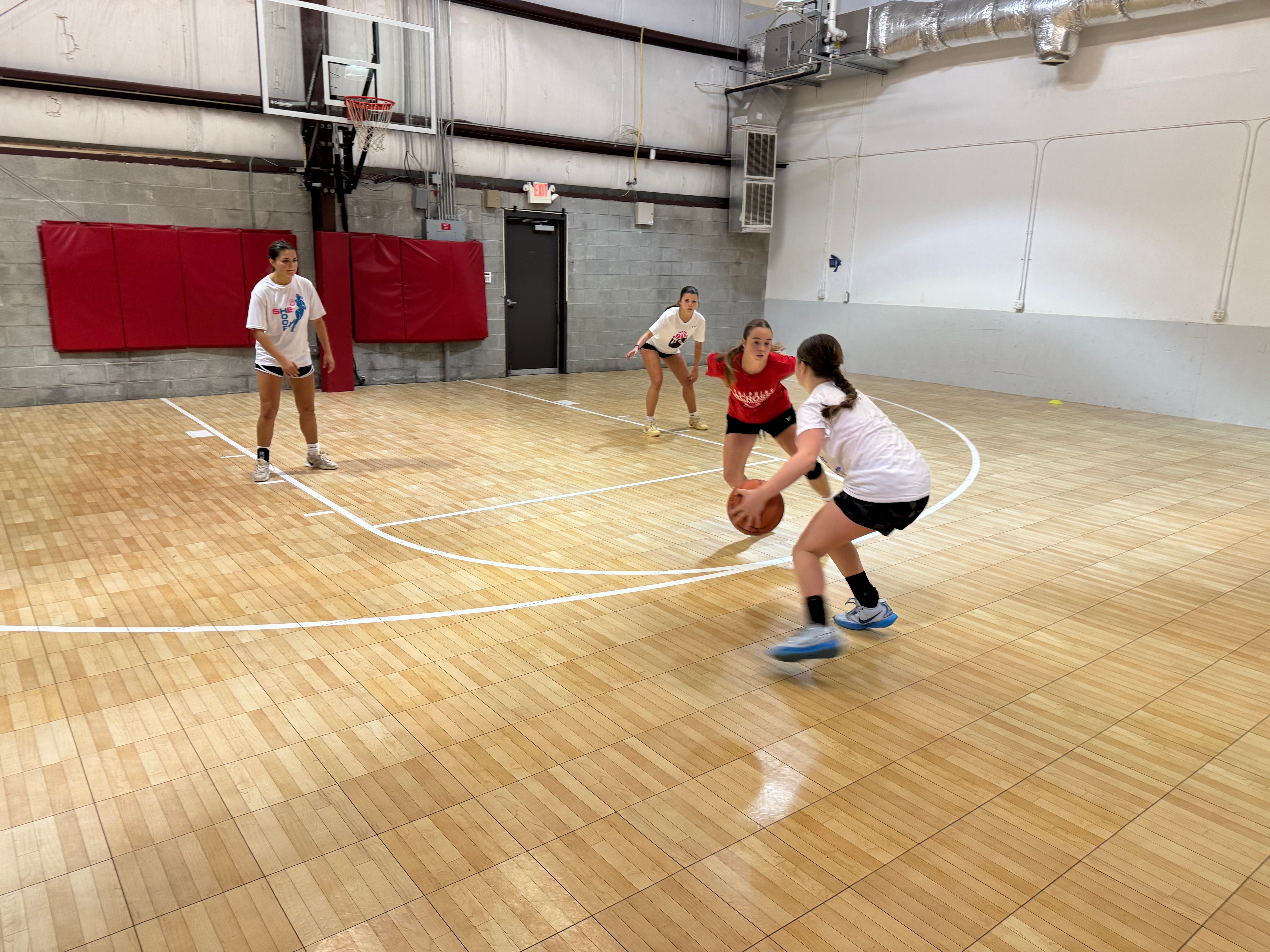
The result? Players who don’t just react—they anticipate and adapt in chaos. As Gray notes in his No Way Out appearance (streaming now), “CLA isn’t about adding technique; it’s about removing barriers so the athlete-environment relationship reveals the skill.” For franchises, this means scalable development: lower injury risk through variability, faster on-court decision-making, and cultures that self-organize like special operations units.
Predictive vs. Prospective: Not Either/Or—Both/And
CLA thrives on prospective control—real-time attunement to the environment without heavy reliance on internal predictions or mental models. But motor control science is split. The Predictive vs. Prospective Control paper (Wilson et al., preprint December 2024) highlights sharp disagreements: Does anticipation stem from internal generative models like Boyd’s Orientation (predictive: forecasting via Bayesian priors or predictive processing) or direct coupling (prospective: feedback loops or affordance detection)?
Predictive camps (e.g., Active Inference, Predictive Processing) argue that a world model (Orientation) embodies expectations to bridge delays.
Prospective ones (PCT, Ecological Dynamics) counter: No need for prediction and world models—the environment specifies what’s next.
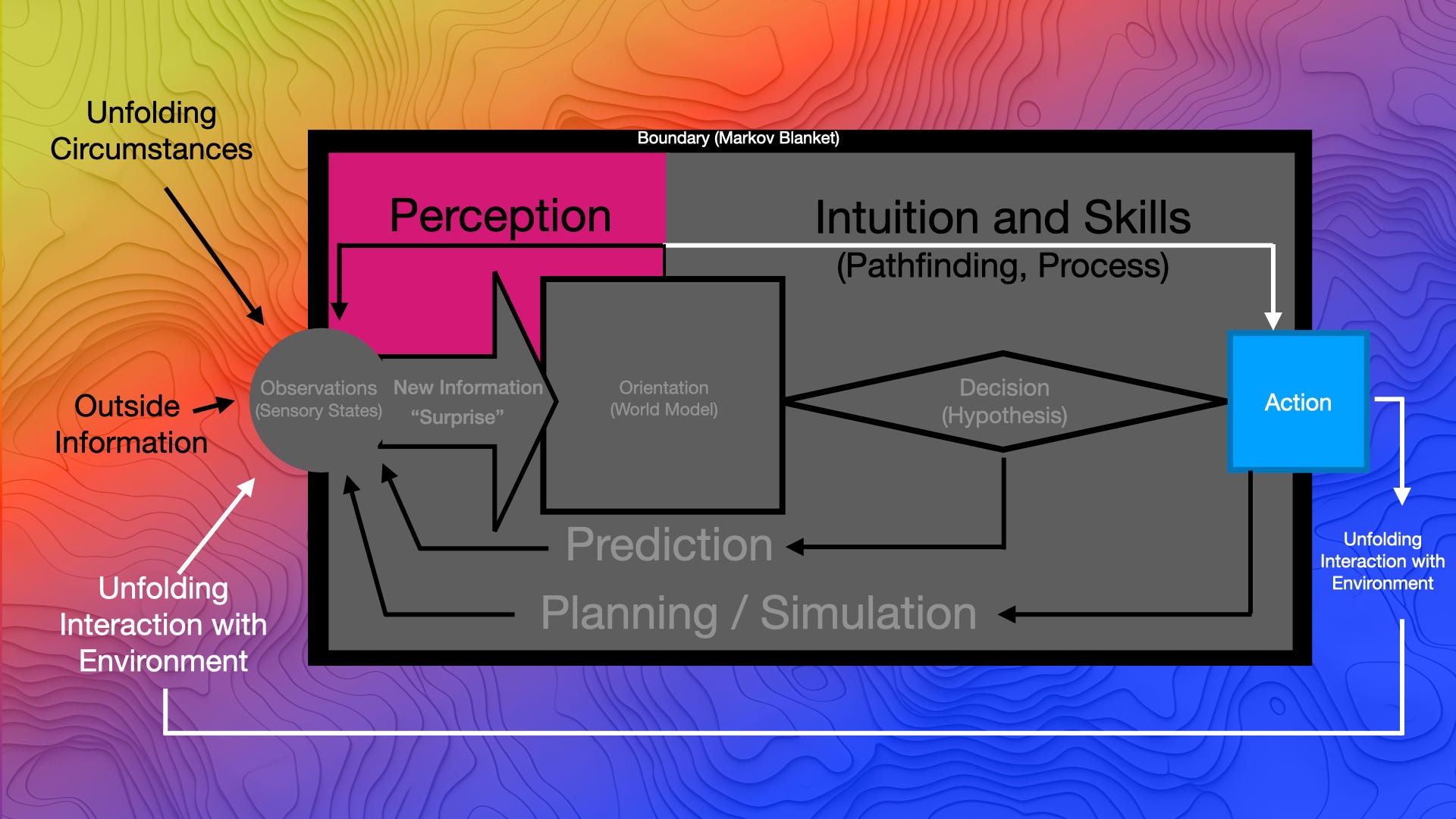
Agreements abound: Both camps affirm anticipatory behavior as essential, rejecting pure reactivity. Disagreements? Predictive risks overemphasizing internal simulations (brittle under pressure and short timelines); prospective might undervalue learned priors in developing organizational adaptive strategies. Predictive and prospective are not mutually exclusive within the OODA Loop. Context determines emphasis. In live play—milliseconds to decide—prospective control is favored: perception, Implicit Guidance & Control (IG&C), and action flow seamlessly. In strategy sessions or product development—weeks to iterate—predictive control leads: generative models forecast outcomes, minimizing expected free energy.
Note: What’s in your leadership and organizational Implicit Guidance & Control (IG&C) pathways will determine whether you favor adaptive approaches or linear, top-down approaches. IG&C pathways within the OODA Loop represent your default mode of operating. IG&C can be changed—Destruction and Creation.
Enter the real OODA Loop—Boyd’s Observe-Orient-Decide-Act cycle, refined as a continuous, integrated flow. It doesn’t choose sides. It harmonizes them. Predictive and prospective aren’t opposing camps; they’re complementary lenses on the same adaptive engine. In CLA terms: Constraints manipulate the environment to elicit both—forecasting for strategy, coupling for execution.
The Real OODA Loop: Where Flow Lives
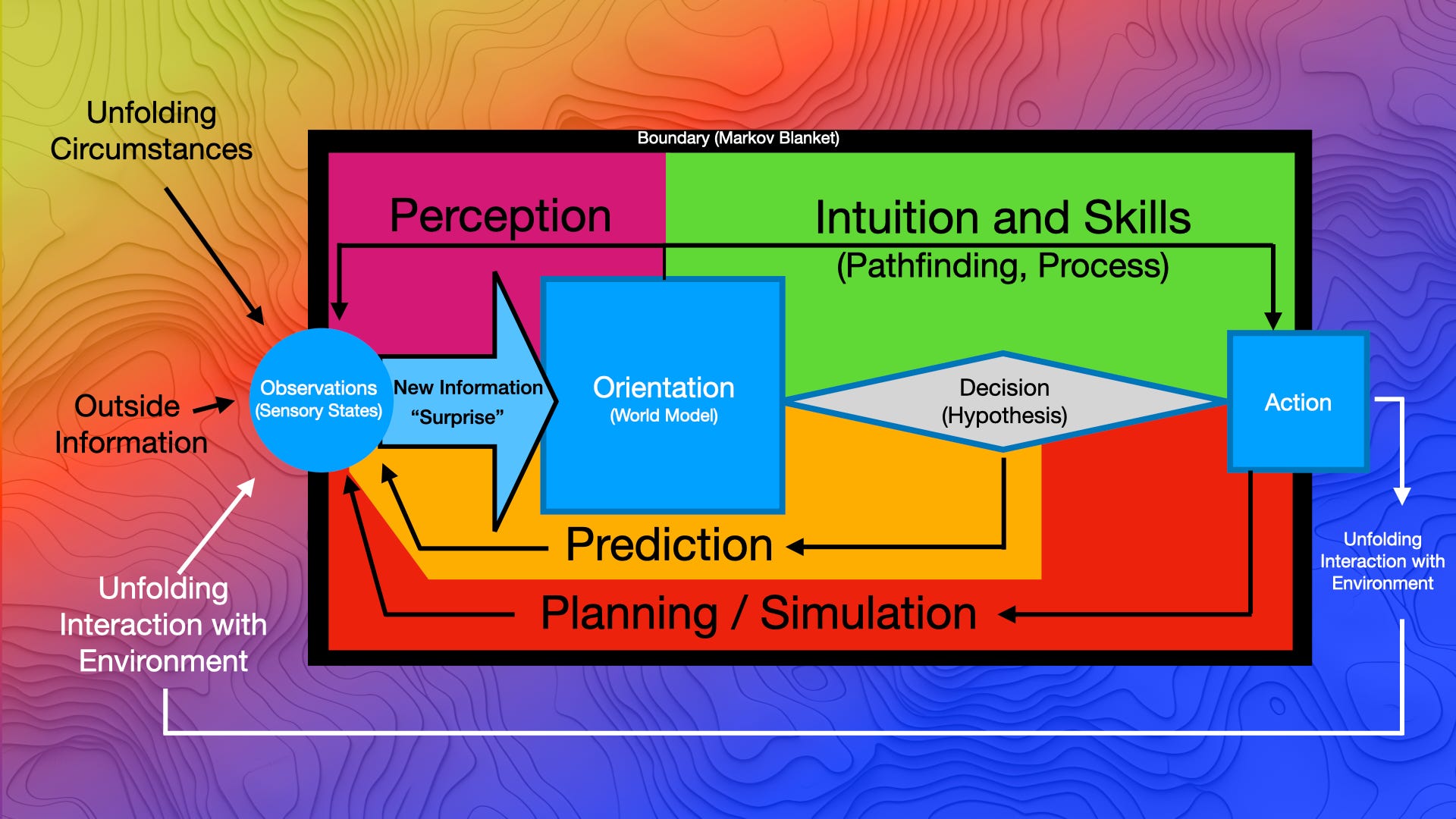
Flow emerges from the adaptive skills we develop. Within the OODA Loop, these skills are embodied in the Implicit Guidance & Control (IG&C) pathway that flows from Orient to Act—the individual and organizational fingerspitzengefühl Boyd demanded. Notice that IG&C sits between perception and action. This is the Constructal Law in action: flow systems evolve toward configurations that provide easier access to currents—here, information, energy, and the ball.
CLA as Boyd’s Legacy in Motion
1. CLA = Organic Design + Mission Command for Coaching
Boyd’s 1987 brief envisioned command as an “organic” entity—self-synchronizing, pattern-forming, like flocking birds. Yet he cautioned that command and control are misnomers:
“Command means to direct, order, or compel; control means to regulate, restrain… In this sense, the C&C we are speaking of seems more closely aligned to leadership (rather than command) and to some kind of monitoring ability (rather than control)… Appreciation includes the recognition of worth or value and the idea of clear perception as well as the ability to monitor. Moreover, it is difficult to believe that leadership can even exist without appreciation.”
— Organic Design for Command and Control
CLA embodies leadership with appreciation—coaches set constraints (the organic pattern), players self-organize (mission intent without micromanagement). It’s Mission Command on the court—empower athletes to exploit unfolding circumstances, not script every possession. As Samara told High Post Hoops, “We design chaos so players thrive in it.” For Thunder and Grizzlies execs exploring CLA, this means rosters that scale: Veterans mentor via shared constraints, not lectures.
Higher levels restrain interference, encouraging bottom-up initiatives, consultation, and critique. “Get inside, know your adversary,” Boyd urged. “Shape his perception… manipulate his plans.” CLA does precisely that—probing opponent tendencies through variability, undermining rigid defenses with emergent creativity.
2. Ecological Dynamics = OODA’s Flow State
Affordances map directly to OODA’s External World (Outside Information/Unfolding Circumstances and Unfolding Interaction). The perception-action loop brackets the Implicit Guidance & Control pathway, embodying an agent’s or team’s intuition and adaptive skills required to meet external challenges.
This is flow—Mihaly Csikszentmihalyi’s optimal state where novelty, risk, and consequences are met by autonomy, purpose, blended egos, familiarity, pattern recognition, and open communication. Gray unpacks this in No Way Out: “In CLA, flow emerges when constraints attune perception to action—no overthinking.”
Purposeful practice builds requisite variety—the repertoire of responses that matches or exceeds the environment’s demands. The perception-action loop exists within Boyd’s OODA Loop; it is the loop that must be developed through deliberate training. CLA offers an effective way to do this, developing fingerspitzengefühl (finger tip feel) and the adaptive capacity to survive and thrive on your own terms.
3. Predictive + Prospective: Dual Lenses on the Real OODA
There is no beginning or end to the OODA Loop. It is non-linear. It is fractal. Observe is not passive perception—reality is not a static television feed; reality is constructed. Perceptual Control Theory (PCT) begins with action to control perception against reference values (Orientation?). Ecological psychology begins with affordances in the external environment, directly specifying opportunities for action without internal models or the need to explore predictions. Active Inference and predictive processing emphasize world models—what Boyd called Orientation.
The real OODA captures their interplay: Surprise or New Information from Observe fuels Orientation’s generative models (predictive) while triggering perceptual control (prospective). In Wembanyama’s CLA sessions, he forecasts via priors (predictive) but couples to the ball’s optic flow (prospective)—a unified loop that outpaces scripted offenses.
Boyd (Organic Design, Slide 9):
“Variety/rapidity without harmony/initiative → chaos.
Harmony/initiative without variety/rapidity → non-adaptability.”
CLA is a harmony engine—constraints generate variety, perception-action coupling generates initiative. This is Constructal Law: flow evolves toward designs that facilitate easier movement—here, of information, energy, and momentum.
The No Way Out Convergence: We’re All Chasing Boyd
Three authors of the Predictive vs. Prospective Control paper have been No Way Out guests:
Inês Hipólito (Ep 9) – Active Inference, Free Energy Principle
Warren Mansell (Ep 127) – Perceptual Control Theory
Rob Gray (Ep 134 – today) – Ecological Dynamics, CLA
This is a signal. The real OODA Loop is the low-energy framework unifying human performance, AI, and Organic Design. It’s fractal: The same loop that develops a jump shot scales to teamwork and an organizations’ adaptive strategy. Focus on the external environment, develop IG&C—harmony follows.
Peak Performance: Developing IG&C
Boyd (1976): “In air-to-air combat, you are my environment and I am yours. One of us will cope. The other will become unglued.”
Peak performance within the OODA Loop demands developing the Implicit Guidance & Control (IG&C) pathway from Orient to Act. This pathway represents intuition and adaptive skills forged through experience—training technical and non-technical skills to bypass Decide-Act and flow directly from Orientation → IG&C → Action.
CLA does exactly that—for individual and team technical skills (shooting under fatigue and using space). For non-technical skills (teaming or teamwork skills), Add team development interventions using the same CLA logic, and your entire organization dominates—from rookie to front office.
“CLA doesn’t apply just to basketball. This philosophy applies to business owners seeking to develop managers and leaders within their organizations. Instead of seminars and lectures, put them in “game-like” situations. Let them work through uncertainty, collaborate with others, and reflect on their decisions. Over time, these experiences reveal patterns and principles that no presentation ever could.”
—Joe Boylan
We agree. Check out The Flow Learning Lab!
Surprise: The Output of Organic Design
Boyd: “Surprise is not input. It is output. You become surprised because you couldn’t keep up. Shock is just harder surprise.”
Free Energy Principle connection:
Minimize your own surprisal → harmony via coupling
Maximize opponent’s surprisal → mismatch via variety
CLA’s dual objective:
Minimize internal surprise → flow
Generate external surprise → dominance
Harmony/Initiative: The Glue of Organic DesignBoyd warned:
“Variety and rapidity without harmony and initiative lead to confusion, disorder, and ultimately to chaos.”
CLA delivers both: Perception-action coupling creates implicit cross-referencing; shared constraints build a common outlook; exploratory variability executes Cheng/Ch’i maneuvers. This is Mission Command on the court—intent without micromanagement.
Friction: The Invisible Tax on Flow
Boyd identified friction as:
“Menace, ambiguity, deception, rapidity, uncertainty, mistrust…”
CLA diminishes it: Shared exploration builds trust, constraints clarify what matters now, coupling synchronizes tempo. Result: Organizational flow—5 players, harmonized.
The Franchise Imperative
Your opponent is your environment. You are theirs.
One of you will cope.
The other will become unglued.
Who is coaching your competitor?
Tune into No Way Out Ep 134 with Rob Gray — now live.
Check out the extended version on YouTube