


About three weeks ago, I came across “The Zombie OODA Loop” by Lieutenant Commander Tom Hamrick, and I commented on it on LinkedIn. Today, I saw the post by Ian Brown on X, so I thought I’d take another look at this to see what the latest conversation is.
Why is this important? Well, the connection back to the Vincennes is important for the science of teamwork, and we’re also connecting ideas to John Boyd’s Observe-Orient-Decide-Act loop. If you’re not familiar, I’m a huge fan of the origins of team science, which, through Eduardo Salas, emerged from Naval Aviation CRM, built on commercial aviation CRM and lessons from TADMUS, and that’s the connection back to the USS Vincennes. So I found this article particularly important, including in the age of AI, where many folks are fixated on large language models and are ignorant of, or unaware of, things like reinforcement learning, active inference, and physical AI that’s connected to cybernetics. That’s on the way, and it should be here real soon. So I decided to go ahead and write this article to make some of those connections.
What Hamrick Wrote
“The Zombie OODA Loop” in this month’s Proceedings is worth a read.
The piece runs in the October 2026 issue of Proceedings (Vol. 152/10/1,484). Hamrick is a retired Navy MH-53E Sea Dragon pilot on the faculty of the Naval Postgraduate School. He uses the Vincennes shootdown of Iran Air 655 to ask what happens to human judgment when a machine hands a stressed crew a clean, confident answer. His answer is “supportive friction.” Push judgment down to the people who carry the cost of being wrong, and let the machine extend their senses instead of deciding for them.
The Naval Institute shared the piece on X with the article’s own hook: “The Vincennes disaster warns of AI decisions that are fast, confident, and wrong.” Hamrick gets a lot right. He writes that “frictionless speed is the enemy of awareness.” He also restates Boyd in information terms: “The winner is not the side with the fastest processor. It is the side whose decision cycle maintains the highest connection to battlefield reality as it changes.” I agree with both.
Three things I would like to add to this article.
1. The Sensors Were Right
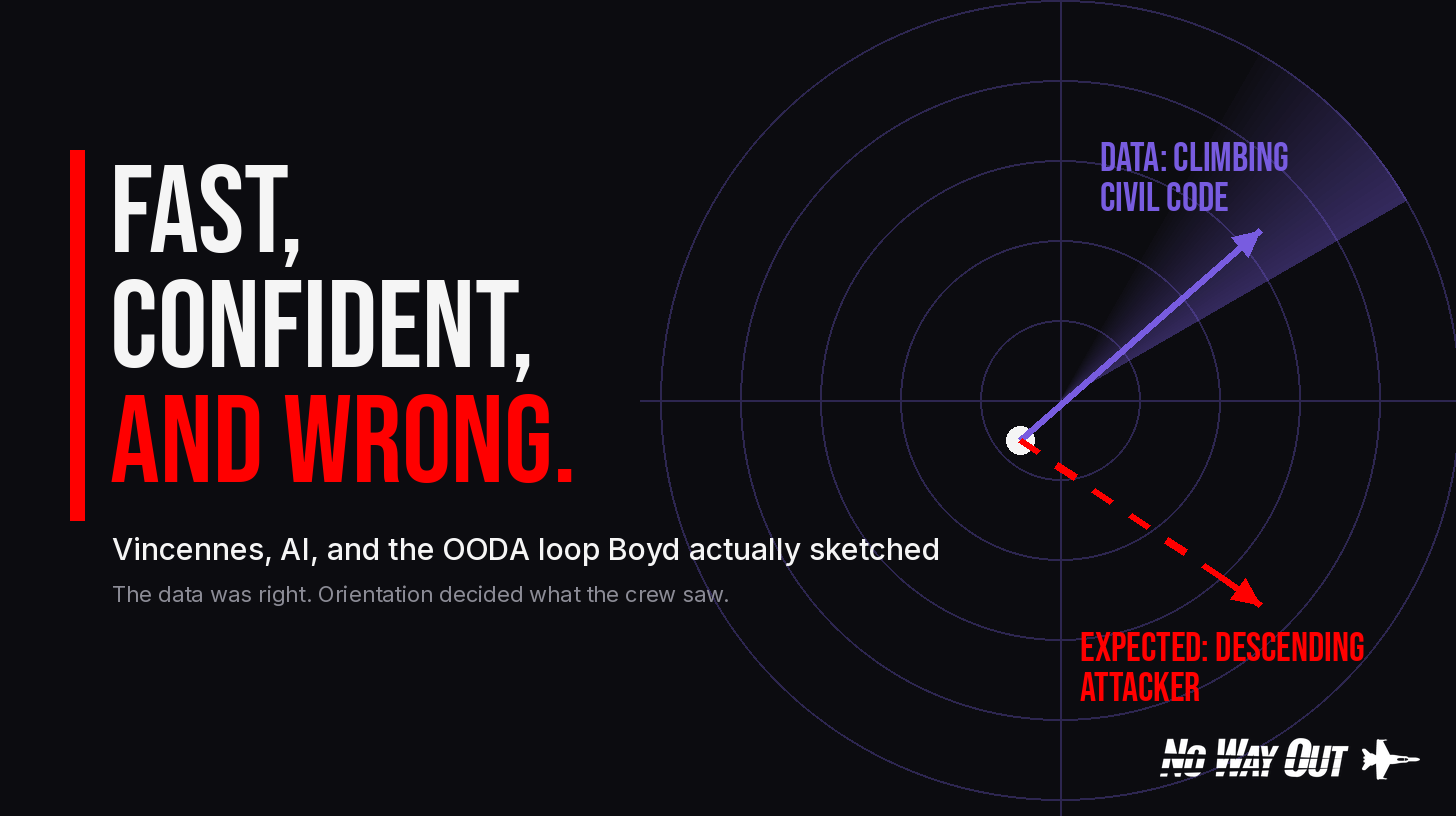
1. The Navy’s investigation found the Aegis worked as designed. Its data showed a climbing contact squawking a civilian code. The crew reported a descending attacker after a morning of fighting gunboats at general quarters. Researchers later called it scenario fulfillment. The data was right the whole time. Orientation (fatigue, training, stress, context) decided what the crew saw.
The record is blunt about it. The formal investigation found that the ship’s command and decision system “showed TN 4131 continuously ascending, while the CO received reports of ‘descending altitude’ immediately prior to enabling the firing key.” Admiral William Crowe, Chairman of the Joint Chiefs, wrote that Aegis “performed as designed and subsequent analysis indicated that the sensor data collected was accurate.”
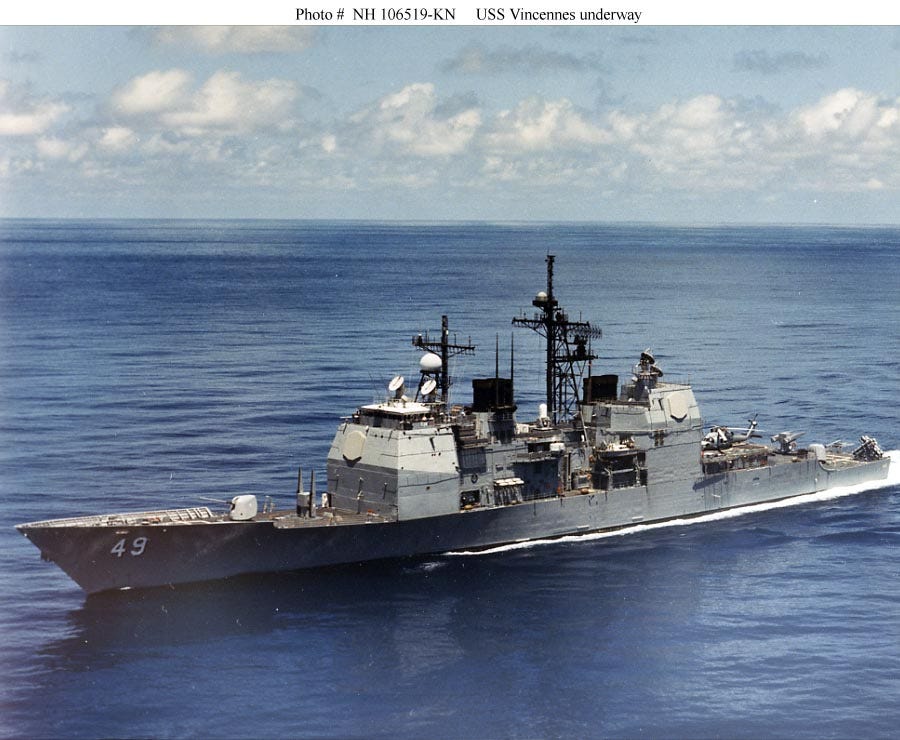
Scenario fulfillment is a phrase from the 1988 record itself. The tapes and the crew’s memories did not match, so the senior investigating officer asked for “a USN Medical Corps Team consisting of a psychiatrist and a physiologist,” who arrived in Bahrain after the formal hearing closed. The report’s opinions, drawing on that team, say the tactical information coordinator “appears to have distorted data flow in an unconscious attempt to make available evidence fit a preconceived scenario. (”Scenario fulfillment”)” Central Command’s endorsement of 5 August 1988 quotes the same concept. Look at how tight the timeline was. General quarters sounded at 0613Z. Vincennes opened fire on the boats at about 0643Z and was still in that fight when Flight 655 took off about four minutes later. The airliner was shot down at about 0654Z. Two hundred ninety people died on 3 July 1988.
The One Signal That Pointed the Wrong Way
One signal did point the wrong way, and it deserves a straight answer. Early in the flight a single Mode II-1100 return, a military code, came in through the ship’s IFF interrogator and never came back. The SPY-1 radar never picked it up. Central Command judged that the source “cannot be verified” and that ducting from a military aircraft on the ground at Bandar Abbas “appears plausible.” Crowe added that Aegis “was never advertised as being capable of identifying the type of aircraft being tracked. That decision is still a matter for human judgment.” Hamrick makes the same point when he says the raw data “required judgment to interpret.” The altitude and the civilian code were right, and a single ambiguous return became the anchor for everything that followed.
The room had limits too. The captain’s large screen display could not show altitude in real time; the report says so plainly. Central Command also found that putting an officer “qualified only through on the job training” in the air warfare coordinator seat “in effect denied a double check on the information being provided from the ship’s ‘Air Alley.’” Hardware and watch organization shaped what reached the captain. What happened in the tactical information coordinator’s head is still the part a faster computer can’t touch, and Hamrick says it plainly too: the failure “is not computational.”
What the Crew Expected to See
Boyd told us where to look. Orientation, he wrote, “shapes the way we interact with the environment—hence orientation shapes the way we observe, the way we decide, the way we act.” It “represents images, views, or impressions of the world shaped by genetic heritage, cultural tradition, previous experiences, and unfolding circumstances.” In that combat information center the unfolding circumstances were a surface fight still underway and a crew at general quarters, primed for an attack. The data reached them, and their orientation filtered it.
Scenario fulfillment names something every crew and every team does. We see what we expect to see. The record says that after the single Mode II report, the tactical information coordinator’s picture bent toward “a preconceived scenario,” and each report that seemed to fit made the scenario harder to question. Chuck Spinney and the group working with Boyd had a name for this: incestuous amplification. In Spinney’s words, it happens when “the preconceptions in the decider’s Orientation ... misshape the Observations feeding that Orientation.” Once it starts, the loop feeds on itself.
2. The Article’s Loop and the Loop Boyd Sketched
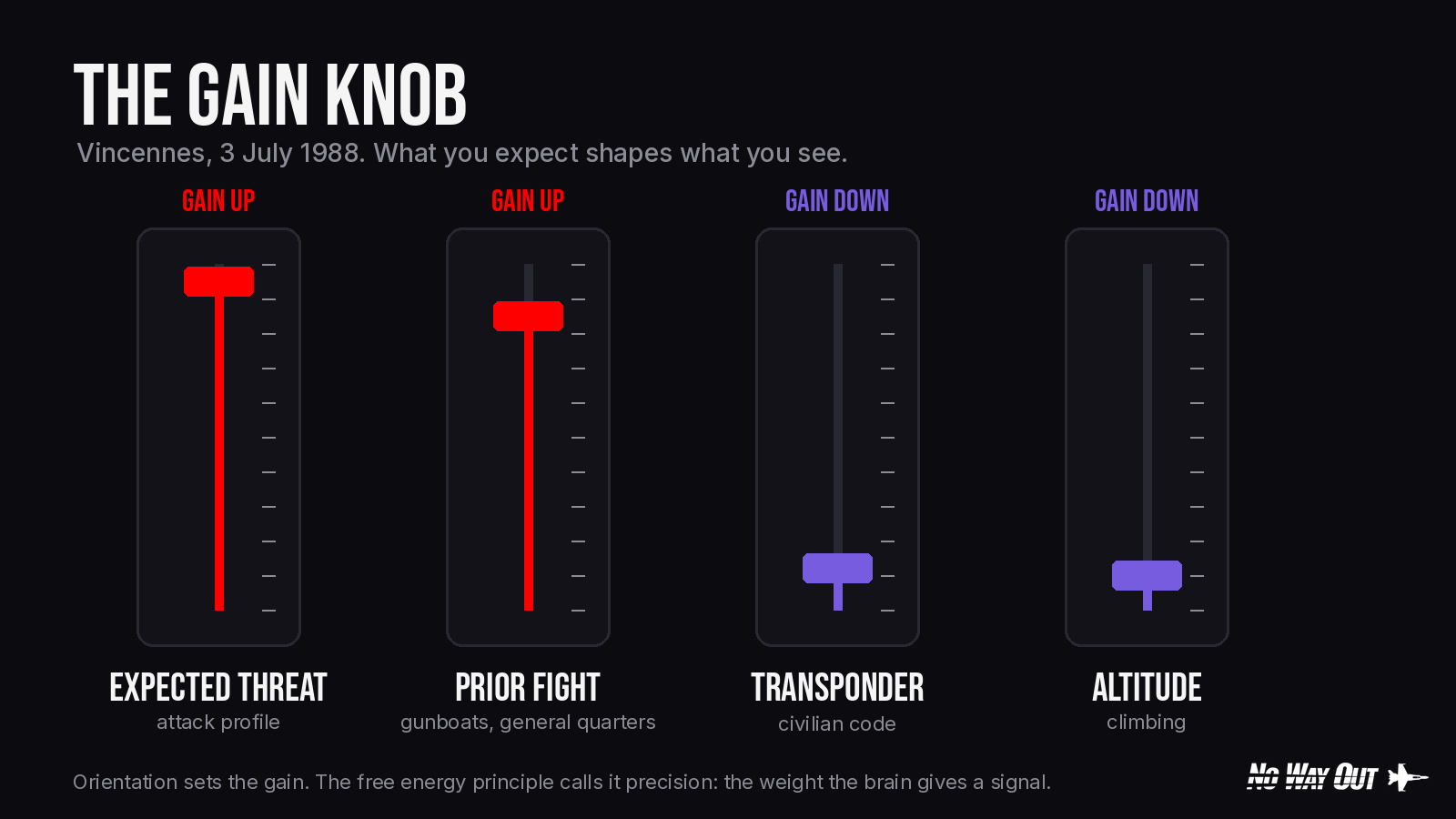
2. The article uses the four-step, linear OODA loop. Boyd’s sketch puts Orientation at the center and runs an arrow back into Observation, which he labeled implicit guidance and control. What you expect shapes what you see. Picture a radio with a gain knob on every channel. That morning the gain was all the way up on the expected threat and turned down on the transponder and altitude readouts. The free energy principle calls that precision, the weight the brain gives a signal. Boyd’s sketch also holds the fix. Decision is a hypothesis, and Action is a test.
Hamrick never writes “four-step” or “linear.” His loop still runs one phase after the next. The winner, he writes, “observes reality more accurately than the adversary, orients to it faster, and decides and acts from that orientation,” and his zombie is a loop where “Observe and Orient have disconnected. Decide and Act are still running.” Nowhere in the piece does expectation reach back into what the crew sees.
Why the Arrows Matter
This matters more than it looks. In the four-step version, Observe feeds Orient, Orient feeds Decide, Decide feeds Act, and around we go. There is no arrow for expectation reaching back into what we see. So the four-step loop can’t even show what happened in the combat information center that morning. It is a snake eating its own tail. You can run it faster, but you can’t see the failure with it.
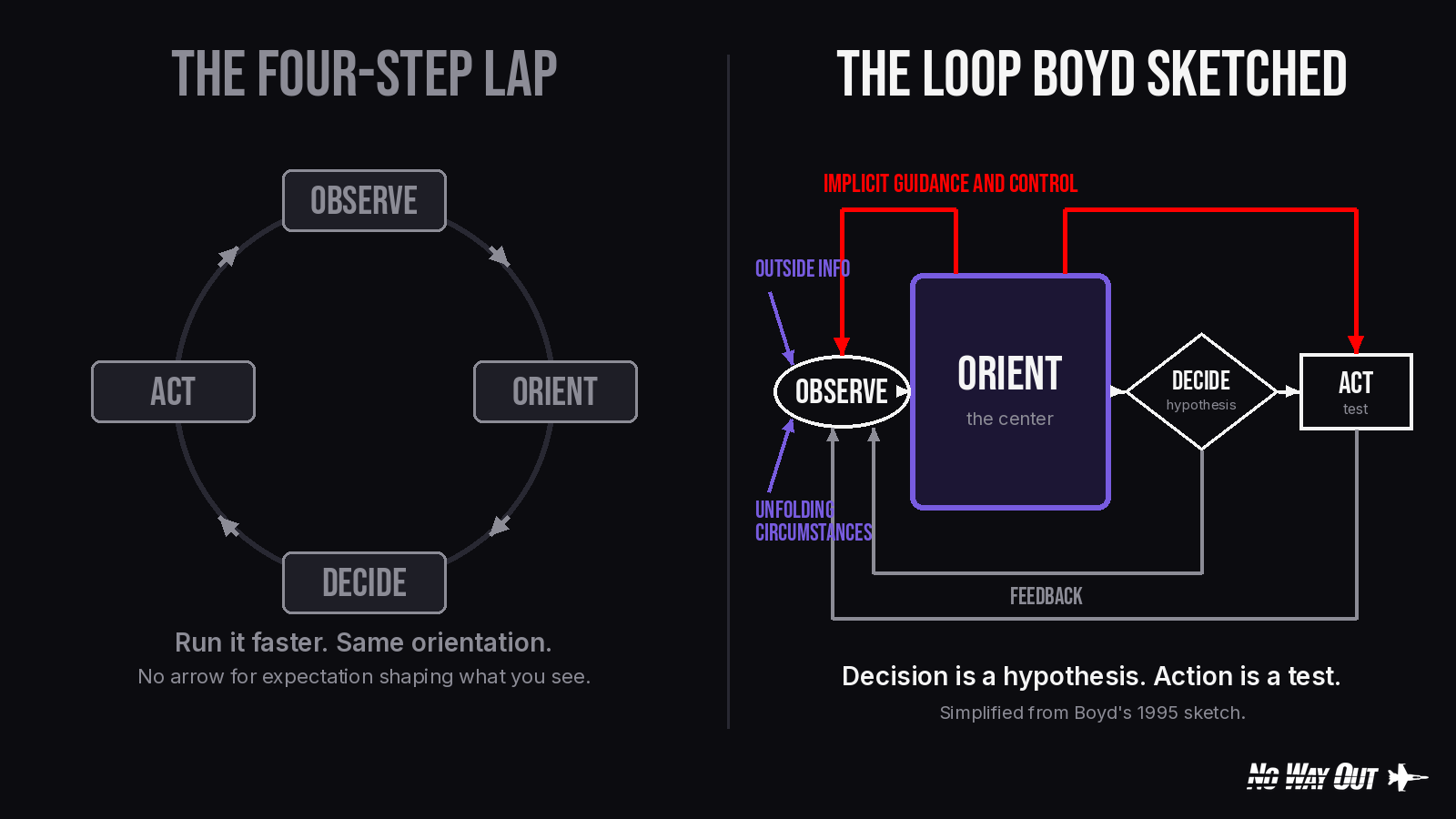
In Boyd’s sketch, the implicit guidance and control pathways matter as much as the four named parts, maybe more. When orientation matches the world, implicit guidance and control is the quick path. It runs straight from orientation to action without a slow trip through explicit decision. Real tempo comes from there, from relative quickness against an adversary earned through a well-matched orientation. When orientation is mismatched, the same arrow into Observe locks expectation tight and the system starts confirming itself. Incestuous amplification runs on this arrow, and so does scenario fulfillment. We can go in the wrong direction as fast as possible.
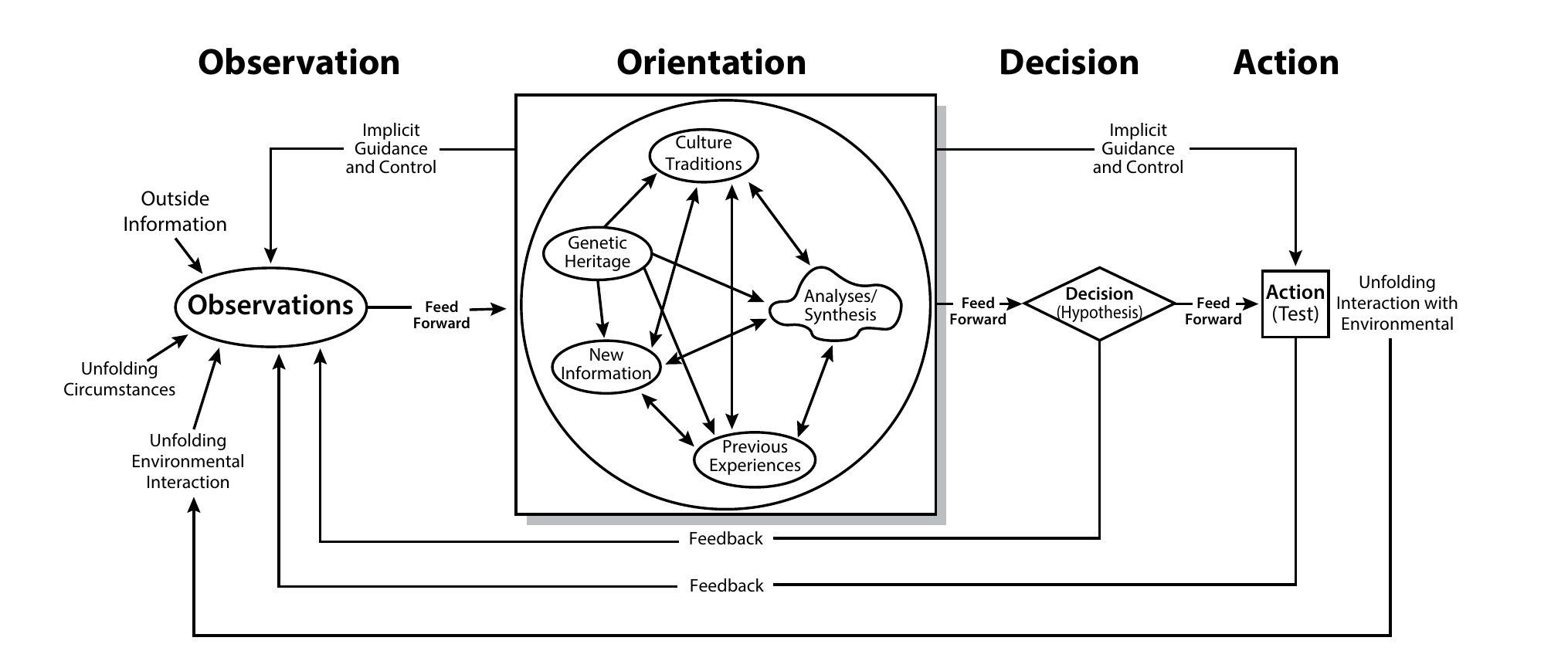
The fix was already on the slide. Treat “descending attacker” as a hypothesis and make action a test that could prove it wrong. Admiral Crowe’s endorsement points the same way. He wrote that the force anti-air warfare coordinator (”GW”) or the ship’s anti-air warfare coordinator “should confirm or disaffirm important reports (such as descending altitude),” above all the ones that change conditions as the captain nears the firing point. In the same paragraph he wrote, “It is impossible in the heat of battle to double check every piece of data being reported.” He judged it “unlikely that this one piece of information would have settled the issue one way or another,” and he placed “the principal responsibility for the tragedy” on Iran. Read with that context, his lesson is narrow and practical: test the few reports that change the firing decision.
Where AI Fits
Now add AI. A large language model in use does not reorient. Its orientation was set in training, and it hands back a clean, confident answer shaped by the same frozen orientation every time. It is the four-step loop in software. Put it in front of a stressed crew and you have turned the gain up on whatever the model already expects.
We need to be clear about which AI we mean. When I talk about large language models, I am talking about closed systems. Ben Ford said it on No Way Out: “When you have an LLM, what you get out of the box will never change, right? Its orientation will never change, right?” Reinforcement learning, recursive self-improvement, and active inference point somewhere else: toward AI, and toward super intelligence, that keeps updating through contact with the world. Reinforcement learning changes its policy from outside reward. It is a cousin of active inference, and the two are not the same. Active inference updates its beliefs and the precision it gives each signal. Recursive self-improvement goes after the model itself. Those approaches are open systems, more aligned with cognitive complexity, and they sit much closer to Boyd’s real OODA loop than to the four-step lap.
3. Vincennes Already Gave Us the Answer on Teams
3. Vincennes already answered “a human in the loop isn’t enough.” The Navy stood up Tactical Decision Making Under Stress (TADMUS) after the shootdown to study how teams decide under pressure with technology in the room. Before he wore stars, LCDR James Stavridis worked on behavioral markers, built on the idea that teamwork is observable, so you can measure it, train it, and debrief it. Naval Aviation CRM built on TADMUS and on commercial aviation CRM, the foundation of today’s team science.
To be clear, Naval Aviation CRM did not grow out of Stavridis’s work. CRM started in commercial aviation, with roots usually traced to a 1979 NASA workshop, Resource Management on the Flight Deck. As Eduardo Salas tells it, team science emerged from Naval Aviation CRM.
How I Came Across Stavridis
The part about Admiral Stavridis goes back to 2018, when I was on the Secretary of the Navy’s Industry Best Practices and Learning Culture team. One of my jobs was to understand peak performance, culture, safety, weak indicators, weak signal detection, and things like that. It became the foundation of what is now known as The Flow System, which I co-created and co-authored with John Turner and Nigel Thurlow.
When I was doing my research on behavioral markers, which are a great way to get an objective approach to understanding team performance, I came across some articles about Admiral Stavridis, at the time Commander Stavridis, who was exploring the same ideas years ago, in the early nineties. Hold on to that, because it brings us back to Boyd.
The Office of Naval Research sponsored TADMUS, which was in its eighth year by 1998. It studied air warfare teams in the combat information center. Janis Cannon-Bowers and Eduardo Salas pulled the findings together in Making Decisions Under Stress. Out of that work came training that still holds up: Team Dimensional Training, guided team self-correction, and the question Salas and his colleagues asked in the title of a 1997 book chapter: how do you turn a team of experts into an expert team?
Eduardo Salas told us on No Way Out that shared mental models were how his team convinced commands that teamwork matters. Scott Tannenbaum showed us why debriefing is where teams actually learn. Both deal with the observable side of teamwork, the part a command can watch and coach.
Bad Boyd in Doctrine
Here’s the miss. Doctrine taught Admiral James Stavridis the same four-step, linear OODA loop it taught the rest of us. The people who explored the science of teams, and the practitioners who learned team science, were given bad Boyd in doctrine, a version with shared orientation stripped out, and shared orientation is the part that explains why teams work. Two lines of work that belonged together grew up apart.
The TADMUS research never cited Boyd. I’m the one connecting the two. Team science grew up around shared mental models, and the Boyd that doctrine handed to the same people had no room for shared orientation.
Later on, when you fast forward to 2024, Admiral Stavridis is citing the bad OODA loop, which is connected to bad doctrine. In March 2024, he and Elliot Ackerman wrote in The Wall Street Journal that the side that “can move through its OODA loop fastest will possess a decisive battlefield advantage.” Mark McGrath called that “Bad Boyd” at the time, and he was right.
So we were handed the bad OODA loop. If we had the right OODA loop, the real one Boyd sketched, I think we’d have a deeper understanding of how we’re going to need human-agent teams, and how we’re going to work those in.
Boyd had already written the team piece. In Organic Design for Command and Control he says leaders and subordinates alike need the chance to interact with the world and with each other to create “a similar implicit orientation, needed to form an organic whole.” That similar implicit orientation, he wrote, lets them “[d]iminish their friction and reduce time.” Shared orientation cuts friction inside the team. Testing hypotheses against the world keeps friction where it belongs, between our expectations and reality. Hamrick’s supportive friction and Boyd’s organic whole work as two sides of the same loop.
A Faster Lap Loses
Hamrick lists people, ideas and hardware, and he gets to people near the end. I’d start there. Retire the four-step, linear OODA loop from doctrine and teach the loop Boyd sketched, with the cybernetics, neuroscience, quantum physics and complexity thinking behind it. That loop represents how a living system co-evolves with a world that keeps changing under it. AI now changes that world faster than people can adapt. If your model of adaptation is a faster lap around four steps, you will lose that race.
Boyd’s last major briefing, Conceptual Spiral, makes the same case without a single dogfight. Its focus is how science, engineering, and technology influence “our ability to interact and cope with an unfolding reality that we are a part of, live in, and feed upon.” Technology produces change through novelty. Novelty produces mismatches. And “the presence and production of mismatches” is what keeps the whole enterprise alive.
Then Boyd lays out the trap. People using theories or systems built from one variety of information “will become more and more isolated from that which they are trying to observe or deal with,” unless they use the new variety to change those theories or build new ones. He adds that “we cannot determine or discern the character or nature of such systems (super or otherwise) within themselves.” Hamrick’s zombie fits the warning: a closed loop that keeps running fast and sure of itself while it drifts away from the world it thinks it sees.
Closed Systems and the Way Out
I read that page as a test for AI. Boyd never wrote about AI, so the reading is mine. A large language model is a closed system, built from one body of information and frozen there. The AI and super intelligence worth putting next to a crew has to stay open, keep taking in new variety, and keep reorienting. Reinforcement learning, active inference, and recursive self-improvement are where that work is happening, and that is where Boyd’s real OODA loop belongs in the conversation.
Boyd’s Answer
Boyd’s answer is reorientation. The enterprise of science, engineering, and technology, he wrote, affects us “by changing our orientations to match with a changing world that we, in fact, help change.” AI is that kind of technology. It changes the world, and the world changes us back. The only way to keep up is to keep reorienting.
He put it in the line our show is named for: “There is no way out, unless we can eliminate the features just cited.” His next words: “Since we don’t know how to do this, we must continue the whirl of reorientation, mismatches, analyses/synthesis over and over again ad infinitum.”

For the Navy, and for anyone else putting AI in the room, that work starts with teaching the loop Boyd sketched and training shared orientation as a team skill crews can observe and debrief. From there every machine answer becomes a hypothesis the crew tests, and tempo gets measured against the adversary and against reality.
One small note for the record, which Ian caught on X. The article’s footnote calls Boyd’s Discourse “Unpublished briefing slides.” That is no longer true. Air University Press published A Discourse on Winning and Losing in 2018, edited by Grant Hammond, and it is free to read online. Ian Brown, author of A New Conception of War, has been on No Way Out twice: episode 49, “Wargaming: Building Adaptive Leadership Capability with Ian Brown“, and episode 128, “Bad Boyd, Good Receipts: Inside Snowmobiles & Grand Ideals with Ian Brown“.