

Originally published in The Whirl of ReOrientation on February 10, 2026.
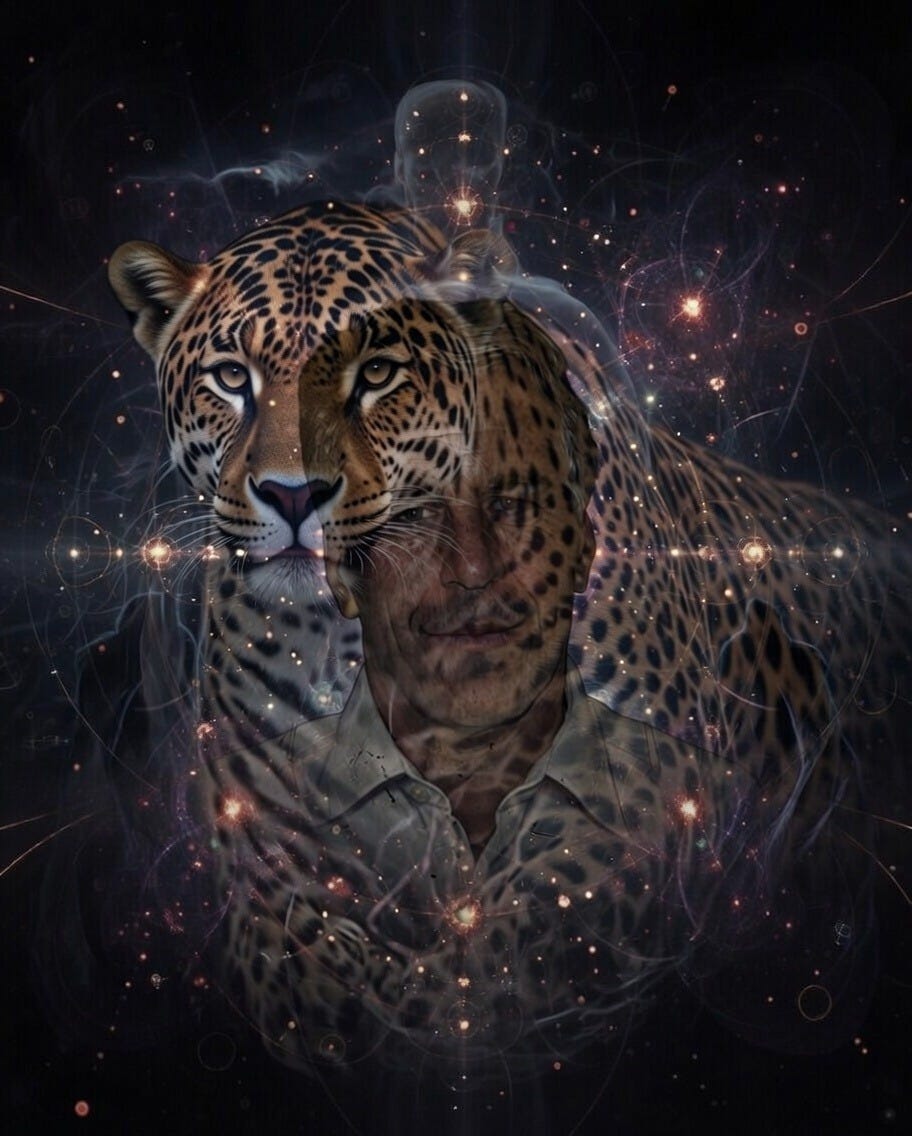
The Epstein files continue to deliver revelations that force even the most jaded observer to pause. Last week, Mark “Moose” McGrath shared with me a few standout items, including a Steve Bannon-Jeffrey Epstein interview – a conversation that’s as intellectually provocative as it is unsettlingly ironic. Epstein positions himself as a forward-thinking donor to the Santa Fe Institute (SFI) in the late ‘80s and early ‘90s, claiming he sought to push beyond “old-fashioned” institutions like Rockefeller University toward true interdisciplinary complexity work. Yet, as I revisited Murray Gell-Mann’s The Quark and the Jaguar (1994) this morning, that acknowledgment stands out starkly: “Support of my work through a donation to SFI by Jeffrey Epstein is also gratefully acknowledged.” It’s a detail that lands heavier today, especially through the lens of the Gell-Mann Amnesia effect – the perfect explanation for why we repeatedly lower our guard with the same unreliable sources.

Gell-Mann Amnesia effect
Michael Crichton coined the term in his 2002 speech, naming it after physicist Murray Gell-Mann, SFI co-founder and Nobel laureate. The effect is simple yet profound: When you encounter media coverage on a topic you know deeply, you immediately detect distortions, omissions, or errors that undermine credibility. But shift to an unfamiliar subject, and you default to trusting that same outlet as authoritative – amnesia wipes the slate clean. It’s a subtle, almost comical cognitive glitch, except when the stakes involve elite networks, science funding, and moral corruption.
The world economy and your body are both comprised of little systems interacting with each other and making one big system.
-Jeffrey Epstein
The Epstein case exemplifies it. In the Bannon interview, Epstein details his SFI funding – totaling around $275,000, with some continuing post-2008 conviction – as an effort to apply mathematics to complex systems, where small perturbations yield outsized effects (think financial crashes or personal empires built on hidden leverage). Gell-Mann’s book blends quantum “quirks” with adaptive complexity in nature and society, and SFI (founded 1984) became a hub for this during the complexity surge, influenced by works like Mitchell Waldrop’s 1992 Complexity.
This brings us to John Boyd, whose OODA loop and life’s work remains foundational for navigating uncertainty. Boyd presented at SFI to an audience of Nobel laureates, likely including Gell-Mann, sharing ideas on adaptation in chaotic environments. He drew heavily from SFI-adjacent texts on his reading list and influences: James Gleick’s Chaos, Ilya Prigogine’s Order Out of Chaos, Brian Goodwin’s 1994 How the Leopard Changed Its Spots (a personal favorite), Ian Stewart’s Does God Play Dice? The Mathematics of Chaos (1989), and Gell-Mann’s The Quark and the Jaguar (1994). These books and authors shaped his “Conceptual Spiral,” integrating cross-disciplinary insights into Boyd’s understanding of how living systems create novelty.
Crucially, Boyd did not sketch his famous OODA loop diagram until 1995 – in his presentation The Essence of Winning and Losing (first dated June 28, 1995, with revisions into 1996). This came after his deep engagement with complexity theory, including those SFI-linked books and presentation. The 1995 sketch synthesizes years of evolution, expanding beyond a simple four-step cycle to emphasize orientation’s dominance, feedback loops, and adaptation in nonlinear systems. Boyd’s earlier works (like Destruction and Creation in 1976 and Patterns of Conflict in the ‘80s) laid groundwork, but the full OODA visualization crystallized post-complexity immersion.
The irony? While Boyd used these ideas to promote agility and ethical adaptation – and explicitly warned about the dangers of evil and corruption – Epstein funded similar venues, his “philanthropy” often a veneer for influence-peddling and darker pursuits (eugenics interests, elite grooming). Boyd defined evil as occurring when individuals or groups embrace codes of conduct or standards of behavior for their own personal well-being and social approval, yet violate those very same codes or standards to undermine the personal well-being and social approval of others. Corruption, in Boyd’s view, occurs when individuals or groups, for their own benefit, violate codes of conduct or standards of behavior that they profess or are expected to uphold. Recent unsealed documents from January 30, 2026, underscore how SFI handled post-conviction donations, with media sometimes framing Epstein’s involvement benignly as intellectual patronage rather than calculated access-seeking.
Gell-Mann Amnesia explains the blind spot perfectly here: Someone deeply versed in complexity science or SFI’s history might read an article on those topics and immediately spot distortions—fudged timelines on Epstein’s donations, downplayed personal ties to Gell-Mann, or sanitized framing of his “philanthropy” as pure intellectual curiosity rather than influence-buying. They dismiss it as sloppy or biased reporting. Yet the same reader often turns around and accepts that outlet’s broader narratives about Epstein’s machinations (his trafficking empire, financial schemes, or elite connections) without the same scrutiny—amnesia in action.
Epstein himself embodies a twisted version of this in the Bannon interview: He lectures confidently on fractional reserve banking, the 2008 crisis as a systemic “stroke,” and how most world leaders are financially illiterate and unable to grasp complex systems. He positions himself as the rare mind that does understand them. But he conveniently ignores (or “forgets”) his own profound ethical voids—the very corruption and exploitation that made his access to those systems possible. It’s Gell-Mann Amnesia applied inward: claiming mastery in one domain while erasing inconvenient truths in another.
The Strategic Game of ? and ?
This prompts the uncomfortable question: Did Epstein grasp Boyd’s Strategic Game of Interaction and Isolation—that core dynamic (from Boyd’s 1987 briefing of the same name) of fostering vital connections in one’s own sphere while deliberately isolating adversaries from information, allies, and coherence to shatter their cohesion? Was this the corrupt underside of the real OODA loop, informed by complexity theory and crystallized in Boyd’s 1995 sketch? In Boyd’s framework, interaction fuels vitality and growth, while isolation leads to decay and collapse—yet the game is won by modulating between them to out-adapt opponents. Here, evil and corruption thrive by controlling from the outside in, bottom-up: engineering attractors to pull elites inward, exploiting affordances for hidden leverage, and manipulating outside information to shape narratives and isolate victims or rivals. Is this the ultimate perversion of strategic thinking—corruption as a game where isolation serves unchecked power?
Gell-Mann Amnesia reminds us: Scrutinize consistently. Challenge all assumptions. Boyd’s late synthesis of complexity into OODA—emphasizing relentless (re)orientation and adaptation—urges us never to amnesia away proven flaws.
So many other connections to be made here. We would like to hear your thoughts. For example, how does PISRR fit into what we are all learning about the Epstein files?
PISRR?
Penetrate society at all levels
Isolate government from people
Subvert components of government including local governments, police and military.
Reorient subverted components
Reharmonize people with newly installed government