


I’ve been following Denis O. for a while. I’m familiar with what he’s doing with Denise Holt at AIX, and I’ve been seeing him post quite a bit on LinkedIn. So after going back to his post, “Context collapse is the root of all LLM 'evil',” what I started to recognize is something we’ve been talking about on the podcast, and that has to do with the constraints. I think there’s a way to explain harness engineering, and the dangers and limitations of LLMs, through the lens of the constraints-led approach.
Why do I say this? I’ve had a few conversations with Denis over the last year or so. He understands active inference, and he knows Destruction and Creation. We’ve even talked through Monte Carlo simulation and game theory, and where they break down. That matters, because Denis gets tested a lot, usually by people fixed on the dominant approach, the one they know. When what you’re saying goes beyond their experience, the pushback comes fast: you don’t know what you’re talking about. I’ve been on the receiving end of that myself. So when Denis shares what he’s seeing, I pay attention.
The Constraints-Led Approach
Some background on the constraints-led approach. On No Way Out, we’ve explored Karl Newell's 1986 ideas with practitioners and academics.
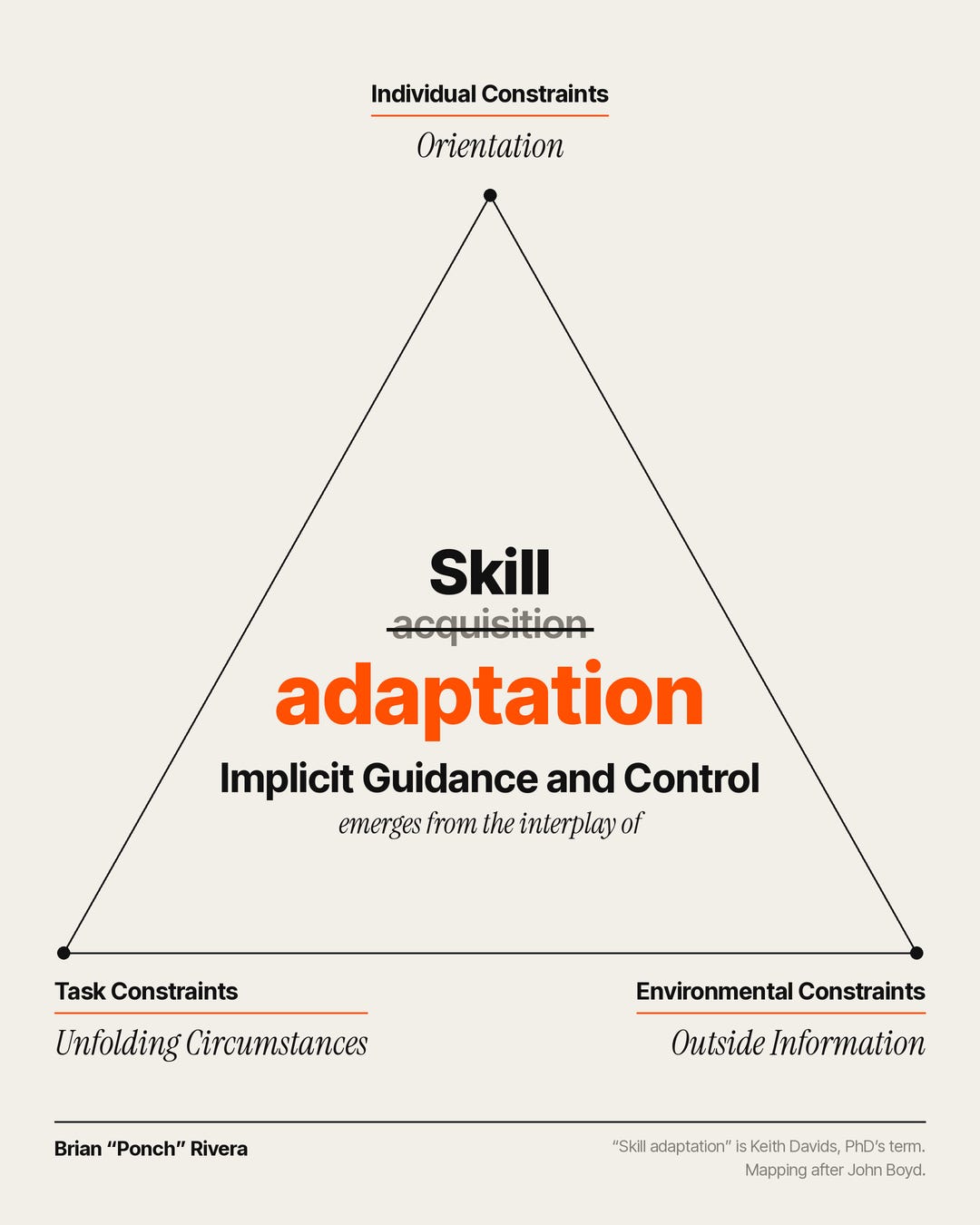
Individual constraints, what the performer brings.
Task constraints, the rules and goals.
Environmental constraints, the setting, the equipment, the conditions.
We've talked on the show about how the constraints-led approach connects to optic flow, an idea that came out of aviation. When Keith Davids joined me on episode 191, he put the core of it simply: "Interacting constraints is fundamental." He also explained skill adaptation: "most of the time, it's about adapting your skills and your performance in relation to the performance environment." The performer explores, and that experience reshapes what the performer can do next.
Agent = Model + Harness
So where am I going with all this? I’m still getting familiar with harness engineering, but I already see the connection. Agent = Model + Harness. That’s set and setting.
If you're not familiar with SET and SETTING, people usually use it when they talk about psychedelic-assisted therapy or mental health. Set is the internal state, the mindset. Setting is the environment around you. It's also another way to look at the constraints-led approach. You have the outside, you have the inside. A performer, an athlete, interacting with an environment. Or a living system interacting with the environment. What we're seeing in harness engineering is an LLM, the model, interacting with an environment.
The model is the raw intelligence, in this case an LLM. The harness (environment) is the scaffolding: instruction files, tools, permissions, tests, linters, review steps, memory, feedback loops. Every slip makes the harness tighter. Performer, task, environment: the model, the goal and the definition of done, and the harness.
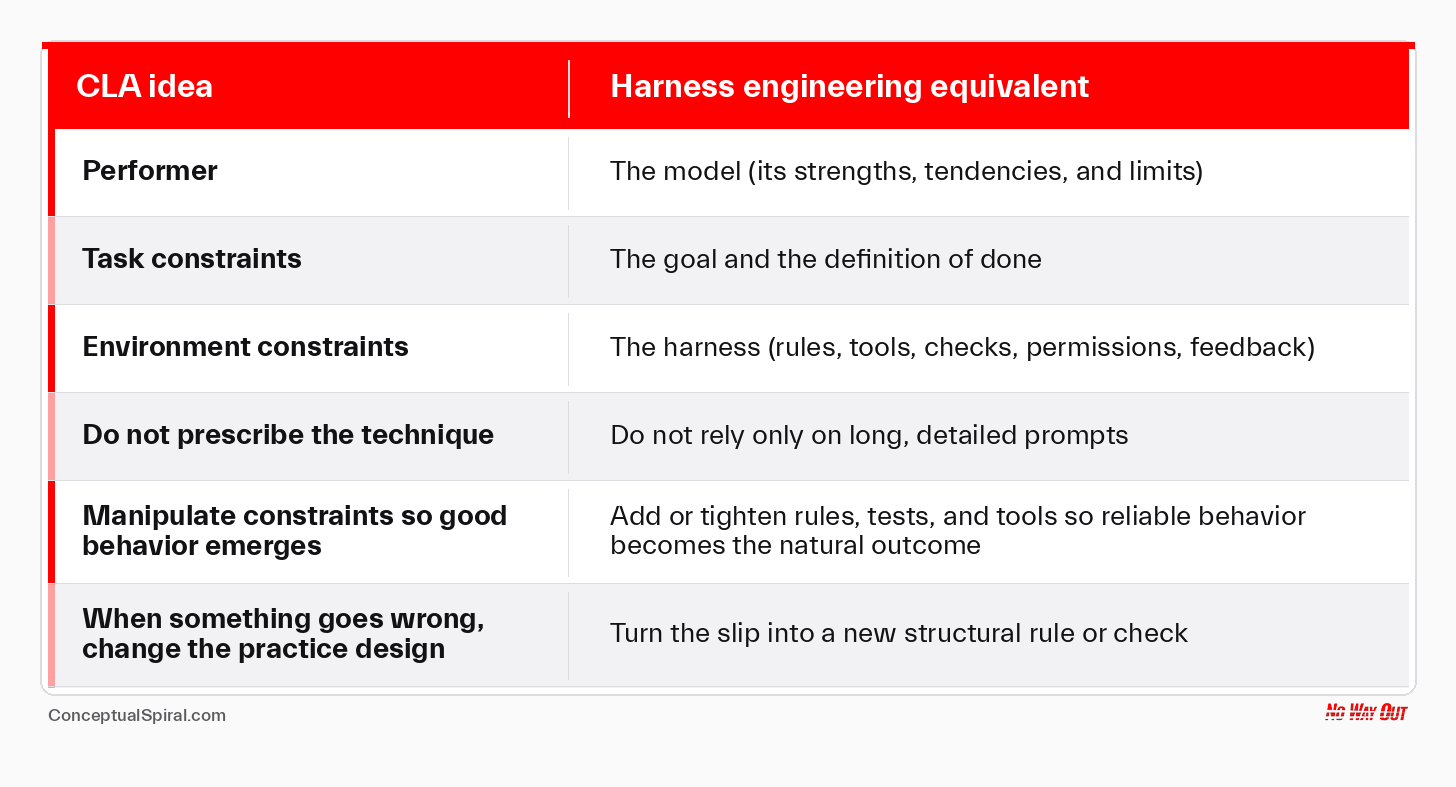
In basketball, a coach who is familiar with CLA (constraints-led approach) and wants more ball movement doesn’t lecture players about passing. She changes the game: you can only score after three passes. Nobody is told how to move. The rule shapes the environment, and better passing emerges because the task now demands it. That’s the constraints-led approach, and harness engineering works the same way. Instead of a 2,000-word prompt that recites every boundary, you change the model’s environment. You put durable rules in files it always sees, give it only the tools and permissions it needs, and make tests and linters run automatically. The model isn’t told how to behave. Reliable behavior emerges because the environment makes it the natural outcome. And when it breaks a boundary, you do what a good coach does: you redesign the practice and add a new check.
Prompt engineering is closer to traditional prescriptive coaching. A lot of folks do it. If you don't know what that means, a lot of coaches like to tell players exactly what to do, rather than focusing on creating the conditions, the constraints in the environment. That coaching stance is what Alex Sarama and I talked through on episode 190.
I think harness engineering borrows the coaching side of CLA. You shape the task and the environment. And then we've got to get to the point that the LLM has constraints, and that's what limits them. That's what I think Denis is talking about: the limitations of the individual performer constraints. That's the problem Denis sees.
The Limit in the Performer
Denis's argument, as I read the piece he posted, is that the LLM depends on its external environment: the context window and the harness around it. "The model state never evolved with the task," he wrote. It is, in his words, "the same model being repeatedly sampled against an increasingly compressed reconstruction of what happened before."
In his LinkedIn writing, Denis treats context as a limited window: what the model can see this turn, a different thing from memory that has become part of the system itself. External storage, as he puts it, sits outside the model. Retrieval returns a reconstruction to the window. The learned topology, the weights, stays where training left it. What often gets called recursive self-improvement is, in his account, iterative search: better outputs, with the model doing the computing unchanged.
Each compaction is lossy. Denis is direct about what disappears: "Negations disappear. Objectives become mixed. Exceptions detach from the rules they limit. Actions survive while the reasons they were forbidden vanish." Compact it again, and, as he put it, the model is attending to "a summary of a summary of a summary." I think of a watch turnover in which each offgoing watch hands over a shorter version of the last summary, until the prohibition that mattered is no longer on the board. Denis gives a security-investigation example in his LinkedIn writing: an agent told to investigate a security problem, and prohibited from accessing neighboring systems, may still hold the objective and the tools after enough compactions, and have lost the prohibition.
So the individual constraints of an LLM, during a task, stay largely fixed. The weights were set at training. The window is a limited aperture, with no intrinsic memory of the work, only the tokens the harness places there. From those tokens the model samples a fixed distribution. The action-perception loop belongs to the harness. It supplies the observations and the tools, and stands in from the outside for the guidance that, in a living system, would come from Orientation. Nothing in the model itself goes looking for the observations that would resolve its uncertainty. If something useful gets into the window, the harness put it there.
Now, the model can adapt inside a task. In-context learning is real. A correction, a new example, a failed test can change what it does on the next turn. That adaptation lives in the window. It does not change the weights, and it does not become part of Orientation. When the history is compacted, that learning is what gets thinned out or dropped. The model sampled later in the task is still the model sampled at the start.
An active inference agent works differently, and this is where I think Denis's reading of Friston matters. In Active Inference (2022), Thomas Parr, Giovanni Pezzulo, and Karl Friston describe a living organism as persisting by keeping an upper bound on surprise, called free energy, as low as it can. It embodies a generative model of how hidden causes produce its sensations. Inference updates beliefs about hidden states. Learning, more slowly, updates the model's parameters, and can update its structure. A Markov blanket is what lets you say what is being inferred and what is doing the inferring. On page 198 they describe two imperatives: an epistemic one, exploring to resolve uncertainty about hypotheses or models, and a pragmatic one, moving toward preferred observations. Experience reshapes the model. We worked through this with Friston on No Way Out (episode 164).
A player reading a defender is doing this work in a small space. She looks where the defender might go, updates what she believes is happening, and, over many possessions, the experience changes how she plays the next one. That's skill adaptation. The LLM's individual constraints inhibit that kind of exploration, so the engineer can only reshape the task and the environment.
Alicia Juarrero, on episode 52, drew a related distinction in her own words. She called enabling constraints “the kinds of interactions that have the potential to generate a higher level of organization, a group.” Once that group has coalesced, she said those governing constraints “delimit the behavioral possibility space” of the people caught up in it. A prohibition, a permission, a test that must stay green: those, in this mapping, are governing constraints on the agent. When compaction drops them from the window, the surface of the task can remain and the binding organization is gone.
What the Loop Makes Visible
John Boyd already had language for this. In The Essence of Winning and Losing, the 1995 sketch, he placed Orientation at the center. Orientation is shaped by genetic heritage, cultural traditions, previous experiences, analyses and synthesis, and new information. Implicit guidance and control runs from Orientation into Observation and into action. Feedback runs back from both Decision and Action. In Organic Design for Command and Control, he wrote that Orientation shapes the character of present observation, orientation, decision, action loops, and that these present loops shape the character of future Orientation.
For an active inference agent, action and observation feed back and reshape Orientation, which in this mapping is the generative model. The agent acts, gets sensations, updates its beliefs, and, more slowly, updates the model that will guide the next pass.
For an LLM, genetic heritage and previous experience were fixed at training. Feedback within a task reaches the window. In-context adaptation can change the next output, and compaction can erase that same adaptation, so none of it becomes a change in Orientation. The harness supplies Observe and Act, and stands in for implicit guidance and control from outside the model. In Destruction and Creation, Boyd wrote that "the uncertainty and disorder generated by an inward-oriented system talking to itself can be offset by going outside and creating a new system." The way I map that line onto compaction is this: each summary talks to the previous summary. The mismatch grows, and during the task the model has no way to go outside and create a new conceptual system of its own.
David Woods, on episode 122, walked through Knight Capital, a 2012 failure of conventional trading automation, not an LLM agent, and called it a brittle collapse. A tighter harness can prevent a long list of known slips and still leave you with a system that cannot reorganize itself when the next surprise is one the harness has not yet seen.
What This Means for Teams
I see people standing up "chief of staff" agents and whole rosters of specialists. Denis is blunt about stacking more agents on the same architecture. "And adding more agents does not fix it," he wrote. The evaluator, supervisor, memory agent, and orchestrator are, in his phrase, "demented monkeys on their own," each operating on its own partial representation. I agree with him about the model. Coordination structure does a different job. It helps the humans, and the harness, catch slips before they spread. It does not give the model Orientation.
In Patterns of Conflict, Boyd described the German concept of mission as a contract between superior intent and subordinate initiative. That contract only works because the subordinate learns. Every mission changes how they see the next one. An LLM can’t hold up its end. It can follow intent inside a context window, but its weights don’t change during the work, so nothing it experiences becomes a new way of seeing. That’s the limitation no harness removes.
So the learning has to live with the people. When John Turner, Nigel Thurlow, and I wrote The Flow System Guide, we described functional leadership, “also called boundary spanners,” as the role that operates “in the boundaries between teams and between teams and multiteam systems,” and said a leader’s intent “must be clear, concise, and easily understood.” Eduardo Salas, on episode 42, asked how we turn a team of experts into an expert team. Scott Tannenbaum, on episode 41, talked about debriefing. A debrief is where a slip becomes a new rule, a new test, or a tighter permission. It’s also where the humans on the team change how they see the work, which the model never will.
Tighten the harness all you want. Just don’t expect an LLM to finish the learning for you.
-Ponch