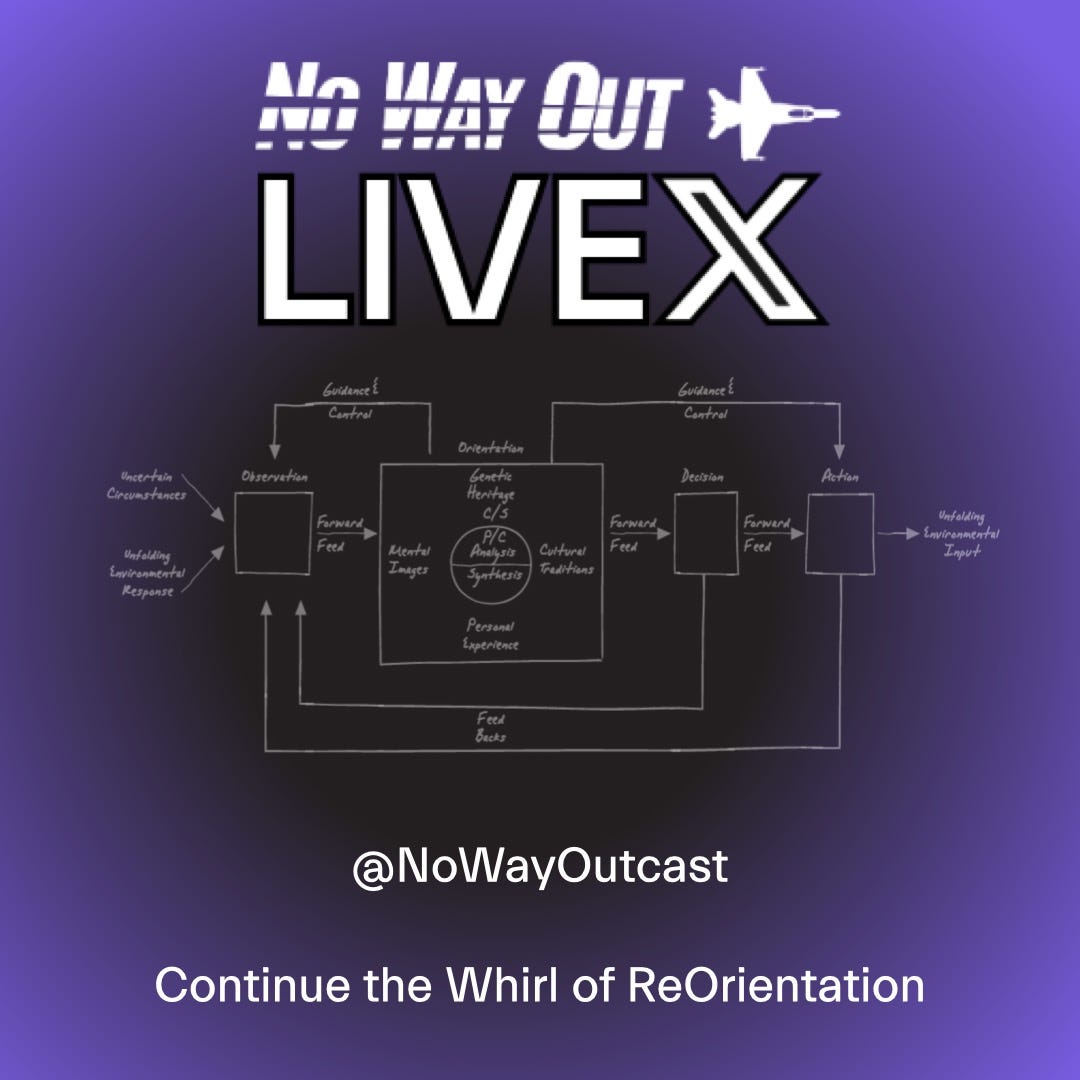

Originally published in The Whirl of ReOrientation on January 12, 2025.
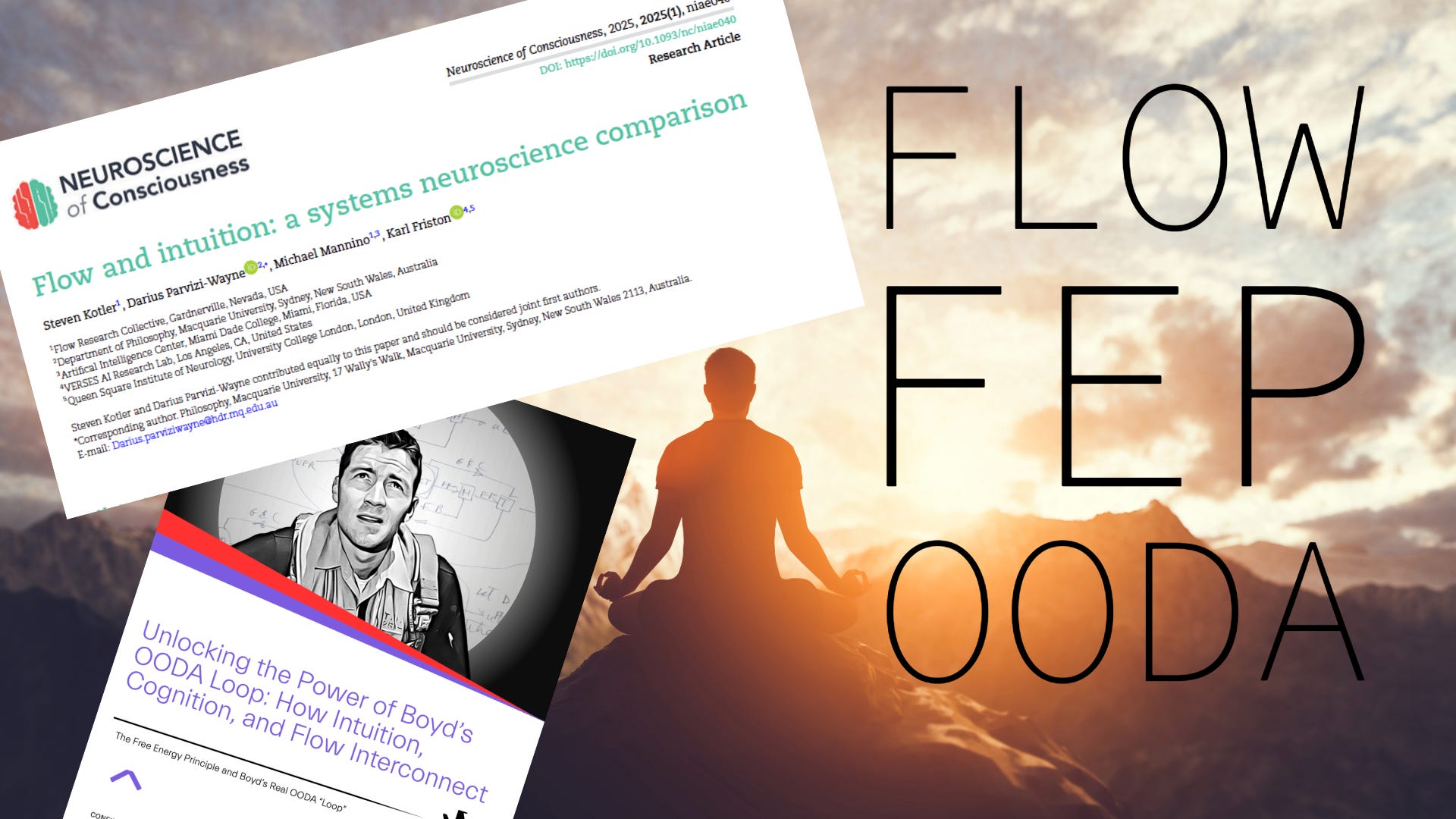
FOLLOW US ON X FOR LIVE SHOWS!
A few months ago, during a conversation with Steven Kotler, he mentioned he was collaborating with Karl Friston, PhD and other authors on a paper linking flow states to the Free Energy Principle. Intrigued by this, I decided to explore the connections between Type 0, Type 1, and Type 2 cognition with Boyd’s OODA loop. Some of you might have already received a paper from me filled with images and diagrams; if you are a paid subscriber and want a copy, feel free to DM me here on Substack.
If you’ve been following our discussions on The Whirl, No Way Out podcast, or AGLX, you’re aware that the Free Energy Principle (FEP) and its corollary, Active Inference, have significantly enhanced our understanding of Boyd’s work. As the co-creator of The Flow System, I’ve been exploring how Boyd’s ideas and his OODA loop sketch relates to the Constructal Law, complexity theory, and the latest developments in neuroscience. My background as a combat veteran with PTSD introduced me to Friston’s Free Energy Principle through the psychedelic-assisted therapy community, particularly through the work of Robin Carhart-Harris with Karl Friston on what’s known as the Entropic Brain Hypothesis.
What you are about to read, I hope, will deepen your understanding of the OODA loop, FEP, Active Inference, and why we emphasize viewing Orientation as a generative model—an internal model the external world—alongside recognizing the significance of the Implicit Guidance and Control (IG&C) pathway that moves from Orient to Act.
The following insights may carry profound implications for understanding AI, mental health, risk management, human performance, unrestricted warfare, teamwork, leadership, and flow.
OODA Loop, Free Energy Principle, and Flow States
In today’s fast-paced and unpredictable VUCA (Volatile, Uncertain, Complex, and Ambiguous) world, understanding how humans and organizations can adapt rapidly and effectively is critical. Colonel John Boyd’s OODA Loop (Observe, Orient, Decide, Act) serves as a foundational abstraction for dynamic decision-making. When integrated and explained with modern neuroscience concepts such as the Free Energy Principle (FEP) and flow states, the true brilliance of the OODA Loop transcends its often misinterpreted role as a mere fighter pilot decision-making process.
In their paper titled “Flow and intuition: a systems neuroscience comparison,” Steven Kotler, Darius Parvizi-Wayne, Michael Mannino, and Karl Friston explore how intuition and flow states relate from a neurodynamic perspective. This study posits that both flow and intuition involve nonconscious information processing, yet they differ in how they contribute to cognition and action. Kotler, known for his work on human performance and flow, and Friston, a renowned neuroscientist who developed the Free Energy Principle, bring a unique blend of insights from performance psychology and computational neuroscience to this exploration.
The OODA Loop: Beyond Simplicity
The OODA Loop is frequently misconstrued as a simple, linear sequence. However, Boyd envisioned it as a dynamic, iterative system where Orientation functions as the internal model of the external environment, serving as the “schwerpunkt” that influences our perception, sensing, adaptation, learning, planning, and actions. A living system’s Orientation is in a perpetual state of evolution (The Whirl of ReOrientation) achieved through a process of synthesis and analysis that integrates new information (surprise or mismatches) from the external world with the system’s genetics, culture, and past experiences. This approach dovetails seamlessly with the Free Energy Principle’s idea of minimizing prediction errors by continuously refining internal models to more accurately reflect external realities.
Friston’s Free Energy Principle: The Computational Key
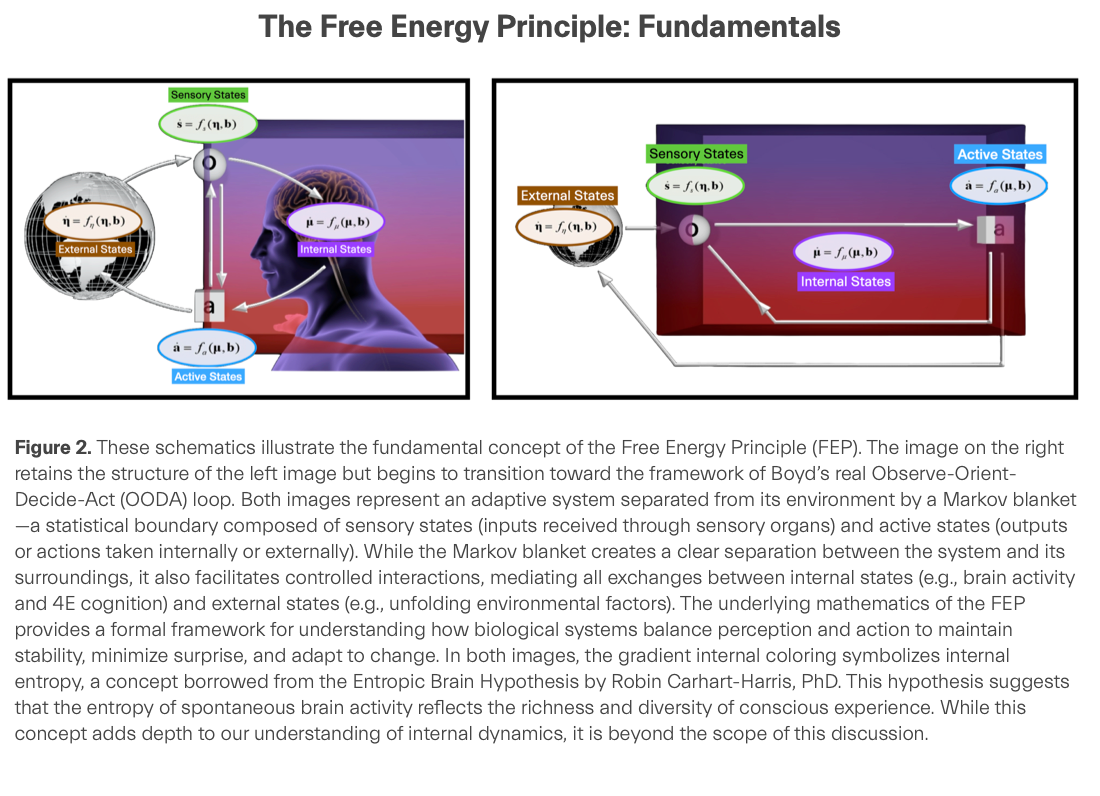
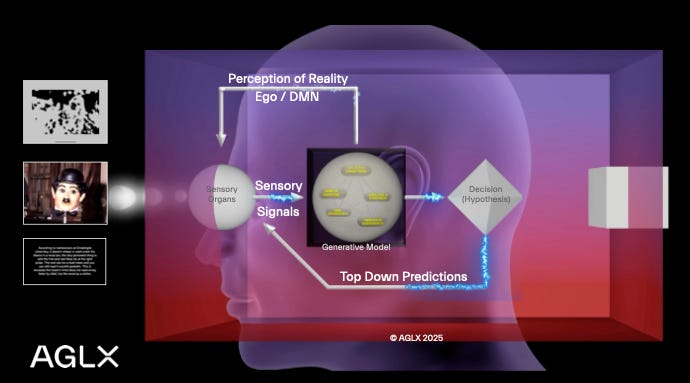
Karl Friston’s Free Energy Principle provides a computational framework for understanding how living systems maintain stability amidst environmental unpredictability. It suggests that the brain operates as a predictive engine, continually adjusting its internal model (Orientation) to lessen the gap between its predictions and actual sensory inputs, known as “prediction errors” or “free energy.” This mechanism is analogous to Boyd’s “Whirl of Reorientation,” where sensory data refines Orientation, thus influencing and directing actions.
Boyd’s OODA Loop: Free Energy
Within the OODA loop, the Observation-Orientation-Decide (OODO) loop, exists to minimize what is known as Variational Free Energy (VFE). VFE can be thought of as uncertainty or what Boyd identified as the features of the world that we cannot avoid (”There is No Way Out”). In contexts like warfare or sports, VFE represents the “Mismatches” our opponents experience when we “Act” in ways to “get inside their OODA loop.” The internal OODO loop is crucial for inferring the hidden internal states beyond the system’s boundary.
According to the Friston-Kotler paper, the Free Energy Principle (FEP) is key to understanding flow and intuition. FEP posits that anything persisting in time, like a living organism, possesses a set of defining states, referred to as an attracting set. A Markov blanket acts as a boundary separating an organism from its environment. The organism’s internal states function as if they are inferring the hidden external states beyond this boundary. This involves minimizing variational free energy (VFE), which represents a bound on surprise or uncertainty. Minimizing VFE equates to maximizing evidence for an organism’s model of its world or niche, a process known as self-evidencing.
Why Boyd Put Two Action Pathways on His Sketch
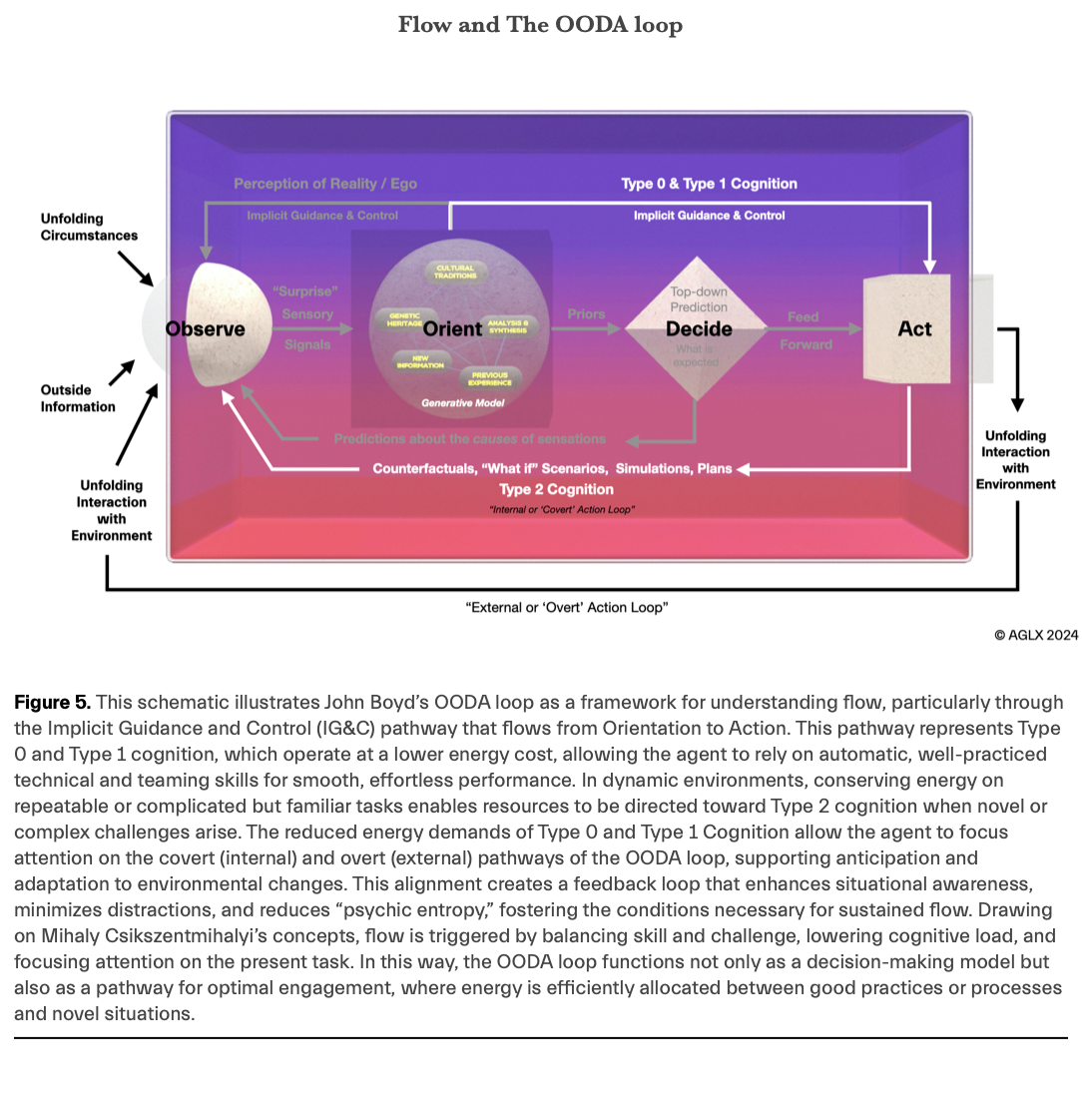
Boyd’s OODA Loop sketch includes two action pathways: one internal to the system and the other external. The internal pathway represents a simulation, a plan, a counterfactual, or a policy. The external pathway shows how that plan unfolds in interaction with the external environment. During planning, an agent must select between different courses of action (COAs) by evaluating their expected free energy (EFE), which predicts the amount of free energy the agent expects under different scenarios. By minimizing EFE, organisms can choose actions that lead them toward preferred states (risk management).
Intuition and the Implicit Guidance and Control Pathway
Within the OODA loop, intuition is intricately linked to Boyd’s Implicit Guidance and Control (IG&C) Pathway, which flows from Orientation to Action. This pathway is instrumental in understanding how automatic, ingrained processes guide behavior without conscious thought. Intuition aligns with what Boyd called fingerspitzengefühl—a “fingertip feel” developed through extensive experience, vital for quick and effective decision-making in high-stakes scenarios.
To develop IG&C and achieve flow, Kotler et al. suggest:
Cultivate a rich tapestry of experiences: Intuition relies on “implicit or tacit knowledge acquired throughout a lifetime” and “tacitly (in)formed cue-criterion relationships.” A diverse range of experiences enriches this intuitive foundation.
Refine pattern recognition: Intuition is akin to a “habitual mental action” for assessing contextual cues. Training in pattern recognition through case studies or simulations can enhance this capability.
Foster interoceptive awareness: The role of interoceptive cues or “gut feelings” is highlighted. Practices like meditation, controlled breathwork, and yoga can heighten sensitivity to these signals.
For fostering flow:
Develop mastery in a skill: Flow involves optimal performance in challenging tasks, requiring dedicated practice to achieve proficiency.
Seek challenges that match your skill level: Flow is found at the balance point between skill and challenge, necessitating tasks that stretch but do not exceed one’s capabilities.
Minimize distractions and cultivate focus: Flow demands deep immersion; hence, creating a focused environment is essential.
In Boyd’s OODA Loop, the IG&C pathway shows how internal models guide actions intuitively, bypassing explicit reasoning. This pathway includes:
Type 0 Cognition: Automatic, nonconscious responses from procedural memory, akin to muscle memory.
Type 1 Cognition: Quick decision-making using heuristics, based on learned patterns.
Both types of cognition facilitate flow states, where actions and awareness merge seamlessly, reflecting Csikszentmihalyi’s flow concept.
In essence, by integrating the FEP with Boyd’s OODA Loop, we gain a scientific understanding of how these cognitive processes operate, emphasizing the brain’s role in adaptation. This integration positions the OODA Loop as a profound tool for decision-making, harnessing flow states across various domains in our complex world.
Stay tuned as we will be going deeper into these connections on No Way Out and No Way Out LIVEX.
-Ponch
Follow Us On X For Live Shows!