


Originally published in The Whirl of ReOrientation on March 10, 2025.

Chet Richards’ recent Slightly East of New post on Deconstructing The Essence of Winning and Losing provides key insights into John Boyd’s work, offering a fresh perspective on the origins and implications of the OODA Loop. Chet has been a guest on No Way Out multiple times, and it seems he’s due for another conversation. Our connection dates back over a decade, when I first began exploring the intersection of Cynefin and the OODA Loop. Over the past four years, I’ve been sharing with Chet and others what I believe to be a compelling synthesis: the relationship between Boyd’s theories and Karl Friston’s Free Energy Principle (FEP).
This connection has profound implications across multiple domains—team dynamics, cognitive flow, organizational flow, mental health, risk management, strategy, and even the next generation of artificial intelligence. By revisiting Boyd’s intellectual journey, particularly his final formal articulation of the OODA Loop in The Essence of Winning and Losing (1996), we can explore how his work not only foreshadowed Active Inference but also aligns with Friston’s thermodynamic framing of adaptation.

The following post takes a speculative yet grounded approach, examining how Boyd’s interdisciplinary genius—rooted in physics, information theory, and cognition—might have anticipated some of the core principles of Free Energy and Active Inference. By drawing on Boyd’s personal library, Chet Richards’ reflections, and contemporary developments in neuroscience, we can begin to bridge military strategy with cognitive science in ways that redefine how we think about decision-making, adaptation, and survival in complex environments.
Boyd’s Intellectual Foundations: A Tapestry of Diverse Ideas
John Richard Boyd (1927–1997), a visionary Air Force colonel and military polymath, left an indelible mark on military theory with his Energy -Maneuverability theory and the OODA Loop (Observation, Orientation, Decision, Action). Yet, his intellectual pursuits reached far beyond warfare, weaving together physics, thermodynamics, chaos theory, and cognitive science.
I want to explore a tantalizing possibility: how Boyd’s interdisciplinary genius, as reflected in his personal library and culminating in his final work, The Essence of Winning and Losing (1996), might have led him to anticipate Karl Friston’s Free Energy Principle (FEP) and Active Inference—frameworks that redefine how living systems adapt to uncertainty. By examining Boyd’s influences and Chet Richards’ recent insights into the OODA Loop’s origins, I aim to illuminate the breadth of Boyd’s brilliance.
The Free Energy Principle, introduced by neuroscientist Karl Friston in the early 2000s, asserts that organisms minimize “free energy”—a measure of prediction error or surprise—to thrive in unpredictable environments. Active Inference extends this, suggesting that actions align sensory inputs with internal models. While Boyd never explicitly formulated these ideas, the parallels between his work and Friston’s suggest he was on a convergent path. I speculate that Boyd’s journey, culminating in his first formal OODA Loop sketch in 1996, might have bridged military strategy and cognitive science.
Boyd’s personal collection at the Marine Corps History Division Archives in Quantico reveals a mind hungry for synthesis. His annotated books—such as Werner Heisenberg’s Physics & Philosophy, Ilya Prigogine’s Order Out of Chaos, and Marvin Minsky’s The Society of Mind—span disciplines that also influenced Friston. Boyd’s 1976 treatise Destruction and Creation lays a foundation, proposing that mental models must be destroyed and recreated to match reality, driven by Gödel’s Incompleteness Theorem, Heisenberg’s Uncertainty Principle, and thermodynamics. This dialectical process echoes FEP’s core idea: minimizing prediction errors to align internal states with the external world.
Boyd absorbed thermodynamics during his studies at Georgia Tech and saw parallels between energy dynamics in physical systems and tactical maneuvers. This theme is reinforced by Prigogine’s Order Out of Chaos, which explores self-organization in far-from-equilibrium systems—a direct influence on Friston’s thermodynamic grounding of FEP. Boyd’s library also includes Jeremy Campbell’s Grammatical Man, which ties information theory and entropy to life’s adaptability, and Brian Goodwin’s How the Leopard Changed Its Spots, which explores evolutionary biology’s complexity—both resonating with FEP’s view of organisms as adaptive systems. Boyd’s notes and briefings, like Conceptual Spiral (1990–1992), explore iterative adaptation, hinting at a system-level optimization process akin to FEP.
The OODA Loop’s True Origins: The Essence of Winning and Losing
Contrary to popular belief, Boyd did not develop the OODA Loop directly from his F-86 experiences in Korea. As Chet Richards recounts, the loop’s first formal sketch emerged in 1995, when Boyd mailed a pencil draft to Richards for refinement, culminating in The Essence of Winning and Losing (January 1996)—his final work. Richards notes that while Boyd had used the term “OODA Loop” since Patterns of Conflict (1977–1986), often as “operating inside their OODA loops,” he rarely defined it as a standalone concept until 1996.
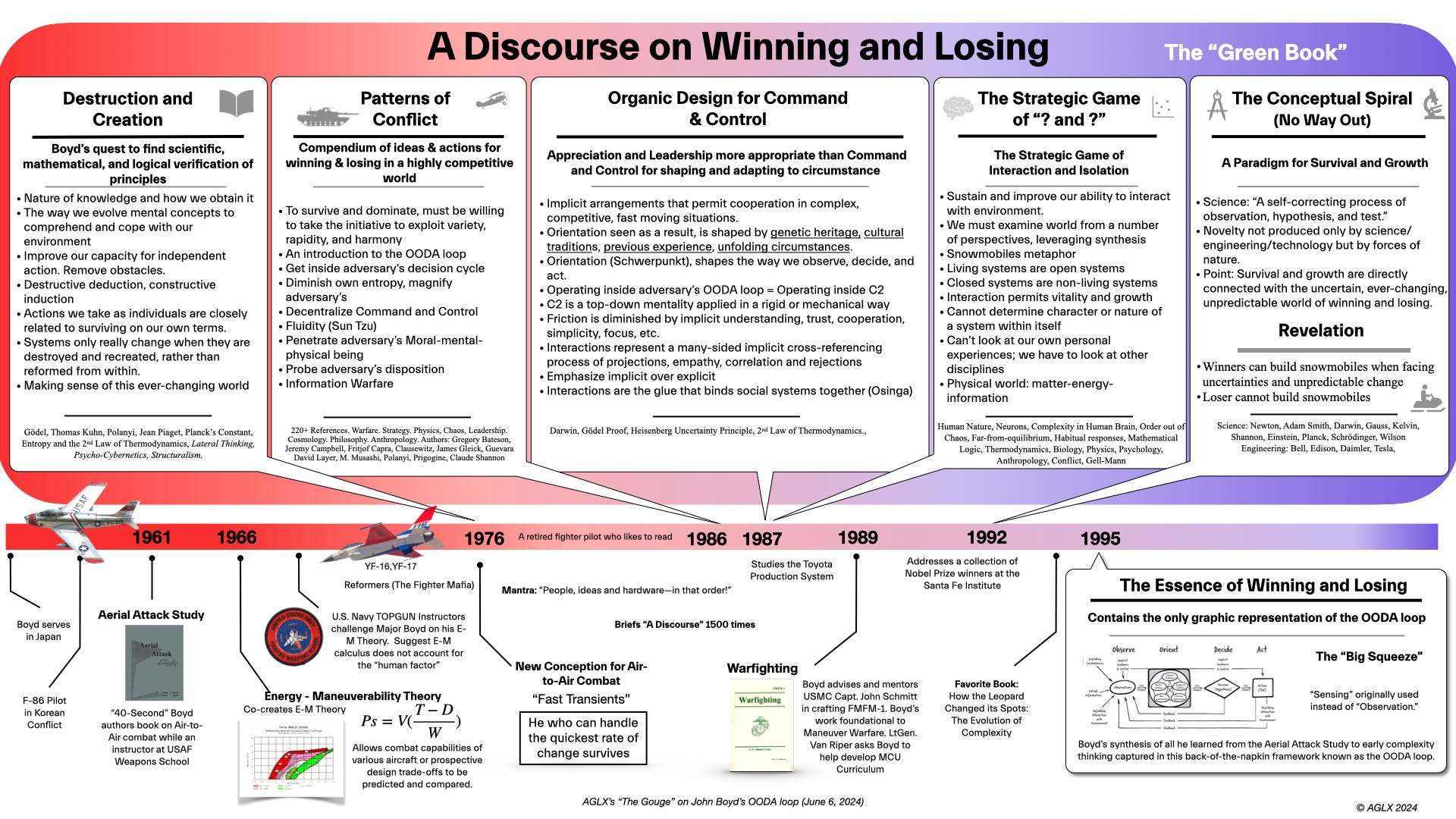
This late crystallization reframes the loop’s origin: rather than a direct product of dogfighting, it was a retrospective synthesis within ADiscourse on Winning and Losing (1970s–1980s) that explained pilots’ intuitive success. In The Essence of Winning and Losing, Boyd introduces the “implicit repertoire”—intuitive practices enabling survival in an “uncertain and ever-changing world.” Richards highlights Boyd’s central question: from infinite possible practices, how do we select and adapt? The OODA Loop, Boyd argues, is the answer—a dynamic process where new information (akin to Friston’s free energy or surprise) enters the OODA loop via Observation (Sensory States). This information feeds into Orientation, where it interacts with an agent’s genetic heritage, cultural traditions, and previous experiences through analysis and synthesis.
Boyd defines Orientation in Organic Design (1987) as “an interactive process of many-sided implicit cross-referencing projections, empathies, correlations, and rejections,” shaping and being shaped by these inputs. From Orientation, multiple outcomes emerge, including a constructed perception of reality, a prediction of the causes behind new information, a decision to act, and an implicit guidance and control mechanism influencing both observation and action. Richards emphasizes that this process is not just about Orientation but the entire loop—a “far-from-equilibrium” structure evolving through unfolding interactions with the external world.
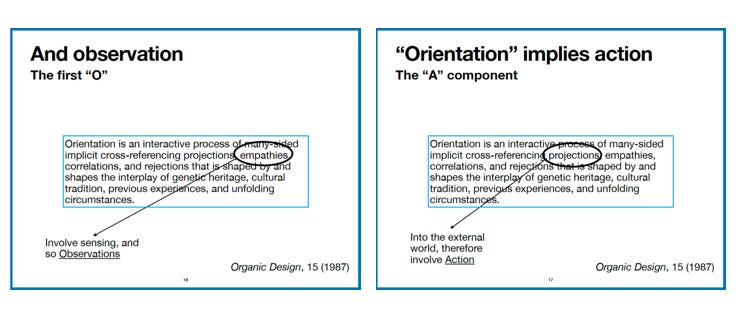
Boyd’s meticulous revisions with Richards—debating the directions of arrows in the Orient block—reflect this holistic interplay, with solid arrows linking all elements to signify continuous interaction, much like FEP’s Bayesian updating.
Boyd’s Genius: A Legacy Unfinished
Boyd’s death in 1997, just months after completing The Essence of Winning and Losing, halted further evolution of his sketch. Richards speculates that additional models would have followed, a testament to Boyd’s relentless refinement process. His influence—evident in the Marine Corps’ success during the Gulf War—underscores his practical genius, yet his marginalization within the Air Force echoes Friston’s initial obscurity.
Today, as Active Inference shapes AI and neuroscience, Boyd’s 1996 sketch reveals a mind ahead of its time. He didn’t just redefine strategy; he glimpsed a unified theory of adaptation, leaving a legacy that invites further exploration. By continuing to connect Boyd’s work with the Free Energy Principle, we might be able to reduce the energy and costs associated with training leaders on decision-making, resilience, and human adaptation in an increasingly VUCA world.