


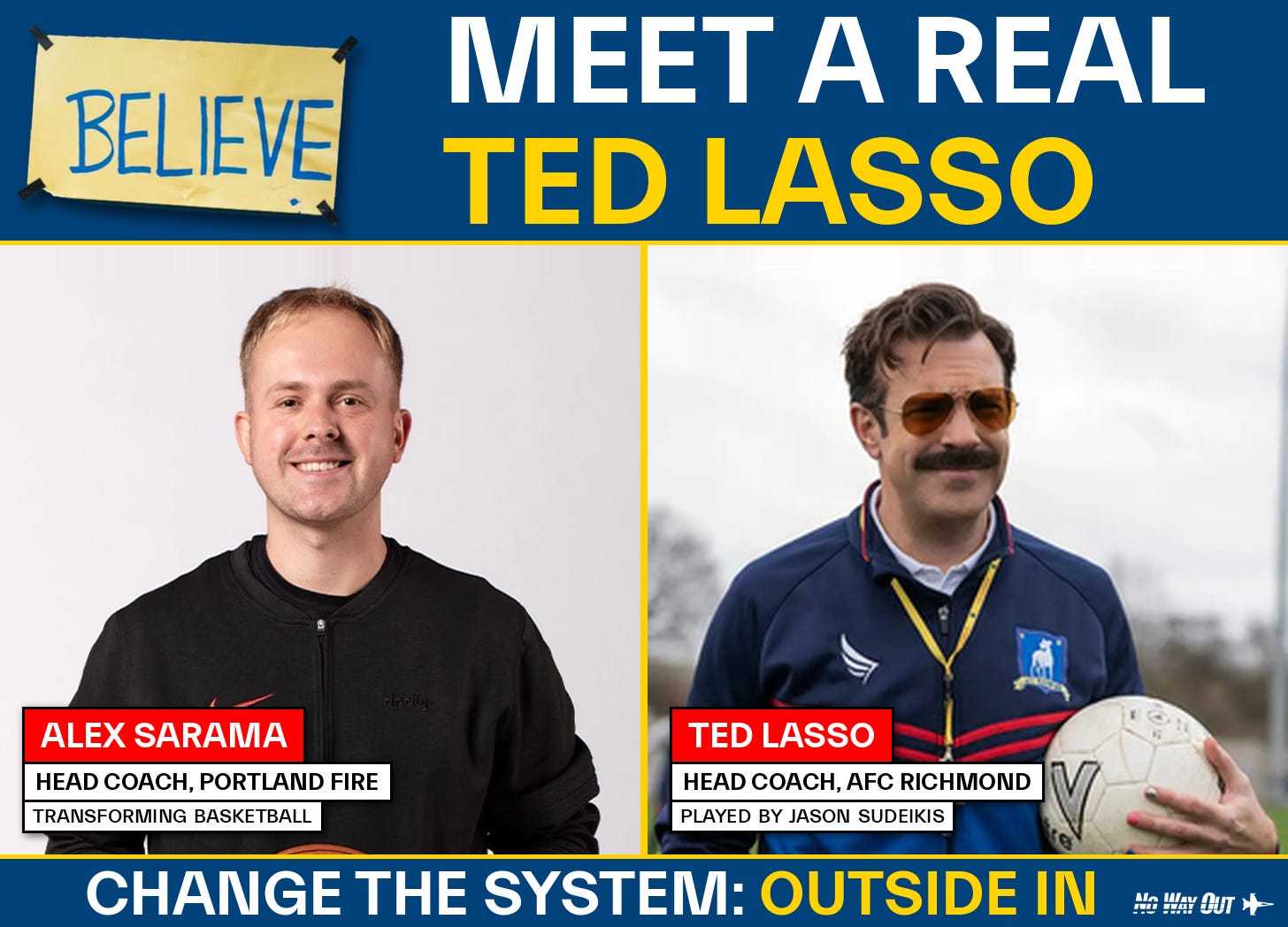
My family and I have been watching Ted Lasso for, what, a few years now? We just wrapped up the latest season. It’s great, full of great stories and a lot of great coaching lessons. In fact, the one I think everybody’s talking about is the time Ted sat next to the assistant coach to be present when she cried. That’s a coaching thing, right? That’s a presence thing. That’s a human thing. Our family really enjoys that.
Jamie Dimon does too. “I love Ted Lasso,” he recently told the Wall Street Journal. “He comes in and he doesn’t know anything about football, and he’s just gracious. He’s working with people—their insecurities, their bad behavior, their work ethic—and he’s getting them to function as a team.”
Fortune ran that quote from the CEO of JPMorgan Chase on 20 October. That’s pretty powerful.
There are plenty of articles on leadership and coaching lessons from Ted Lasso. LinkedIn is full of them. Some of them include Amy Edmondson’s work on psychological safety. Ted is a fictional coach, though, and his lessons come from a writers’ room.
The big question is, what if there was a real Ted Lasso, with real principles every organization could embrace?
There is. His name is Alex Sarama.
A Real Ted Lasso, in Reverse
Ted Lasso was an American football coach who went to England to coach soccer, a game he barely knew. Near the end of his first season he is still asking, “How is that offside? I don’t understand that yet.”
Alex’s story runs the other way. He came from the UK to the US. Alex never played college or pro basketball, and he came up coaching youth and academy teams in Europe. He grew up in Guildford, England, played youth basketball for the Guildford Heat until about 16, and studied modern history at the University of Nottingham. “No one in my family ever played basketball,” he told me on No Way Out episode 190 (5:40). In January 2019, at age 23, he heard Stuart Armstrong present the constraints-led approach at the Future of Coaching conference in Leicester. He went home and started downloading the papers on ecological dynamics and nonlinear pedagogy. He then coached young players at Elite Academy Antwerp in Belgium and at College Basket Borgomanero in Italy.
He founded Transforming Basketball. In 2023 he became director of methodology at the London Lions in England, and in the 2023–24 season he worked in the US for the Rip City Remix, the Portland Trail Blazers’ G League affiliate, as director of player development. In September 2024 he joined Kenny Atkinson’s staff at the Cleveland Cavaliers as Director of Player Development, later became an assistant coach, and stayed about a season and a half. He calls it “a really kind of enjoyable two years.” At 30 he became the first head coach of the new Portland Fire in the WNBA, the youngest head coach in WNBA history. In September, Routledge published A Constraints-Led Approach to Coaching Basketball, which he wrote with Alex Lascu, George Vaz Rocha and Neil Houghton.
What My Daughters Heard
Both of my daughters play basketball. When they first heard Alex, they didn’t know he had an accent. They didn’t know he came from the UK, that he was British. And they said, “Dad, he’s like a reverse Ted Lasso.” And I’m like, you’re right, with a few exceptions. I told Alex the same thing when we recorded episode 190.
A View From Europe
He’s an English coach who came up outside the American system. He sees it as an advantage, because “it’s given me extra motivation at times when I needed it in my career.”
One of the key things about coming from the outside is what John Boyd wrote in Destruction and Creation: “According to Gödel we cannot— in general—determine the consistency, hence the character or nature, of an abstract system within itself.” You have to go outside.
Boyd was writing about concepts. The same holds for a club that only checks its game against itself.
Dimon’s line about Ted fits Alex’s job. Alex gets people with different skills, habits and egos to function as a team. His lessons come from practice and games, and he gets feedback on them every possession.
Lessons From Complex Adaptive Systems
In August 2019, the constraints-led approach was pointed out to me at a Cynefin retreat in Whistler, Canada. That same month, I was presenting a Cynefin workshop at a Navy complexity conference, and I was handed The Constraints-Led Approach: Principles for Sports Coaching and Practice Design, the book Keith Davids wrote with Ian Renshaw, Daniel Newcombe and Will Roberts, and asked if I was familiar with it. My first thought was, wow, all this can be applied to what we’re doing with teamwork development interventions, building those non-technical skills that every organization needs. Later, that would be foundational to what we call the Flow Learning Lab.
As my girls got older, they became interested in basketball. I didn’t know much about the technical side of basketball, so I just assumed all coaches were familiar with the constraints-led approach and that what I was observing was them implementing it. None of that was true.
Complex adaptive systems give leaders plenty of lessons. Here are a few that leaders can learn from Alex.
Go Outside the System
Boyd’s answer to a system talking to itself is to build a new one. In Destruction and Creation he wrote that “the uncertainty and disorder generated by an inward-oriented system talking to itself can be offset by going outside and creating a new system.”
Ted Lasso went outside the system, and so did the whole program, which matters more. AFC Richmond, the club Ted came to coach, hired him from American football. They went outside the domain.
Total Football came from another sport. In season three, Ted gets the idea while watching an old Chicago Bulls game in a restaurant in Amsterdam. He describes what he wants, and Beard gives it a name: “You should call it Total Football.” Back in training, Ted gives the players one question: “Now, in Total Football, you gotta constantly be asking yourself, ‘What does this situation need right now?’”
Alex’s path crossed the same kind of lines. He came to basketball from history, to the US from Europe, and to the NBA through youth academies, the London Lions and the G League.
Results Emerge From Constraints
Rob Gray, PhD, laid out the core idea when he joined me on episode 134. A coach works with constraints on the individual, the task and the environment, and “the biggest one that a coach has control over is the task constraints.” Coaches can change the rules, the size of the area, the number of players and the equipment. Rob’s example was the rim. On a 10-foot rim, he said, “I can’t dunk to score. If I lowered it to six feet, then that solution comes back in.” From the interaction of those constraints, the player’s solution emerges. “The word we use is emerge,” he said.
For the theory behind this, read The Constraints-Led Approach: Principles for Sports Coaching and Practice Design (Routledge, 2019) by Ian Renshaw, Keith Davids, Daniel Newcombe and Will Roberts.
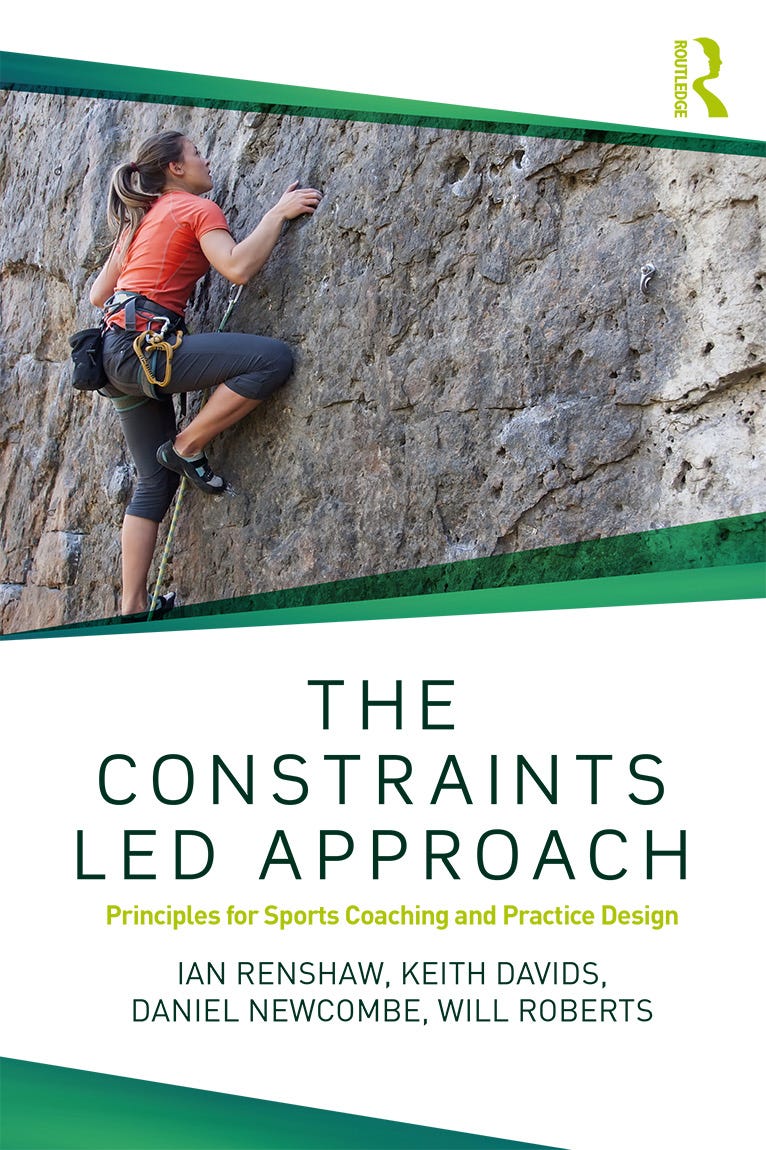
Teamwork training follows the same logic. Teamwork emerges from the interplay of the constraints of the indivdual/organization, the people and the environment.
Psychological safety emerges the same way. It comes from the conditions leaders set through their actions, their conversations and the constraints they put in the environment, meeting the constraints each person and team brings. Alex’s debriefs, which I come back to at the end, show one way a coach sets those conditions.
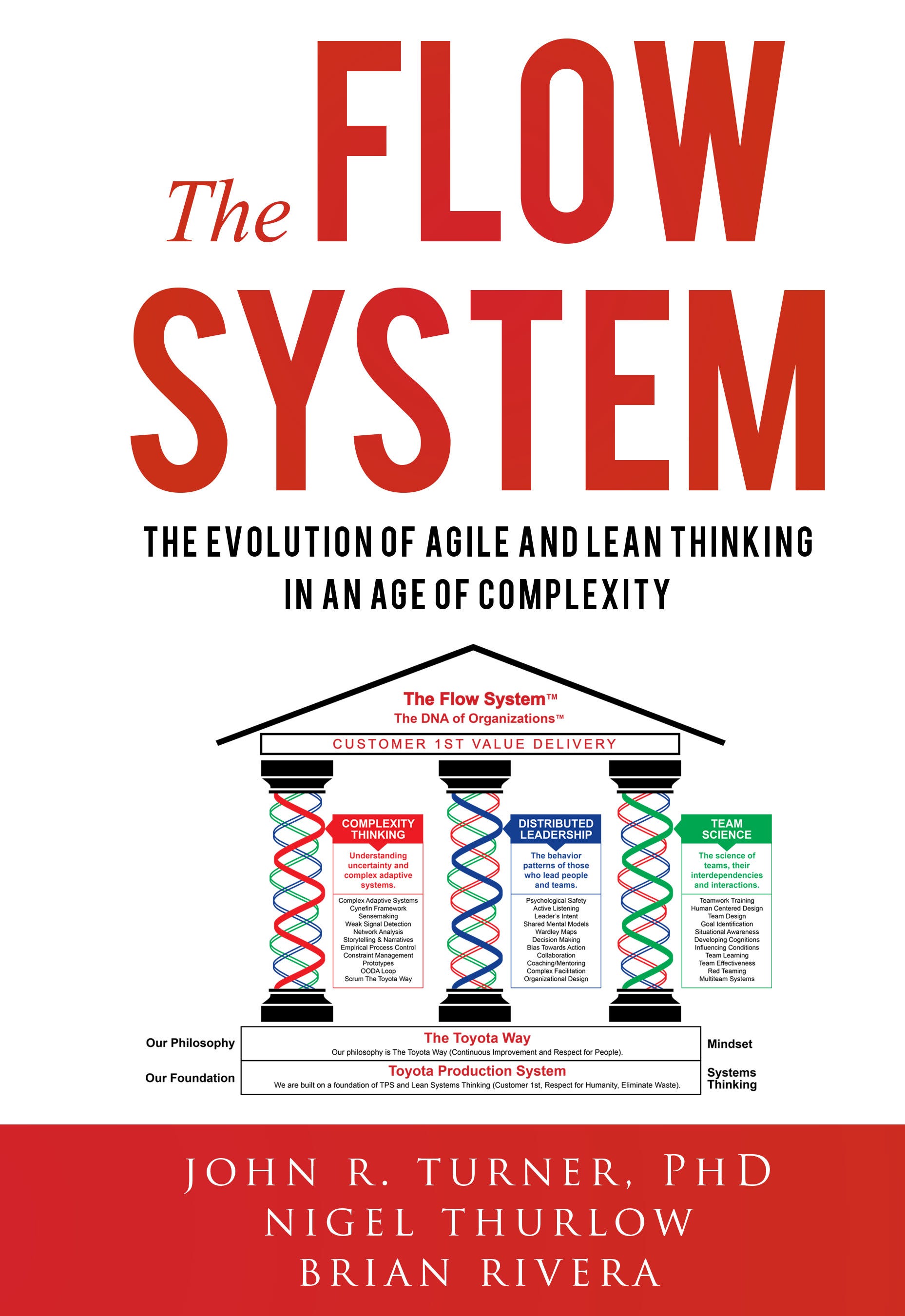
That view of teams sits behind The Flow System, the book I wrote with John Turner and Nigel Thurlow.
The show gets this right. Ted’s Total Football idea starts with “We’ve been playing too rigid, you know? Our guys need freedom.” It works at half-time against Arsenal only after one of the players redraws it himself and tells his teammates, “stop going to me, right? And start going through me.”
Expect It to Look Messy
I’ve watched my own girls go through cone drills and line drills for years. It looks like learning, and a lot of it doesn’t show up in the game. But I have yet to see a static cone appear in a game, and the weave drill always seems to get intercepted by the opposing team. If there is one lesson I learned in naval aviation, it is this: train like you fight, fight like you train.
Alex told me a constraints-led practice is “gonna be a lot messier,” and that getting good at running one takes “so much trial and error.” Rob said the same about youth practice: “It looks messy, right? Kids are making bad passes.”
Pete Blair, PhD, said the same about training officers on episode 186: “By definition, it’s going to look messier when you do the training because you’re allowing them to explore the space.”
Organizations usually want the opposite. They want the five steps to planning or the ten steps to a debrief.
Put Your Ego Aside
Alex was direct about what keeps coaches stuck: “a lot of it is pride, personal egos, we’ve all been there.” Then he said, “if you really want to be a great coach, you have to put that ego aside.”
If something came out tomorrow that showed a better way to run his offense, he would change his mind. “You know, if the facts change, I’m gonna change what I do.”
Sport Is Changing How It Coaches
Sport is going through a big shift in coaching and leadership right now. You can see it in college basketball, in the NBA and in how police officers are trained.
Illinois
On 27 October, CJ Moore of The Athletic reported that Illinois made the Final Four with a record offense and then scrapped it for one with no plays. On game day Brad Underwood arrived with an empty play card and three points of emphasis. As Underwood put it, “A lot of quarterbacks out there. Not just one. A lot of decision makers.”
Moore wrote, “Taking your hand off the joystick can be difficult for some coaches.” He added that a constraints-led approach, “where players are taught how to play rather than be robots, is where the game is trending.” Johnny Carpenter, a Milwaukee Bucks assistant, told him, “to change yourself so much, man, I respect the guts that that takes.”
Moore’s piece covers two things worth keeping apart. One is the constraints-led approach, a way of coaching. The other is a specific offense with no ball screens, which traces to Saint Joseph’s College of Maine, a Division III program.
The NBA
Alex was part of the NBA side of this shift. In Cleveland, he said, “we were the first team to really go all in with this,” and he called Kenny Atkinson “one of the biggest advocates there is for constraints-led approach in the NBA.” When I played him a clip of Golden State coach Steve Kerr on episode 190, Alex said Kerr was right, and that “this is just the direction NBA’s been going last few years.” Rob Gray had seen the same trend on episode 134, a year earlier, with NBA teams moving away from scripted plays “and more towards kind of principles.”
Moore’s piece adds another NBA thread. Noah LaRoche, who had been working on the constraints-led approach since 2009, went to the Memphis Grizzlies and then consulted for the Miami Heat. Moore reports the Heat ranked last in ball-screen usage and second in scoring.
Researchers are looking at how NBA players practice, too. In a 2025 case study, Dave Love, Fabian Otte and Keith Davids look at how NBA shooting coaches plan and schedule each player’s shooting practice, using ecological dynamics and a skill periodization framework. They note that more NBA teams are hiring shooting coaches.
Beyond Sport
Police training is not sport, but even police training is picking up on this.
Pete Blair is Executive Director of the ALERRT Center at Texas State University, which trains police officers across the country to respond to active attacks. On episode 186 he asked the question that sums up this shift. Everyone agrees “The best way to get good at something is to do that thing I’m trying to get good at.” Then he asks, “So why are we doing so many things that are not the thing?”
Pete’s instructors adjust the constraints until trainees succeed about 70 percent of the time. “If they’ve got a hundred percent success rate, there’s not learning going on,” he said.
Coaches Become Designers
Rob calls this “a fundamental shift from being the general, being the instructor,” toward being more of a guide. The coach still has expertise to offer. “There’s still a major role for the coach,” he said. “You’re more guiding and pointing out things and creating practice, designing practice than telling people explicitly, here’s how you do it.”
Alex runs his team on principles of play. He keeps set plays for dead balls and trains the players to play with intention the rest of the time. In his words, “that can’t be done with me calling out on a sideline. That has to be trained through the practice environment and then actually measured to see if it transfers in competition.”
Mission Command and Leader’s Intent
The military has its own name for leading this way. Don Vandergriff teaches mission command, and on episode 4 he explained why it’s hard: “our entire society is one of control and mission command is scary.”
He named the most common failure too: “Go do mission command, but do it the way I would do it.” What counts is that people achieve the end state, he said, “And that takes a lot of trust and a lot of development.” When audiences ask him for the key word, “I say a five-letter word, T-R-U-S-T.”
Mission command runs on Leader’s Intent. People who know the intent and the end state can act without waiting for the next order. David Marquet built intent-based leadership on that idea on the USS Santa Fe and wrote about it in Turn the Ship Around! (2012).
Boyd saw the same pattern. In Patterns of Conflict he wrote that the German operational philosophy “emphasized implicit over explicit communication.”
Coach the Coaches
Ted’s real skill is developing coaches. He asks the kit man for his read on a player, then credits him in front of the press: “This is all cooked up by our very own Nate the Great.”
Kenny Atkinson did that for Alex. Kenny let him “come in and have so much freedom and involvement with the Cavs program.” Alex said, “there’s no way I’m the head coach now of the WNBA team without those two kind of very formative years.”
Lead Like a Gardener
More than anything, this is about what General Stanley McChrystal calls leading like a gardener. “Leading Like a Gardener” is the title of chapter 11 of Team of Teams (2015), by McChrystal with Tantum Collins, David Silverman, and Chris Fussell. In that chapter McChrystal writes, “The temptation to lead as a chess master, controlling each move of the organization, must give way to an approach as a gardener, enabling rather than directing.” (p. 232)
On episode 134 I put McChrystal’s idea to Rob: “We often talk about leading like a gardener. Can you talk a little bit about the coaches role and how all this comes together?” His answer was the shift from general to guide.
Fortune’s piece on Dimon quotes Bruce Avolio on Ted: “He transmits genuine humility, which allows others who know more to step in and contribute to the collective potential.”
Alex’s debriefs show what this looks like on a team. His players talk to each other first in a short debrief, and he builds a shared language with them so they can talk “in the storm of the game.” Timeouts become a structured chance for the players to debrief before he speaks. He told me it “just really allows us to be more effective in the game when you’ve got all the pressure of performance.”
Episodes in This Piece
Alex Sarama, No Way Out episode 190:
Rob Gray, PhD, episode 134:
Pete Blair, PhD, episode 186:
Keep Learning
We’ve been talking about the constraints-led approach and its connections to John Boyd’s real OODA loop. We’ve also been looking at a lot of concepts that connect back to constraints, from Eliyahu Goldratt’s theory of constraints to Alicia Juarrero’s work in Context Changes Everything. We explore this here on No Way Out and across the AGLX ecosystem. Keith joins me on No Way Out next week, on Episode 191.
Very few people in the consulting world, the coaching world or the business management world are familiar with this. If you’re interested in working with us and seeing how the constraints-led approach builds high-performing teams, that’s why we’re here. We’re here to help you learn.
If you want to learn more about how to use this in coaching, there are plenty of resources on our podcast, on The Transforming Basketball Podcast, and on Rob Gray’s The Perception & Action Podcast.