


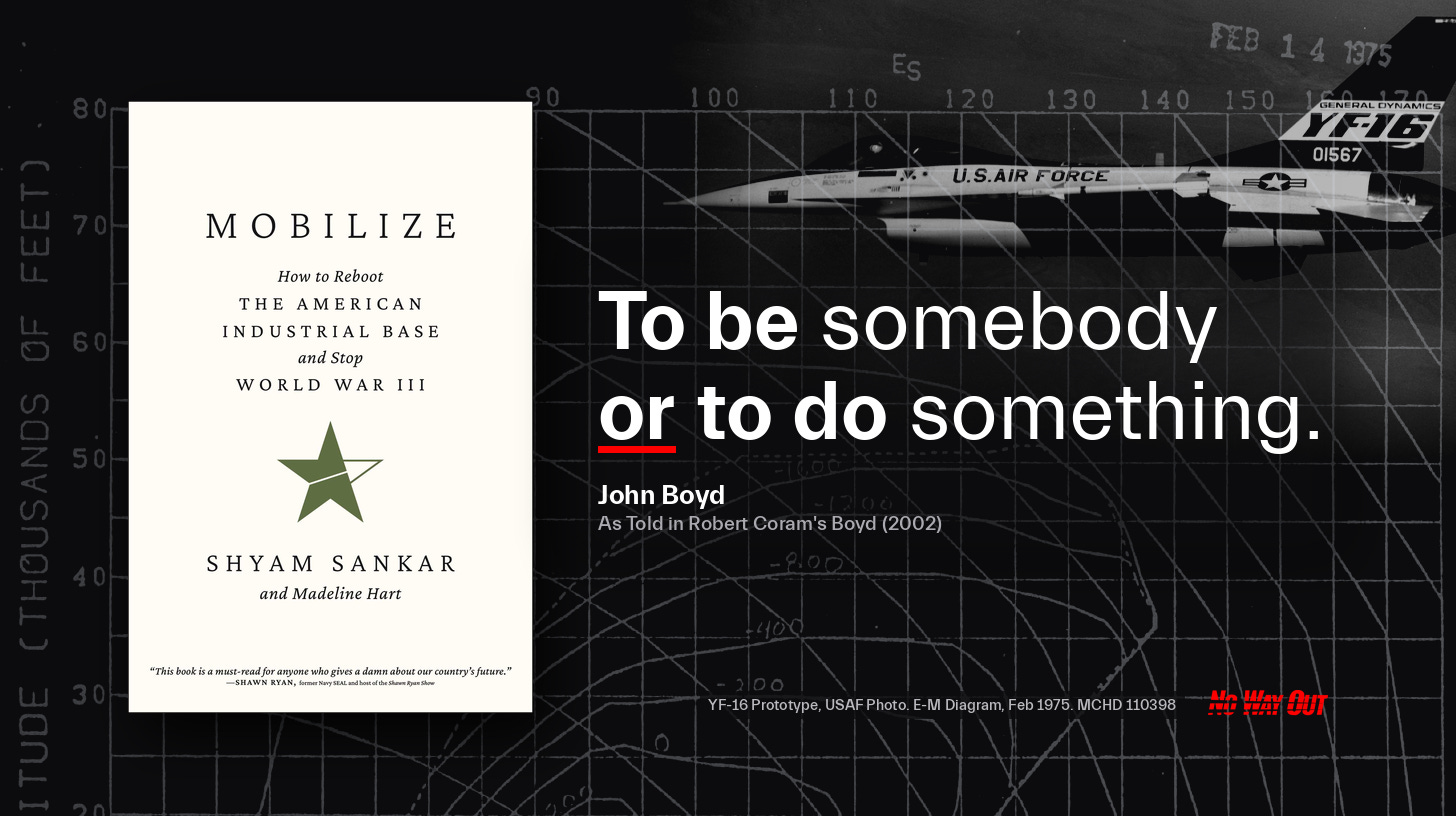
“When we get the right people in place, focus on speed and the OODA loop, and fire up the American industrial base, there is no limit to the chaos and uncertainty we can impose on our adversaries.”
Shyam Sankar and Madeline Hart, Mobilize, chapter 13
Shyam Sankar, Palantir’s chief technology officer, invokes John Boyd all through Mobilize, the book he wrote with Madeline Hart. I’d go a step further. The OODA loop is foundational to their thinking.
Shyam is also an Army officer. On 13 June 2025 he took a direct commission as a lieutenant colonel in the Army Reserve’s Detachment 201, which brings tech executives in as part-time advisers. For someone that new to the uniform, he knows Boyd better than most officers of the same rank. In my experience Army officers have tended to push back on the OODA loop, so it’s about time somebody from the Army got it right. Or mostly right.
So let me say this up front. Mobilize is a must-read, especially if you’re still in uniform or you want to dominate in the age of algorithms and super intelligence. What would make it stronger is bringing in the real OODA loop and some of the key influences behind it. I take up three here: cybernetics, complexity and the Toyota Production System (TPS). Do that, and Mobilize joins my Boyd top 10 list next to Grant Hammond’s The Mind of War, Chet Richards‘ Certain to Win and Frans Osinga’s Science, Strategy and War. What follows are my ideas for getting it there.
A Film for Boyd’s Centennial Year
Shyam has also put a film in front of audiences. Deterrence: Winning the Second Cold War is a documentary from Brighton Maintenance, created by Shyam with Peter Berg as executive producer, and it follows founders building autonomous vessels, hypersonic vehicles and autonomous factories. It screened at Cornell on 5 November and at the University of Texas at Austin on 16 November. The Hoover Institution at Stanford is next, on 3 December 2026.
The Cornell Daily Sun put the running time at 90 minutes and reported Shyam describing the United States as being in an “undeclared state of emergency.” He’s been saying that for a while. In his 2024 essay The Defense Reformation he wrote, “As a nation, we are in an undeclared state of emergency.”
Berg, by the way, directed Lone Survivor, the 2013 film based on Marcus Luttrell’s book of the same name. I’ll come back to Luttrell.
2027 marks the 100th anniversary of John Boyd’s birth. He was born on 23 January 1927. A book and a film that reach a big audience that year are a chance to put more attention on Boyd’s work, because his ideas reach further than Mobilize shows, and further than the dominant understanding of Boyd has ever taken in.
Boyd and the Reformers
Mobilize looks hard at the military-industrial complex and offers a way to reform it, and Shyam points out that Boyd was a reformer too. From the 1970s into the 1980s, Boyd and the military reformers took on the Pentagon over how it bought weapons and how it thought about war. Shyam tells that story, including Boyd’s demeanor in the Pentagon and his habit of using four-letter words with senior officers. Hal Sundt walked us through the reformers and the development of the A-10 on No Way Out #67.
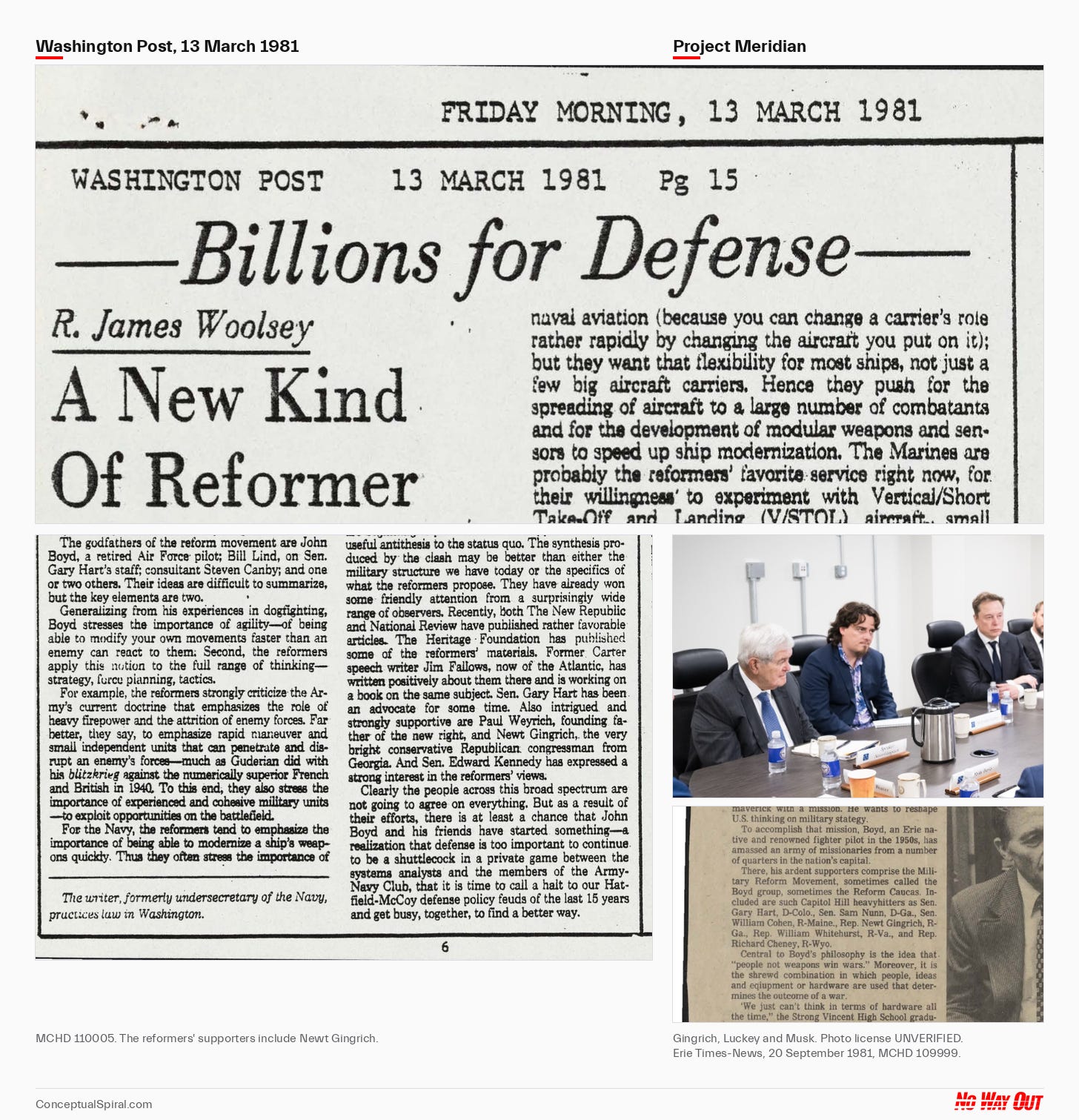
His briefings didn’t stay inside the building. He took them to Capitol Hill, and the reformers had friends there. Newt Gingrich was one of them. In 1981 the Washington Post named the Georgia congressman among the reformers’ strong supporters, and the Erie Times-News listed him among the Capitol Hill heavy hitters behind what it called the Boyd group. Grant Hammond, in his introduction to the 2018 edition of Boyd’s A Discourse on Winning and Losing, writes that Boyd led the Defense Reform Movement “behind the scenes.” Among the members of Congress in it, he names Newt Gingrich, the future Speaker of the House. After Boyd died, his longtime colleague Franklin Spinney wrote in a July 1997 Proceedings tribute that Gingrich “used them [Boyd’s ideas] to plot the Republican takeover of Congress.”
Boyd preached “people, ideas, hardware,” in that order, as Robert Coram records it in his biography, Boyd: The Fighter Pilot Who Changed the Art of War. Shyam keeps that order and adds software to the hardware. Maybe it’s still enough to say people, ideas and things, in that order. In a 1989 lecture to Marine officers at Quantico, Boyd put it this way: “terrain doesn’t wage war, machines don’t wage war, people do and use their minds.”
Project Meridian and the Centennial
Gingrich is back at the table. On 30 September 2026, Secretary of War Pete Hegseth announced Project Meridian, a 120-day study of the future of warfare, with Gingrich, Palmer Luckey of Anduril and Elon Musk as co-leads. It runs under Pentagon chief technology officer Emil Michael, and the study is meant to identify the capabilities the military will need in future wars. Its report is due on 28 January 2027, five days after the 100th anniversary of Boyd’s birth. Anduril, of course, builds autonomous systems.
Look at the calendar. On Friday, 22 January 2027, the day before the 100th anniversary of Boyd’s birth, the Marine Corps History Division will hold a Boyd symposium and publicly announce that Boyd’s archives are open on the web. Expect Speaker Gingrich to join me on No Way Out before the Boyd symposium.
The reformers asked how the Pentagon buys and how it thinks. Those questions are open again, and the people in that room include a man the press counted among Boyd’s supporters in 1981. Boyd’s work belongs in that conversation. It bears on how we Mobilize for deterrence and how we win in a changing environment, which takes in how we develop AI, how we build better leaders and how we think about human performance optimization. It also connects ideas that look far apart until you see the loop underneath them, like mental health and AI, or Lean manufacturing and cognitive warfare. The rest of this article makes that case.
Silicon Valley Has Been Flying the Loop
A brand-new lieutenant colonel knows Boyd this well because he came up in Silicon Valley, and Silicon Valley has been flying the OODA loop for a long time, often without knowing it. That matters here because founders sit at the center of Mobilize. Amy Wilkinson’s The Creator’s Code, built on interviews with founders like Elon Musk and the PayPal team, has a whole chapter called “Fly the OODA Loop.” Plenty of software companies picked up the loop secondhand through Scrum and the Lean Startup, and those methods rest on an incomplete understanding of Boyd’s work.
Start with Scrum. Jeff Sutherland, a former Air Force fighter pilot, co-created it, and he told us on No Way Out #60: “You have to try things in short intervals, you have to be constantly adjusting and adapting. And going back to John Boyd’s OODA loop, that’s probably one of the best explanations of this ever.” In his book Scrum: The Art of Doing Twice the Work in Half the Time, Jeff says Scrum comes from two places, the OODA loop of fighter aviation and the Toyota Production System.
Scrum is a team lifecycle with a mission commander (product owner) and a small team focused on the external environment, the customer. We had the same lifecycle in naval aviation. We planned, we briefed, we executed and we debriefed. A mission commander was the single point of accountability (SPA), and the focus was always outside the jet—on the environment. Here’s the biggest secret in all of this: Scrum, like TOPGUN’s plan-brief-execute-debrief (PBED), is simply the way teams work, since all teams plan, execute, and assess.
What matters is how a team communicates, plans, debriefs and adapts. Those are teaming skills. I’ll come back to why they matter when we get to complexity.
Agile, Lean Startup and the Customer
Alistair Cockburn, one of the authors of the Agile Manifesto, told us on No Way Out #10 that he came to Boyd years after the Manifesto. When he finally read him, his reaction was, “this is what we’re talking about.”
Steve Blank and Eric Ries didn’t come to Boyd late. They built on him, and they say so. Blank built customer development around getting founders out of the building to talk to customers, and on his own site he writes that “John Boyd’s OODA loop is at the core of Customer Development and the Pivot.” Ries worked with Blank directly. Blank was an investor and adviser when Ries was building IMVU, and Ries writes that a dog-eared copy of Blank’s The Four Steps to the Epiphany followed him everywhere. He built The Lean Startup on Blank’s customer development. In that book Ries is explicit: “The idea of the Build-Measure-Learn feedback loop owes a lot to ideas from maneuver warfare, especially John Boyd’s OODA (Observe-Orient-Decide-Act) Loop.” He even sends readers to Chet Richards’ Certain to Win.
Both start with the customer, outside the building. Hold on to that, because Boyd wrote something about it in the margins of a book on Lean and the Toyota Production System.
The Shells and the Skills
Those methods and frameworks were embraced by Silicon Valley and by a lot of large organizations that tried to become agile, and they came from an incomplete understanding of the real OODA loop. They focused on the shells: how teams are organized, which events they run. The most important part got left out, the non-technical teaming skills. The methods are still powerful and useful inside certain limits, what complexity people call bounded applicability. Boyd’s real loop gives us access to more than that.
So my question for anyone in uniform, and for anyone who leads in industry, is this. What if we dug deeper into the real OODA loop? What if the loop we know is much more than a four-step process, and the real loop represents how living systems co-evolve with their environment, or in Boyd’s words, how we “comprehend, cope with, and shape that world as well as be shaped by it”? And what would that mean?
Boyd and Energy-Maneuverability
Shyam and Madeline also tell the story of how Boyd came up with energy-maneuverability (E-M) theory and, with Thomas Christie, built it out in the 1960s. It was Boyd’s side job, his passion.
Read that story again with Mobilize in mind and Boyd looks a lot like a founder. After the Air Force sent him to Georgia Tech for an engineering degree, it assigned him to Eglin Air Force Base in Florida in 1962 and put him in maintenance, a job he didn’t want. E-M wasn’t his assignment. He did it anyway. In his own words: “From that night on, I went home after work and started laying out that work.” As he put it later, “We were doing it all on the side.” He came close to a court-martial and ended up with an award, and he got the math done by stealing computer time on the IBM machines at Eglin. He had no budget and a job he didn’t want, and what he built on the side changed how fighters were designed.
E-M theory gave designers a way to compare two fighters across their whole range of speed, altitude, acceleration and turn. It shaped the F-15, the F-16 and the YF-17 that became the F/A-18. One officer, working nights with a civilian mathematician, changed the hardware.
The Sidewinder and the Skunk Works
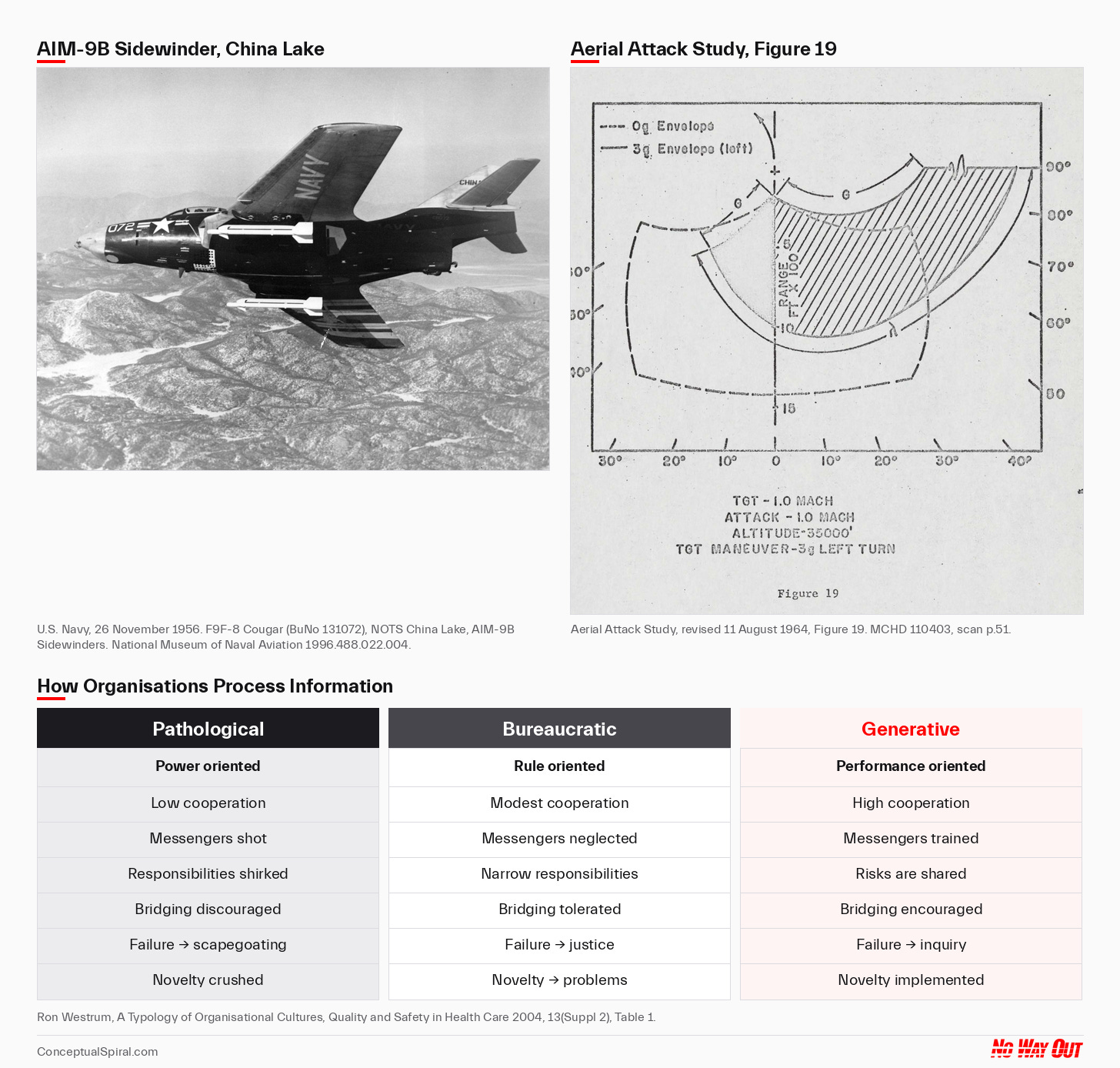
Mobilize tells the story of the AIM-9 Sidewinder. Ron Westrum wrote the book on it, Sidewinder: Creative Missile Development at China Lake, and he joined us on No Way Out #70. We talked about Sidewinder, Skunk Works, information flow and why innovators keep running into the bureaucracy around them. Ron put the healthy version this way: “the generative organization always tends to concentrate on the receiver of the information. What do they need? How is it going to help them? Do they understand the significance?”
Notice where that points. It starts with the receiver, the customer, and works back. I’ll tie that to Lean and TPS later.
Mobilize also tells how the Skunk Works delivered the P-80 in 143 days. Shyam doesn’t get into the engine, so this part is mine. The prototype was built around a British engine, the de Havilland Halford H-1B, later called the Goblin, and a lot of people don’t know that part of the story. When the first engine was wrecked in a ground run, a replacement had to be shipped to the United States before the XP-80 could fly.
I was fortunate to go to the UK last year and learn more about British jet engine design and how that engine helped us build the P-80. It was one of our advantages, and we only had it because an ally had it and shared it. Mobilize keeps coming back to the same lesson in its competition stories. Open the system up to allies, rivals and new ideas, and things move faster.
Boyd’s Aerial Attack Study
Boyd connected to the AIM-9 Sidewinder too. At the end of the 1950s he was an instructor at the Air Force’s Fighter Weapons School, and there he wrote the Aerial Attack Study, a 150-page manual of fighter maneuvers and counter-maneuvers. It included a section on the basic limitations of the AIM-9B Sidewinder. In 1960 Tactical Air Command picked the Aerial Attack Study as the Fighter Weapons School’s training text, and it came to be called the bible of air-to-air combat.
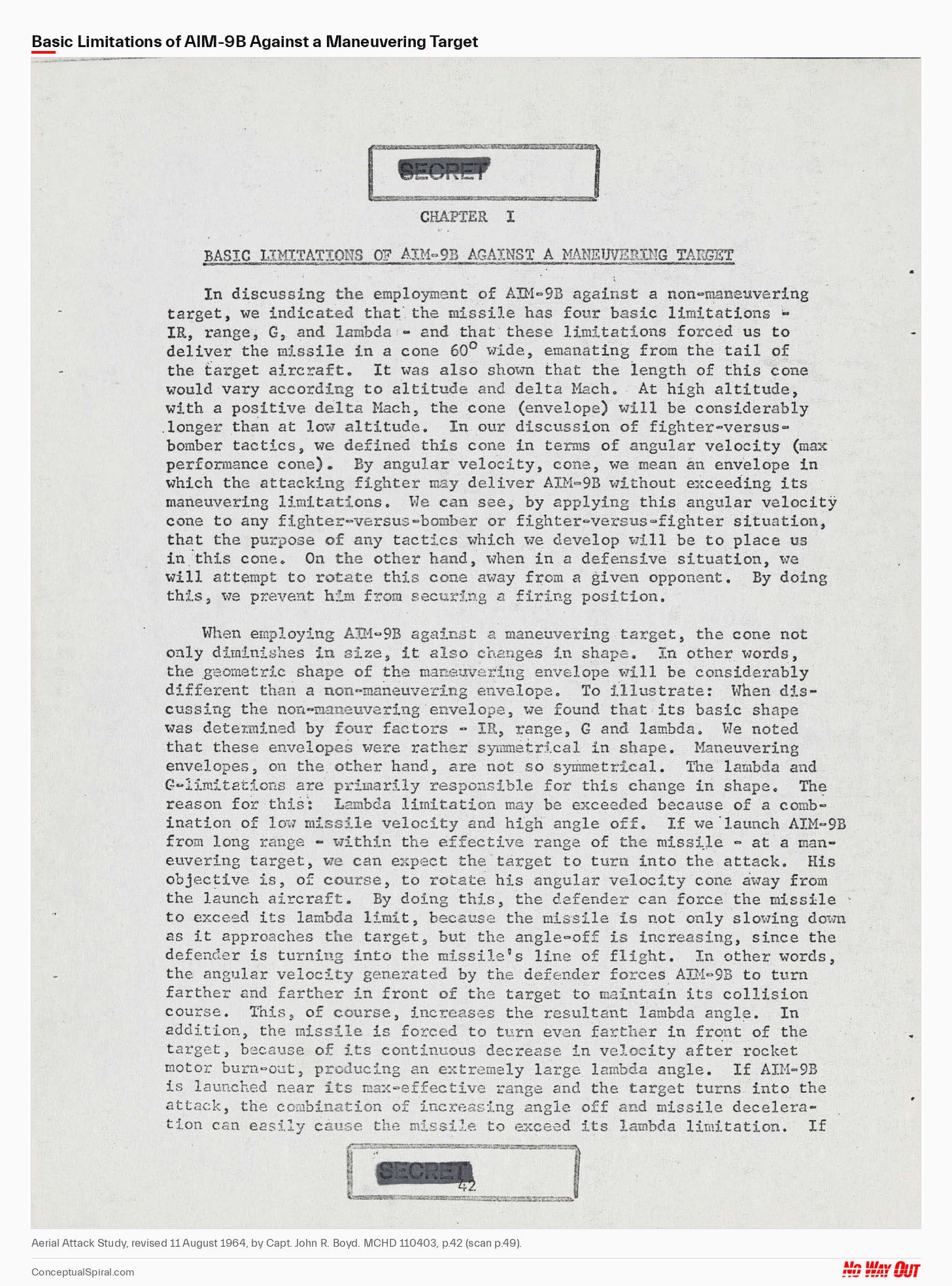
That matters because the study turned air combat into something you could write down, study and teach, move and counter-move. In Boyd’s words, at the Weapons School “it was used as our teaching document.” That’s verbal knowledge and procedural knowledge together, a distinction Pete Blair walked us through on No Way Out #186. A new idea changed how the Weapons School taught pilots to fight, and nobody needed a new airplane for it. Two years later Boyd was at Eglin, working nights on E-M theory.
TOPGUN and the Complex Adaptive System (Person) in the Cockpit
There’s one more story about competition in the military I’d add to the ones Shyam tells. It gets overlooked, and it involves Boyd’s E-M theory.
In 1968 the Ault Report looked hard at what was going wrong in the air war over Vietnam, and on 1 March 1969 the Navy stood up its Fighter Weapons School, TOPGUN. CAPT Dan “Yank” Pederson was there from the start. He wrote about the report in his book, TOPGUN: An American Story, and in 2025 I visited him at his house to record No Way Out #125. TOPGUN was a lean startup. A small group of mavericks, under-resourced, given the freedom to focus on the mission.
By then the U.S. Air Force had been using Boyd’s E-M theory for several years to compare its fighters, the F-4 among them, against the MiG-17 and MiG-21. Boyd started that work in 1963 and 1964, and both services were flying the F-4. When I sat down with Yank, I agreed with his assessment that E-M was also informing how the Air Force thought about how to fight. The Air Force was still flying Fluid Four, the four-ship formation it had used in World War II and Korea, while the Navy was moving to the two-plane loose deuce. In TOPGUN: An American Story, Yank wrote that the message from Boyd’s E-M briefings was that we couldn’t fight a MiG.
A TOPGUN Maverick Takes On an Air Force Maverick
The rest of the story comes from Yank and from my own time in the community. It’s a TOPGUN maverick taking on an Air Force maverick.
Yank picked eight instructors for TOPGUN. One of them was Mel Holmes, in Yank’s words “probably the brightest guy in aerodynamics, jet aerodynamics,” and Mel was the one who took on Boyd. He met Boyd while Boyd was briefing E-M theory on how to fight. The TOPGUN pushback was simple. You’re forgetting the person in the cockpit, the heart, skill and drive of the pilot. In complexity terms that person is a complex adaptive system, and an energy chart has no place to put one.
Yank told us that story on No Way Out #125. I haven’t found any of it in Boyd’s papers, so this part is Yank’s account and mine. In that account, TOPGUN focused on the people, while Boyd was fixated on a closed system, his E-M theory.
So Where Did the OODA Loop Come From?
Most accounts of where the OODA loop came from start with Boyd in Korea, flying the F-86. The path runs somewhere else. It goes through the lightweight fighter prototypes, the YF-16 and the YF-17, and then through the question Robert Coram raises about creativity, which is why Boyd came up with something others didn’t. The TOPGUN story shows Boyd fixated on an engineering approach, like a lot of engineers today. Where he ended up shows in the loop he went on to build. Fast transients sit on that path. Boyd’s 1981 Patterns of Conflict defines fast transient maneuvers as an “irregular and rapid/abrupt shift from one maneuver event/state to another.” In 2010, Steve Blank wrote that “The Customer Development model that I write and teach about is the entrepreneur’s version of Boyds’ OODA loop,” and he writes that “John Boyd’s OODA loop is at the core of Customer Development and the Pivot.” Eric Ries defines a pivot as “a structured course correction designed to test a new fundamental hypothesis about the product, strategy, and engine of growth.” In 2019, I wrote about “the concept of fast transients (pivot) in the Lean Startup.” The pivot is a fast transient for a startup.
Boyd’s own papers hold a detail that would make the book’s E-M story even richer. Roger Spiller wrote a critique of Patterns of Conflict that traced the OODA loop to Korean War dogfights between the F-86 and the MiG-15. Boyd disputed it. Next to the passage he wrote “No” in the margin, and then: “OODA Loop came from work and anomalies associated with evolution and flight tests of YF-16/17.” That page sits in his papers at the Marine Corps History Division.
What Boyd Said in 1977
He told the same story in his Air Force oral history, recorded on 28 January 1977. Partway through the interview he walked the interviewer through what he called “a condensed version of the briefing,” and he named it: Patterns of Conflict. So the briefing already existed in early form by then. It came about, he said, “when we had some arguments relative to analysis between simulation and the real world; the real world and the mock world in air-to-air combat.” They had E-M analysis and both manned and digital simulation, and the results still didn’t line up with “what the pilots said.”
Then someone at NASA called him, concerned that Boyd “was siding too much with the fighter pilots and was not paying enough attention to the simulation.” Caught between the models and the pilots, Boyd went back to an idea he had been carrying for a long time. It gave him “a whole new concept for air-to-air combat,” and that idea, he said, “led to warfare when I expanded on it.”
Coram and the Search for Creativity
Robert Coram adds a second thread. He writes that Boyd became obsessed with “trying to understand the nature of creativity,” a search that started when he wondered how he’d come up with E-M theory in the first place. In Coram’s words, “E-M is at heart such a simple thing; why had no one else discovered it?”
In April 1972 Boyd left for his combat tour in Thailand, a year in command at Nakhon Phanom Royal Thai Air Force Base. By the time he came home, Coram says, he was deep in “an obsessive search for the nature of creativity.” That search produced something you can hold in your hand. On 3 September 1976 Boyd finished Destruction and Creation, the short paper Coram says he had been working on since 1972, on how we break ideas apart and recombine the pieces into new ones.
Boyd’s margin note puts the origin of the loop in the YF-16 and YF-17 flight tests. Coram puts it on a longer path. They tell one story. The anomalies in those flight tests, the fights between simulation and what pilots said, and the TOPGUN pushback on the person in the cockpit were reorienting events. Each one tested how well orientation matched reality, and each one showed the gap between the model and the environment.
What Military Doctrine Taught Us
Read the chapter 13 quote again: “focus on speed and the OODA loop.” I understand why Shyam and Madeline wrote it that way. Boyd briefed tempo himself.
But the wording changed over time, and the change matters. In the 1977 oral history, walking through that early Patterns of Conflict, Boyd talked about getting inside “our adversary’s observation-decision-action time scale.” There’s no orientation in it yet. In the later versions of Patterns of Conflict, the ones collected in A Discourse on Winning and Losing, he told audiences to “operate inside adversary’s observation-orientation-decision-action loops.” Shyam’s line reads those later briefings accurately. It’s also what doctrine taught all of us.
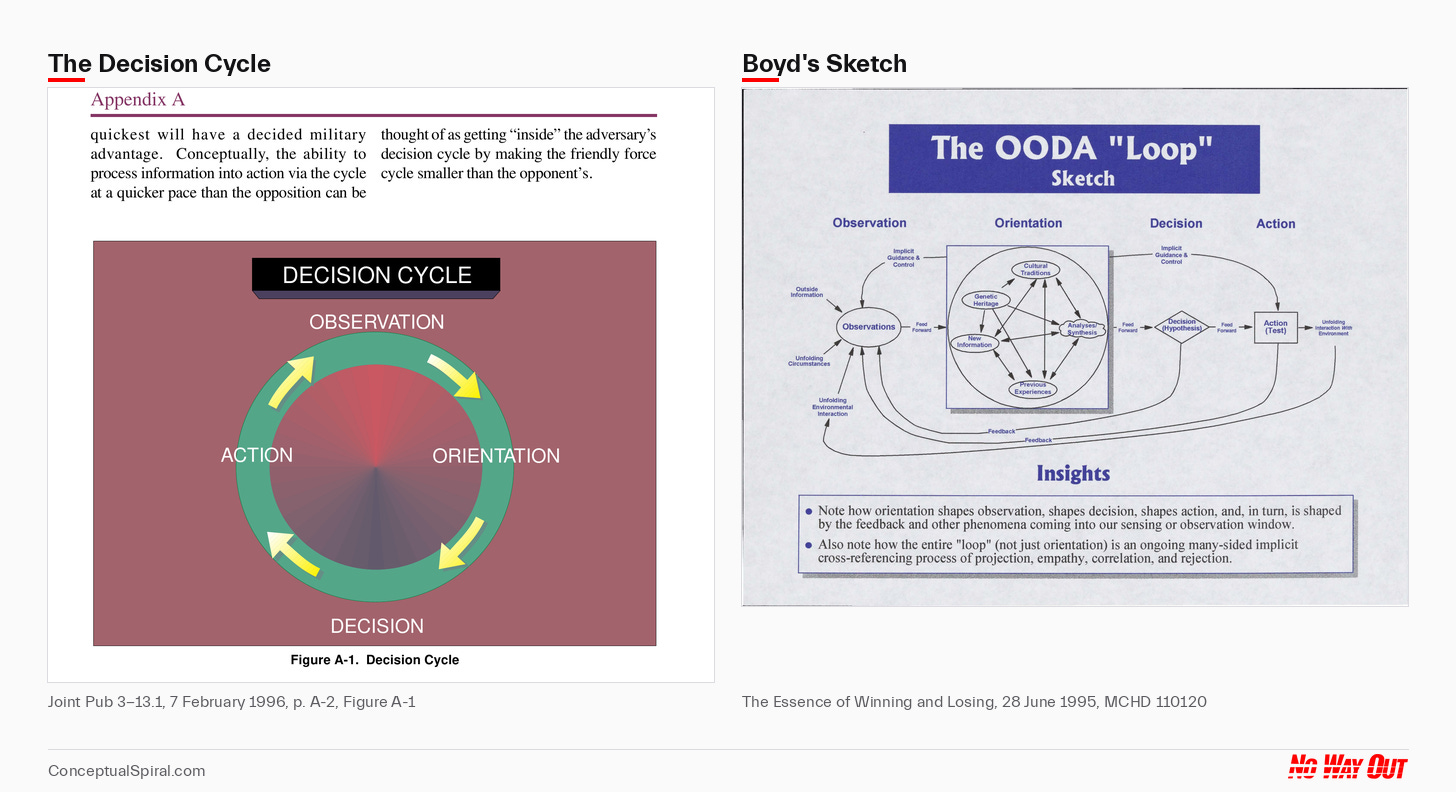
Boyd’s sketch of the loop is in The Essence of Winning and Losing, which he dated 28 June 1995. In February 1996, Joint Pub 3-13.1 printed a four-step ring, called it the decision cycle, and gave the advantage to the commander who could move through it quickest. That’s the loop most military leaders learned, and it’s the version Silicon Valley picked up in Scrum and the Lean Startup. Nobody set out to get Boyd wrong. The four-step version fits on a slide, institutions compress ideas to fit the slides they have, and the compressed version is the one that spread.
Orientation at the Center
Boyd’s loop goes much deeper. He put orientation at the center, and his sketch shows implicit guidance and control running from orientation straight to observation and to action, skipping decision. Observation in that sketch stands for our senses. So those pathways tie orientation back to what we sense, and they let us act without stopping for deliberate decision-making.
What they describe is perception and action coupled between an agent and its environment, and that coupling is where flow comes from. Steven Kotler, Michael Mannino, Karl Friston and Scott Kelso describe flow the same way in Neuroscience of Consciousness (2026): “In flow, conscious representations of sensory inputs and outputs are tightly coupled to largely nonconscious, automatic processes honed through experience.”
Boyd wrote his own note under the sketch: “Note how orientation shapes observation, shapes decision, shapes action, and, in turn, is shaped by the feedback and other phenomena coming into our sensing or observation window.” So when someone says “OODA loop,” ask which one they mean. There’s the closed loop doctrine printed, and there’s the open-system loop Boyd sketched, with its feed-forward, feedback, and implicit guidance and control pathways.
Speed Comes From Orientation
This is the critical argument, and it’s where the real loop would do the most for Mobilize.
In the real loop, the speed we show comes from how well we’re coupled to the environment, and that coupling is shaped by our genetics, our culture and our experiences. Orientation holds the coupling together. We build it by staying open to the environment, getting feedback and learning from it. That’s why healthy competition helps. It means more learning, sooner.
Boyd saw this back in 1981. In Patterns of Conflict he described a German system that “emphasized implicit over explicit communication.” The secret, he wrote, “lies in what’s unstated or not communicated to one another,” and it let them “reduce time, exploit lower-level initiative, and gain quickness.” In Organic Design for Command and Control, first written in 1982, he wrote: “Orientation shapes the character of present observation-orientation-decision-action loops--while these present loops shape the character of future orientation.” Chet recorded how Boyd defined agility in 1988: “the ability to shift from one unfolding OODA loop pattern to another by being able to transition from one orientation to another.”
The same idea tells you what’s at stake in cognitive warfare, which goes after how you form and update your orientation. Speed alone won’t save you there. You can go in the wrong direction as fast as possible. Deterrence, the word at the center of Shyam’s film, works on the same ground, because it shapes what an adversary expects will happen if it acts.
Stay Coupled to the Environment
We build that orientation in training that looks like the real thing. Ecological dynamics calls this representative design. Practice keeps the information people will face in the fight, so they learn to pick up the same cues and act on them, and their perception and action stay tied to the world they’ll operate in. The people running the training shape that learning by designing constraints into the environment, and they keep attention outside, on the environment and the feedback it gives. That’s the same idea you find in TPS and in Boyd’s notes, where control is outside-in and bottom-up.
Safe-to-fail probes come from a different place. They come from complexity theory, and from the Cynefin framework in particular. In a complex system you can’t work out the answer ahead of time, so you run several small experiments in parallel, knowing some will fail and that the failures teach you as much as the successes. From the outside it can look sloppy. It isn’t. It’s how you learn what the system will do.
That’s the point Shyam and Madeline make when they write about competition. That’s what the Sidewinder story shows. The Navy’s AIM-9 Sidewinder competed with the Air Force’s AIM-4 Falcon, aircraft designs competed in the 1930s, and the book even tells the story of the Higgins boat. When several probes run at once and compete, each one learns from the others.
Healthy Competition Keeps the System Open
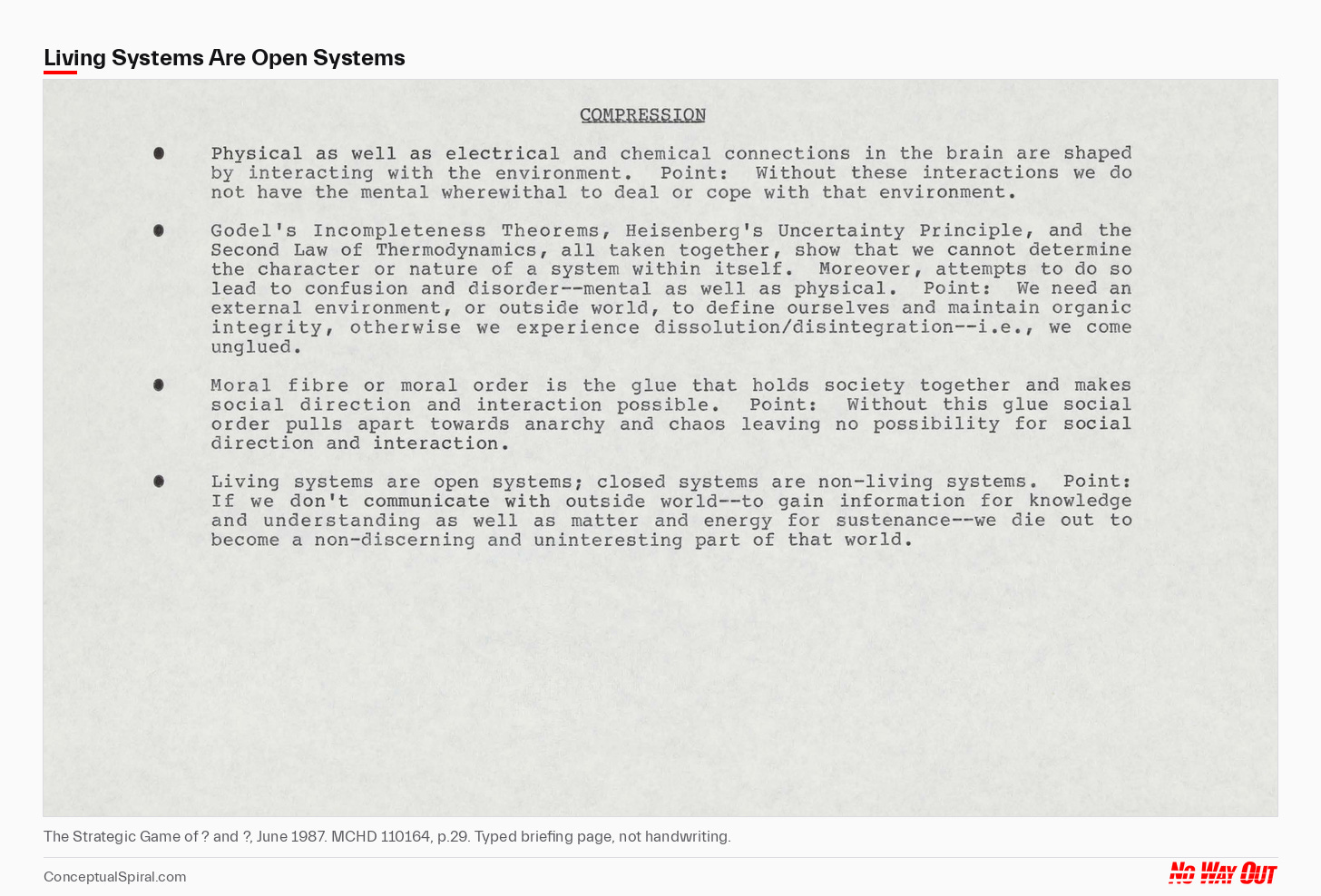
Agile, Scrum and the Lean Startup are trying to do the same thing. They get feedback from the environment and learn from it, and that keeps them open systems. A large language model, once it’s trained, sits much closer to a closed system. So does a requirements process written in a room by people who never go see the work or talk to the people who’ll use what gets built. Boyd put it plainly himself in his 1987 briefing The Strategic Game of ? and ?: “Living systems are open systems; closed systems are non-living systems.”
Shyam and Madeline point to this when they write that our exercises need opposing forces that can win. I’d go further. We need more red air, opposing forces of pilots and AI agents that fight as the enemy in training. We need representative design, and we have to be willing to lose in these exercises, because we learn more from losing in front of others. Anyone who has sat through a debrief after getting shot in the first minute of a fight knows that one. The challenge also has to keep stretching our skills. Mihaly Csikszentmihalyi found that flow shows up when a high challenge meets high skill, and a training environment that never pushes past what we can already do won’t get us there.
If you’ve been following our conversations about ecological dynamics and the constraints-led approach on No Way Out, this is exactly what’s happening in elite sport. You don’t wait for the game. You bring the game into practice. I made the same case to basketball coaches in The Other Team Has a Vote, and I have yet to see a three-man weave work when the other team has a vote.
The work is to slow down and rethink how we organize, train and equip, and to push decisions to the people closest to the fight.
Three Key Influences Doctrine Left Out
Three influences behind Boyd’s loop bear directly on the ideas in Mobilize, and the book leaves them out, largely because joint doctrine and the internet tell an incomplete story of the OODA loop. The real loop is inspired by cybernetics, early complexity theory and the Toyota Production System.
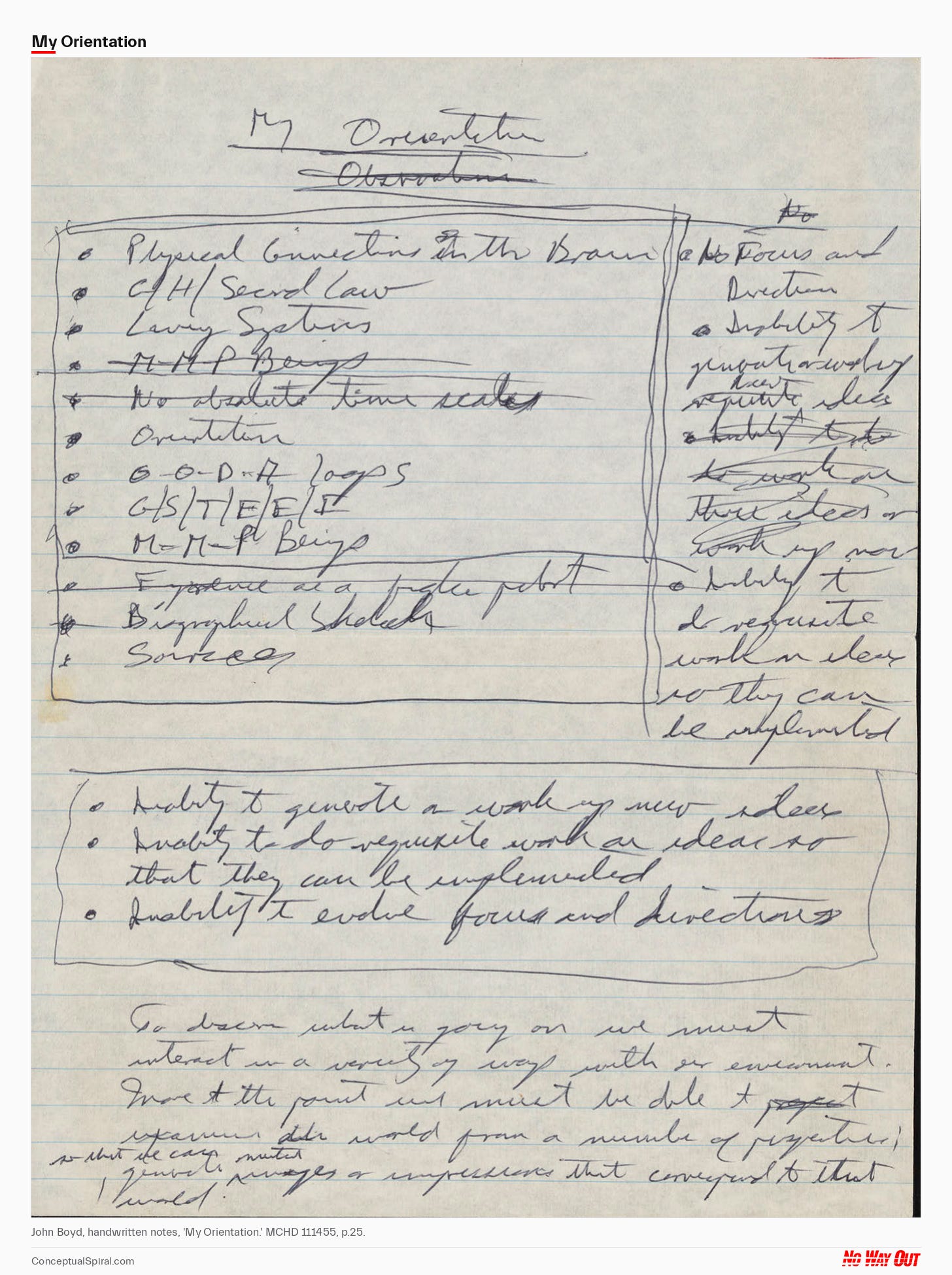
There are others. Neuroscience and quantum physics are two. In The Strategic Game of ? and ?, Boyd wrote that “physical as well as electrical and chemical connections in the brain are shaped by interacting with the environment.” In his handwritten notes, a page headed “My Orientation” lists “Physical Connections in the Brain” in its first box. Still, cybernetics, complexity and TPS are the ones that connect most directly to what Shyam and Madeline care about.
Cybernetics is the study of how feedback steers living things and machines. The autonomous vessels and factories in Shyam’s film, and the systems Anduril builds, sense and act, so feedback is already their engineering language. Boyd’s 1995 sketch speaks it too. It runs on feed-forward and feedback, and Boyd labeled decision a hypothesis and action a test. The idea was with him long before the sketch. Maxwell Maltz’s Psycho-Cybernetics is in the bibliography of Destruction and Creation, and in The Conceptual Spiral, Boyd described testing new ideas against the world as “an analytical/synthetic feedback loop for comprehending, shaping, and adapting to that world.”
Complexity Was on His Shelf
Boyd didn’t use the phrase “complex adaptive systems” in his briefings. Complexity was on his shelf anyway. A handwritten book list in his papers includes Murray Gell-Mann’s The Quark and the Jaguar, Klaus Mainzer’s Thinking in Complexity and Brian Goodwin’s How the Leopard Changed Its Spots: The Evolution of Complexity. The Marine Corps History Division’s finding aid for his library lists Goodwin’s book among the volumes it holds. Grant Hammond writes that Boyd “addressed a collection of Nobel Prize winners at the Santa Fe Institute,” where much of complexity science took shape. His closing slide in The Essence of Winning and Losing says his key statements, the loop sketch and related insights “represent an evolving, open-ended, far-from-equilibrium process of self-organization, emergence and natural selection.” That’s complex adaptive systems in all but name.

In a complex system the behavior comes from the interactions among the parts. That’s why I said the teaming skills matter more than the Scrum events, and it’s why the Agile Manifesto put “individuals and interactions over processes and tools.” Rebuilding the arsenal is that kind of problem. It starts with the people and how they interact. The whole is greater than the sum of the parts. You see that in a high-flow team sport more clearly than you do in wrestling.
Boyd Argued With the Lean Authors
Then there’s manufacturing.
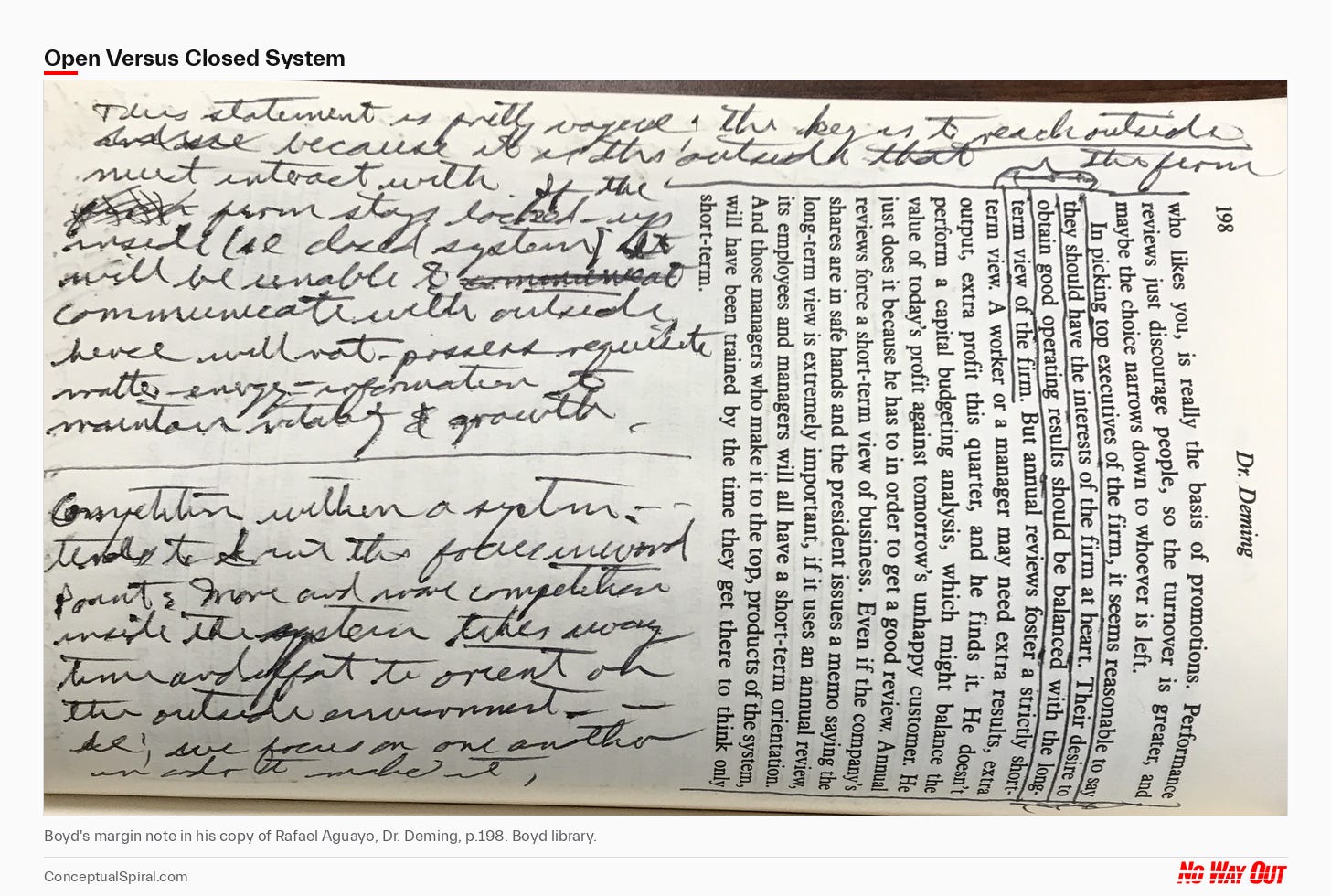
Boyd studied the Toyota Production System in depth, and he argued with the Lean authors in the margins of their own books. The Machine That Changed the World is the book that made the word “lean” famous. In his copy Boyd wrote that the authors “did not come to grips with” Taiichi Ohno and the Toyota Production System. They didn’t understand, he wrote, “how to make snowmobiles,” his image for pulling ideas apart and recombining them into something new. In the same book he wrote: “Japanese totally inside Detroit OODA loop; why? We read Japanese thru our orientation while Japanese exploit our orientation & theirs by knowing both.”
Masaaki Imai’s Kaizen has a table that sets innovation against kaizen. Boyd bracketed it and wrote beside it: “This is not necessarily true. Both Ohno’s & my own work blow these juxtapositions apart.” That note is why Shyam’s kaizen language and his innovation stories belong in the same book.
Control Is Outside-In and Bottom-Up
Here’s where the threads come together. In the same copy of Kaizen, Boyd wrote that if you look at it the way Taiichi Ohno did, “the customer or subsequent process controls the producer/or previous process.” In other words, he wrote, “control is really exercised by the environment (customer).” Then he wrote that control is “outside-in” and “bottom-up,” and summed it up: “command may be top-down but control is bottom-up.”
That thread runs through this whole piece. Ron Westrum’s generative organization concentrates on the receiver. Steve Blank sends founders out of the building to the customer, and Eric Ries builds the loop around what customers actually do. A Scrum team faces the customer. A strike package faces the threat. Each one lets the environment do the controlling, which is the opposite of a requirements process run from the top down and from the inside out. That’s the system Mobilize wants to fix.
According to a recent exchange I had with Jeffrey Liker, Lean is about a healthy system, and it has been taken the wrong way. That may be why Boyd was so fascinated with Ohno and Shigeo Shingo. It matters for Mobilize, which wants to bring manufacturing back to the United States. If we’re going to rebuild the arsenal at home, this is the kind of manufacturing to bring back. Palmer Luckey told an AIAA audience, as Defense News reported in October 2026, “We need to design missiles that can be made in car factories. We need to design aircraft that can be made in tractor factories.” The car factory is where TPS was built. Chet Richard and I pulled Boyd’s notes together in The OODA Loop and Lean: What John Boyd Wrote in the Margins.
Gemba Over Gantt
Shyam also explains why Palantir, where he’s CTO, doesn’t hire project managers. He wants people with real experience, people who know what’s going on, and he makes the point that putting somebody in a room to come up with a project plan doesn’t work. I’d put it this way: gemba over Gantt charts. Gemba is the word TPS and Lean use for the place where the work actually happens. You go there, you see it, and you improve it a little every day. That’s control from the outside in, and it puts people before plans.
Keep those three influences in mind and the book opens up. We start looking at AI as something closer to active inference, with world models connected to the world and room for counterfactual thinking. We look at leadership differently too, at how systems drive behavior and how our actions and feedback loops shape the way we think.
What Got Cut in the Navy
The military needs to become more adaptive and more agile, and to embrace its mavericks, the people who want to do something rather than be part of the system. That’s the heart of the book.
I tried to push the Navy that way. After the 2017 collisions at sea, I volunteered for recall to active duty. I served on the Secretary of the Navy’s Industry Best Practices and Learning Culture team, which looked at how industry builds a better culture, and I led our engagements with academics and executives. We were one of seven Readiness Reform Working Groups set up to carry out the recommendations of the Navy’s Comprehensive Review and Strategic Readiness Review. Over six months we met with 30 companies, 11 academic experts and the leaders of 29 Navy commands. We wanted a Navy whose leaders and teams learn and adapt faster.
Most of it went into our report, The Competitive Advantage of Learning Culture. Not all of it. The OODA loop, the Cynefin framework, Red Teaming and Wardley mapping were all cut by senior Navy leaders, the very people Mobilize describes, the ones focused on their next promotion, the ones who want to be somebody. Boyd put that choice to young officers in what Coram calls his “To Be or to Do” speech: “To be somebody or to do something.” I was a commander (O-5) at the time, and I was fired for speaking out. The admiral in charge brought me back in.
Later, Nigel Thurlow, John Turner and I got to correct that when we created The Flow System, which puts those ideas back in.
What I Saw at DIU
My last Reserve duty was with the Defense Innovation Unit (DIU). I wanted that assignment badly, and I got it. I took leaders from DIU and the National Security Innovation Network through Wardley mapping, whose strategy cycle draws on the OODA loop and Sun Tzu. The pairing fits. Boyd studied Sun Tzu and opened the historical patterns in Patterns of Conflict with him. A map forces you to pick an anchor, the user, talk about their needs and look at how each piece on the map evolves. It starts outside, with the user, just like Ohno’s customer, and it connects to Boyd’s idea that strategy is “a mental tapestry of changing intentions.”
The map showed that DIU exists because we have a broken system. It works as a brokerage around that system more than as an innovation unit. Shyam brings up DIU in Mobilize as a positive, and I agree it is. But innovation comes from people who have the necessary constraints placed on them and the freedom to self-organize, wherever they sit and whatever their organization is called. I don’t know what DIU is today.
The Neuroscience Connection Few Understood
I pushed another idea at DIU. The OODA loop is tightly connected to active inference, a theory from neuroscience that says the brain is always predicting what it will sense next and acting to keep those predictions true. You may know it as the Bayesian brain or predictive processing. At the time, few people knew what I was talking about. They were fixated on large language models, the “stochastic parrots” that map so easily onto the four-step OODA loop. Today there are pockets of people who get it.
The connection runs through cybernetics. Boyd labeled decision a hypothesis and action a test, and active inference says a living system does the same thing. It acts to test its predictions, and the feedback tells it when its model is off. Mark McGrath and I walked Karl Friston, the neuroscientist behind active inference, through Boyd’s sketch on No Way Out #164. He put it this way: “all my active engagement in the world is just soliciting the right observations that enable me to disambiguate and test my hypotheses.” Then he added, “this [the real OODA loop] is isomorphic with active inference.” Isomorphic means the same structure.
AI, the Bubble and the E-M Parallel
AI is where this matters most, because most of the AI we build today looks like doctrine’s closed loop. A large language model learns from its training set, and once it’s trained, its connection to the world it works in is thin and slow. Scaling it up doesn’t change that.
On #125 I told Yank that early E-M theory works like a large language model, because it doesn’t change and it’s built on the data put into it. E-M is an engineering model, powerful inside its limits. What it couldn’t hold was the person in the cockpit, the point Mel Holmes pressed, along with the anomalies that showed up in the YF-16 and YF-17 flight tests. When that closed model ran out, Boyd’s thinking moved to the real OODA loop, which stays open to the world, keeps learning and reorients.
We may be in the middle of an AI bubble. If we are, it comes from leaning too hard on an engineering approach that looks like that same closed loop. Adding more data and more computing power extends a closed model without giving it an orientation, a generative model that stays connected to an ever-changing environment. If investors keep betting that scale alone will close that gap, a bubble follows. The real loop will change the way we look at software, artificial intelligence and human-machine teaming.
Generative Models and Generative Cultures
In active inference, the model at the center of a living system is called a generative model. Machine learning uses the same term for something different. Engineers call large language models generative because they generate text and images from what they were trained on. In active inference the generative model is the brain’s working model of the world, and it keeps updating when the world pushes back. That’s Boyd’s orientation.
Ron Westrum uses the same word for the healthiest culture in his model. Pathological organizations are oriented to power, bureaucratic ones to rules, and generative ones to the mission, with information flowing to whoever needs it. A generative organization does at the scale of a team what a generative model does in a single brain. It keeps updating its picture of the world. If Mobilize wants a defense industrial base that learns, that’s the kind of orientation it needs at the center.
Building AI and Leaders With the Real Loop
Boyd’s work goes beyond what Mobilize showcases, and it informs how we should develop AI and how we build better leaders.
For AI, it points toward systems that stay connected to the world, with a generative model at the center, in the active inference sense, that updates when the world pushes back. That’s the direction Karl Friston described on #164. The autonomous vessels, hypersonic vehicles and factories in Shyam’s film are systems that sense and act, which makes cybernetics a sensible place to start.
For leaders, it points toward training that keeps people coupled to the environment. That’s the constraints-led approach (CLA) from ecological dynamics, with representative design, plus the parallel safe-to-fail probes that come from complexity theory, plus opposing forces that can win. Shyam and Madeline ask for exercises like that, and they want people with real experience in the room. We build better leaders by putting them in that kind of environment, with the right constraints, and letting them learn from it.
Reorientation and Healing
There’s also a strong connection to mental health, and to the veterans suffering from PTSD. Active inference gives us a new way to look at PTSD, and Adam Linson and Karl Friston have already modeled it this way (Cognitive Neuropsychiatry, 2019). In their account, trauma leaves a person with strong expectations of threat, so an ambiguous sound can set off fight or flight before they check what’s really there. In Boyd’s terms, that’s orientation driving action down the implicit path before observation can correct it.
Robin Carhart-Harris and Friston have also proposed that psychedelics relax the grip of rigid, overweighted beliefs so the brain can revise them (Pharmacological Reviews, 2019). We’ve had several conversations on No Way Out about psychedelics and active inference, including with James Giordano, Karl Friston and Jonathan Dickinson. When we asked Karl about it, he said “sometimes it’s useful to relax the precision of deeply held convictions, prior convictions if they’re no longer fit for purpose.” In Boyd’s language, that’s reorientation.
Luttrell, Ibogaine and TBI
That’s also why Marcus Luttrell belongs in this article. Luttrell is the Navy SEAL whose book became Berg’s Lone Survivor, the story of Operation Red Wings in Afghanistan, and he has talked publicly about later going through ibogaine treatment. Luttrell has said on his podcast that the treatment hit him hard, comparable in impact to being thrown off a mountain with his team dying around him.
The real OODA loop helps explain why psychedelic-assisted therapy can matter for PTSD and for traumatic brain injury (TBI). In January 2024, Stanford researchers reported in Nature Medicine on 30 special operations veterans with TBI who received magnesium-ibogaine therapy in Mexico. They found large drops in PTSD, depression and anxiety scores a month later. The study was observational, and the authors said controlled trials are still needed to test safety and efficacy.
Ibogaine is also a Schedule I drug in the United States, and the same paper notes that it “has been associated with instances of fatal cardiac arrhythmia.” That’s why the treatment pairs it with magnesium: “coadministration of magnesium may mitigate this concern.”
No Way Out
If any of the ideas in this article are new to you, it may be time to tune in to No Way Out. The show takes its name from a line in Boyd’s The Conceptual Spiral. In that briefing he listed the features that keep our world uncertain, everchanging and unpredictable. His list includes quantum uncertainty, the entropy of the second law of thermodynamics and mutations in evolutionary biology. It includes the ambiguity of natural languages, and the novelty that comes from “unique individuals and their many-sided interactions with each other.” Then he wrote: “There is no way out, unless we can eliminate the features just cited.”
We can’t eliminate any of that. So, in Boyd’s words, we “must continue the whirl of reorientation, mismatches, analyses/synthesis over and over again.” That’s why I wrote this.
An Invitation to Shyam, Peter Berg and Palmer Luckey
On Hugh Hewitt’s show in December 2024, Shyam said, “How do we have a substantially better OODA loop than our adversary? That is, in fact, a software problem. It’s a problem that John Boyd would recognize.”
Shyam, you’ve made a strong case for reform. Come on No Way Out. Let’s talk about the cybernetic angle, how it connects to AI, what it means for PTSD and TBI, and the bigger picture, well beyond a decision process. Here’s the question I most want you to answer: what would Mobilize look like with orientation at its center?
Peter, your film puts the case for rebuilding industrial strength in front of a large audience. Come on No Way Out and tell us what made you want to tell it, and let’s talk about how Boyd’s work can add to it.
Palmer, you build autonomous systems and you’re co-leading Project Meridian. Come on No Way Out and let’s talk about orientation, training and how we build systems that learn.
To the founders and builders in AI and manufacturing, and to fellow podcast hosts and publishers: Boyd’s real loop is a bigger story than one article. If you want to dig into it, get in touch. What Mobilize and the film describe is what we do on No Way Out.
To everyone else, read Mobilize with Boyd’s real loop in mind. You’ll see how close it already is to my Boyd top 10.
No Way Out Episodes in This Article
No Way Out #10, Alistair Cockburn: “Agile & OODA Loop: Agility as an Outcome”
No Way Out #60, Jeff Sutherland: “Peak Performance for Agile Teams with the Co-Creator of Scrum”
No Way Out #67, Hal Sundt: “MICC Reformers: Sprey, Boyd, Spinney, Kay, Christie and the A-10”
No Way Out #70, Ron Westrum: “Westrum’s World: Culture, Information Flow and Innovation”
No Way Out #125, CAPT Dan Pederson: “The Man Who Founded TOPGUN on John Boyd and Algorithms”
No Way Out #16, Chet Richards: “Chet Richards on John Boyd, the OODA Loop, Zen and Lean”
No Way Out #185, James Giordano: “Neuroweapons Are a Reality: Cognitive Warfare and the OODA Loop”
Excellent. I read this with Trump’s meeting with Xi and Putin running in the background of my mind. One of the things that is said of Trump is that he is playing 3D chess while everyone else playing checkers. The speed of change that he has brought to Washington the past two years makes me wonder if there is such a thing as 3D OODA loop. Mobilize sounds like that. If we think of the world as a large tent with the globalist system as the central tent pole. It would seem that Trump is circling the tent pulling up all the stakes that hold the tent pole in place. The globalists know the tent is collapsing. They haven’t figured out why. Demonizing Trump has not secured the tent pole. It is really bad orientation.