


Originally published in The Whirl of ReOrientation on December 9, 2025.
With my background in fighter aviation, my work with The Flow System, and my deep study of John Boyd’s OODA Loop—a corpus of briefs and a sketch of how living systems interact with their environment to create novelty—I’ve witnessed firsthand how teams become ensnared in outdated assumptions, fostering strategic blind spots that erode adaptability in fast-evolving landscapes.
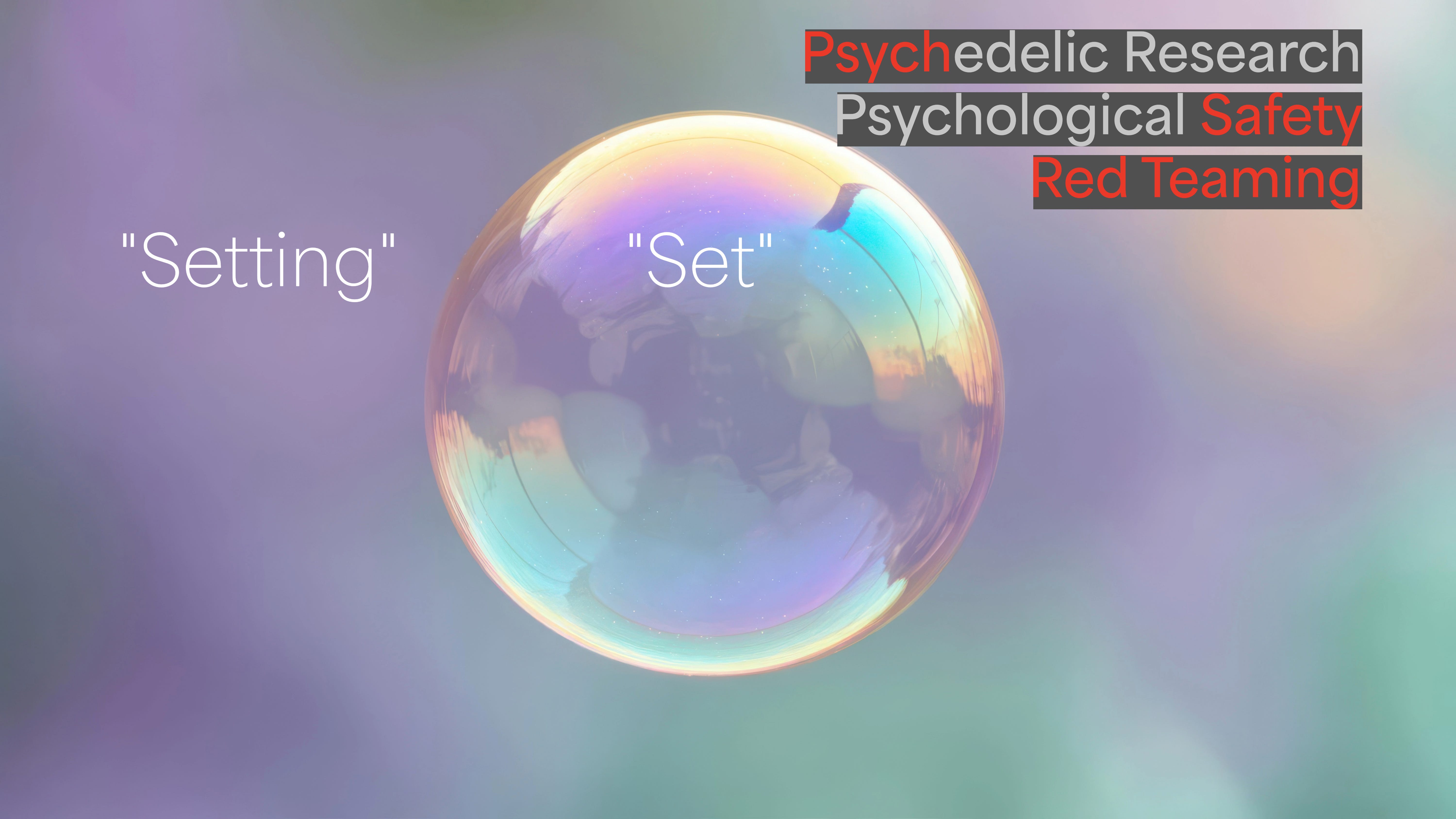
Let me be clear: this isn’t an endorsement of psychedelics for recreational use—they remain Schedule I substances in the U.S., and their application carries significant legal risks. Instead, it’s an opinion on how insights from psychedelic science can illuminate better leadership practices. A November 30, 2025, paper in Philosophical Psychology, “A Causal Pluralist Theory of the Interaction of Substance, Set, and Setting in Psychedelic Experience,” builds on the REBUS model (Relaxed Beliefs Under Psychedelics) by Robin Carhart-Harris and Karl Friston. It argues that psychedelics don’t merely tweak brain chemistry; they entwine with our internal mindset (set) and external environment (setting) to loosen entrenched beliefs. This enactive view—grounded in predictive processing and active inference—echoes what effective Red Teaming and psychological safety accomplish in organizational contexts.
The REBUS Model: Relaxing the Grip of Prior Beliefs
The REBUS model posits that psychedelics dial down the precision of high-level prior beliefs—those rigid convictions about our identities, world views, and realities. It’s akin to a temporary ego melt, paving the way for unfiltered insights. In predictive processing, our OODA loops churn out forecasts (decisions) from past data (Orientation) to quash surprises (New Information); when those forecasts ossify, innovation stalls.
Psychedelics, per the model, ramp up brain entropy, inducing a malleable state where habitual thought patterns loosen. This isn’t isolated neurology; it’s enactive, arising from the brain-body-world dance. The paper champions causal pluralism: the medicine is just one thread. “Set” captures internal elements like intentions, moods, and traits, while “setting” covers the physical, social, and cultural milieu—complete with affordances, those relational possibilities for action that the environment offers up, shaped by our needs and the world’s latent properties.
In my view, this directly parallels Red Teaming—the cognitive discipline I champion for probing assumptions and forging adaptive strategy. Red Teaming is about mitigating cognitive biases and enabling critical thinking by using methods that deliberately relax (or aim to relax) the weight we place on over-learned beliefs. Much like psychedelics might attune an individual to novel affordances in their surroundings, Red Teaming tunes teams to overlooked opportunities, dismantling maladaptive ruts that choke creativity.
Psychological Safety as the Ultimate Setting
Psychological safety, as Amy Edmondson has illuminated in her Harvard Business Review contributions and her awesome books, is the conviction that a team welcomes interpersonal risks—dissent, vulnerability, bold ideas—sans fear of backlash. Leaders craft this “setting” by sculpting the external environment: norms, rituals, interactions, behaviors, and leadership actions that dial down stress and anxiety. In enactive terms, leaders create affordances—inviting structures in the social landscape that make exploration feel not just possible, but inevitable.
Through a psychedelic prism, elevated stress supercharges pessimistic predictions, morphing ambiguity into dreaded outcomes. The paper highlights how anxiety can bias sensory sampling toward confirmation of fears, entrenching unhelpful priors. Psychological safety flips this script, nurturing a relaxed attractor where teams can roam affordances freely, unhindered by precision-weighted dread.
Set and Setting in Action: Internal Tools Meet External Constraints
In practice, Red Teaming and psychological safety aren’t interchangeable, but they synergize through causal pluralism—the paper’s nod to bi-directional causality across scales. Red Teaming operates as a “set” tool: an internal arsenal of techniques, like Think-Write-Share or Gary Klein’s pre-mortems, that target the psyche’s generative models. These methods, akin to the predispositions and expectations in set, work from the inside out, top-down, to soften ego-bound priors and spark perceptual inference—updating predictions against fresh evidence.
Psychological safety, by contrast, is a “setting” tool: bottom-up control from the environment, outside-in. It imposes context-dependent constraints—social cues, rituals, and relational affordances—that govern how teams engage the world. Without this external scaffolding, even the sharpest Red Teaming tools falter; participants retreat into defensive postures, their priors armored by fear. As the paper frames it via enactive cognitive science, experience emerges not brain-bound but from “bidirectional causality in the person-world system,” where setting acts as a “selective constraint” modulating neural and psychological dynamics. Leaders, then, aren’t mere observers; by tuning these external levers, they enable the very relaxation of beliefs that psychedelics mimic pharmacologically, fostering full-self engagement and fluid active inference.
Picture a pressure-cooker strategy offsite. Absent safety, Red Teaming devolves into theater—safe priors unchallenged. Infused with it, the room pulses with the OODA loop’s enactive vitality: observing unfolding affordances from rivals or markets, orienting through updated world models, deciding on adaptive hypotheses, and acting to reshape reality. The internal-external boundary dissolves, much as in psychedelic states where the environment co-authors perception.
Strategy, Intentions, and the Power of Set
John Boyd cast strategy as
“a mental tapestry of changing intentions for harmonizing and focusing our efforts... in an unfolding and often unforeseen world.”
This dovetails with “set”—our inner compass of expectations and dispositions. In the OODA loop, intentions fuel individual or team orientation (Leader’s or Commander’s Intent), harmonizing predictions, actions and enabling flow. Note: There is a fascinating connection between intent and the Platonic space that I’ll save for another discussion.
Psychedelics heighten this by easing self-referential priors, inviting strategic reinvention. Red Teaming, as a set-aligned practice, questions and refines those intentions, ensuring they’re supple. Psychological safety bolsters it externally, stripping away friction so intentions can iterate unbound.
Too often, leaders render the OODA loop a tidy circle, sidelining its enactive essence—the ceaseless coupling of perception and action with environmental affordances. Yet, as the paper insists, drawing on predictive processing’s enactive bent, the world isn’t passive; it “sometimes closes the perception-action loop that are constructive of experience.” Affordances aren’t static—they’re forged in the agent’s dance with setting (The real OODA loop represnsts this dane)
Lessons for Leaders: Beyond the Trip
For executives grappling with those unforgiving features of the world such as uncertainty, the takeaway is threefold. First, wield Red Teaming as your sober psychedelic: a set of internal tools to infuse entropy into deliberations. Second, engineer psychological safety as your setting—deploying leadership actions to conjure affordances that propel outside-in transformation. Third, weave intentions into strategy, harnessing the OODA loop’s full enactive sweep to surf uncertainty.
I’ve seen these threads yield breakthroughs: teams that Red Team under safe auspices don’t just spot surprises—they exploit them. It’s less about conjuring visions than mastering them via equilibrated priors and actions. Echoing Anil Seth and Anais Nin, “We do not see things as they are; we see them as we are.” By loosening those priors—via Red Teaming’s internal probes, safety’s external embrace, or psychedelic-inspired pluralism—we glimpse the world afresh, spiraling through the whirl of reorientation to triumph.
In this bewildering arena, leaders: Are you curating the set and setting for such alchemy? The strategies that emerge might just be your edge.