


Originally published in The Whirl of ReOrientation on March 19, 2025.
In his iconic Gettysburg Address, Abraham Lincoln described the United States as a nation “dedicated to the proposition that all men are created equal.” As mathematician Jordan Ellenberg writes in Shape, the term “proposition” echoes Euclid’s geometry, where it denotes a fact that follows logically from self-evident axioms—“truths you simply cannot rationally deny” (Ellenberg, 2021). Lincoln, a self-taught student of Euclid, found in geometry a framework for clarity and reason, a pursuit that led him to tackle one of mathematics’ most famously impossible problems: squaring the circle.
Squaring the circle, a challenge posed by the ancients over 2,000 years ago, asks whether a square can be constructed with the same area as a given circle using only a compass and straightedge. Mathematically, this requires solving
x^2=πr^2
where ( x ) is the side length of the square and ( r ) is the radius of the circle. The challenge lies in π, an irrational and transcendental number, which makes an exact solution impossible with Euclidean tools—a fact proven in 1882 by Ferdinand von Lindemann, long after Lincoln’s time (Weisstein, 2023). Geometrically, the task is even more daunting: to draw, without measurements, a circle and a square with precisely equal areas—a feat that even Leonardo da Vinci could not accomplish within the strict constraints of Euclidean geometry.
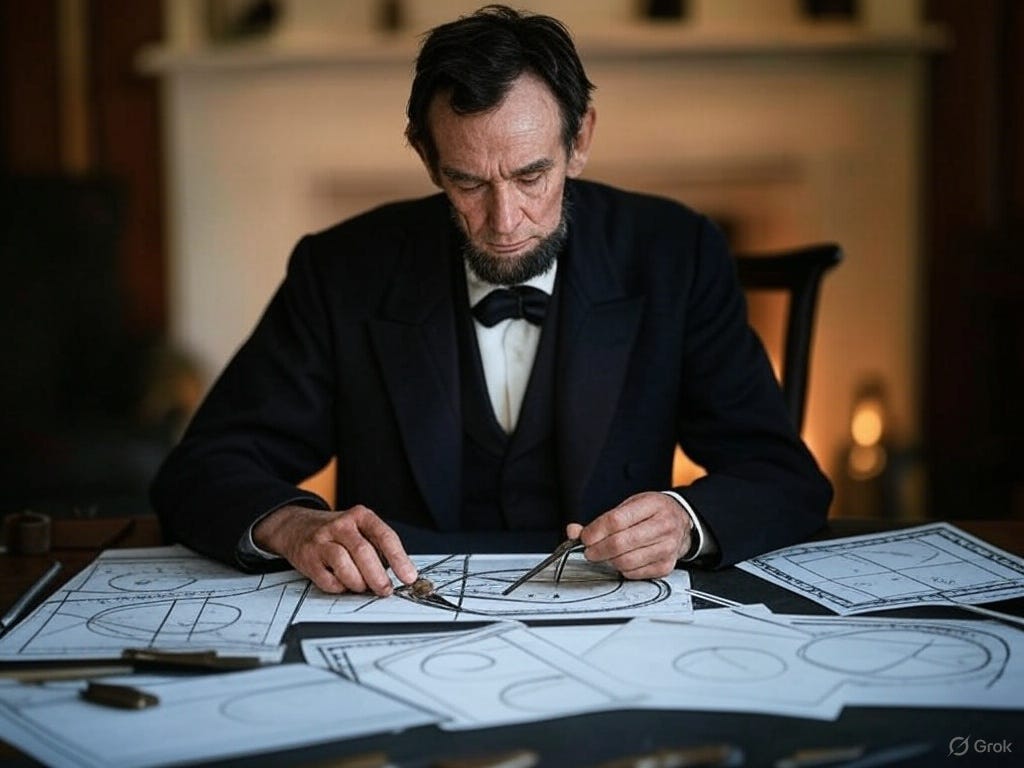
Yet Lincoln, ever the polymath, was undeterred. As Doris Kearns Goodwin recounts in Team of Rivals: The Political Genius of Abraham Lincoln, Lincoln’s law partner, William Herndon, once found him in their office surrounded by “a quantity of blank paper, large heavy sheets, a compass, a ruler, numerous pencils, several bottles of ink of various colors, and a profusion of stationery.” Scattered around were sheets covered with figures, evidence of a monumental calculation. Lincoln, deeply absorbed, barely looked up as Herndon entered. When asked what he was doing, Lincoln replied, “I am trying to solve the difficult problem of squaring the circle.” He had devoted the better part of two days to the task, working almost to the point of exhaustion (Goodwin). Herndon later recalled how Lincoln, during their travels on the legal circuit, would stay up late into the night, his long legs dangling over the edge of a shared bed, a candle illuminating his study of Euclid’s Elements. This self-education was Lincoln’s way of addressing the “want of education” he regretted, mastering geometry to sharpen his logical mind.
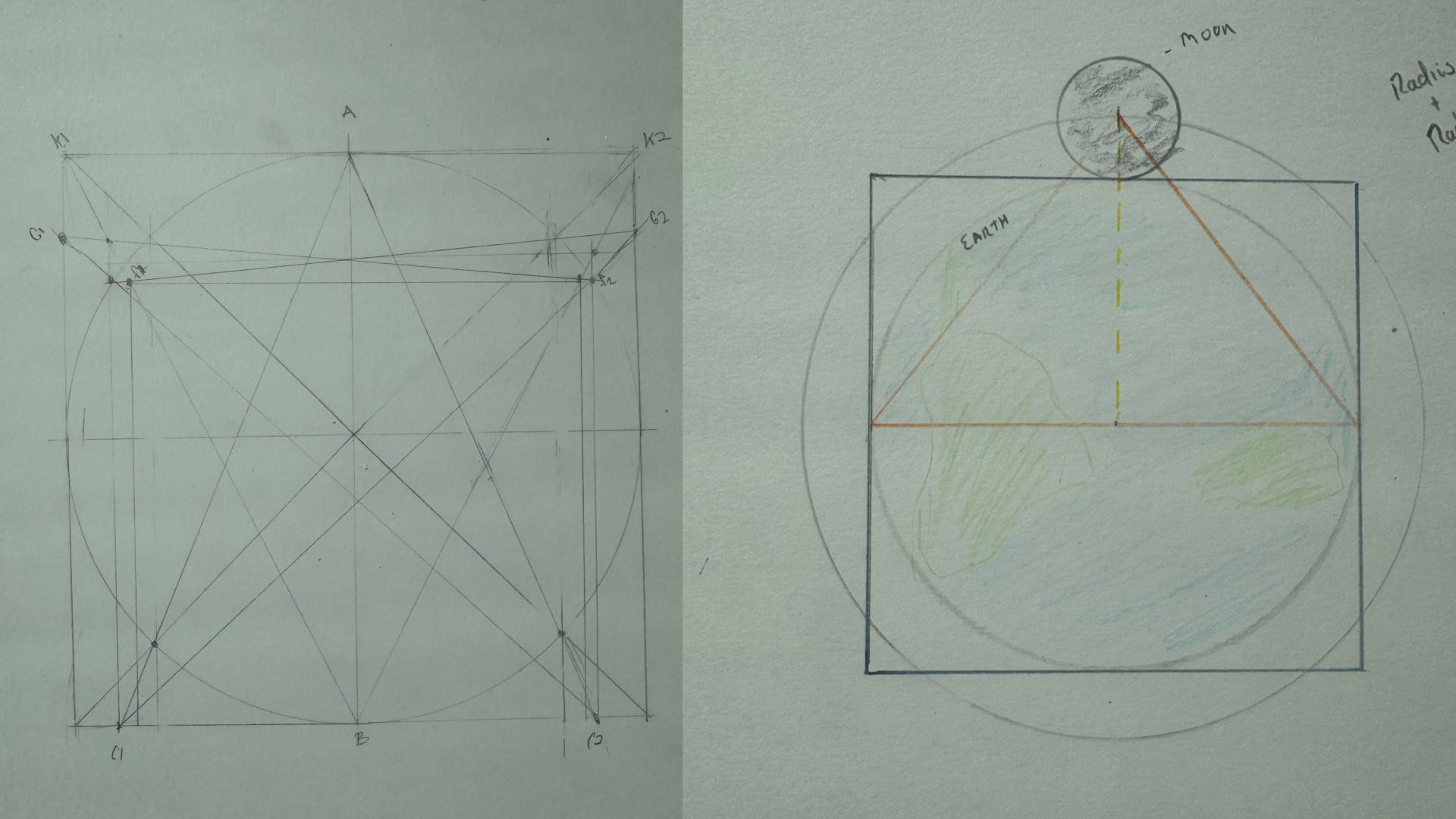
Today, modern thinkers have proposed alternative approaches to squaring the circle. In his book Polymath: The Aquarian Enlightenment, polymath Robert Edward Grant presents multiple methods to achieve this feat. I found the process of following Grant’s methods to be therapeutic, as it encouraged a meditative focus on geometric patterns and their deeper meanings. Additionally, another fascinating method, which I learned from Alan Green, is illustrated on the right.
Lincoln’s geometric quest mirrors his political vision: just as he sought to prove an equality of areas, he fought for an equality of humanity, rooted in self-evident truths. In an upcoming episode of No Way Out, we’ll dive deeper into the Gettysburg Address, exploring how it might encode hidden meanings through codes, sacred geometry, and the echoes of Euclid—revealing layers of flow that go far beyond what meets the eye.
References
Ellenberg, J. (2021). Shape: The Hidden Geometry of Information, Biology, Strategy, Democracy, and Everything Else. Penguin Press.
Goodwin, D. K. (2005). Team of Rivals: The Political Genius of Abraham Lincoln. Simon & Schuster.
Grant, R. E. (2022). Polymath: The Aquarian Enlightenment. Independently published.
Weisstein, E. W. (2023). “Squaring the Circle.” MathWorld–A Wolfram Web Resource. Retrieved from https://mathworld.wolfram.com/SquaringtheCircle.html.