


Originally published in The Whirl of ReOrientation on December 12, 2024.

1. The Origins of Lean and the Toyota Production System (TPS)
Lean, often celebrated as a revolutionary system of efficiency and continuous improvement, emerged from a unique synthesis of American management ideas and Japanese industrial ingenuity. At the heart of Lean is the Toyota Production System (TPS)—a post-World War II response to limited resources, global competition, and the need for adaptive innovation.
Roots in American Management
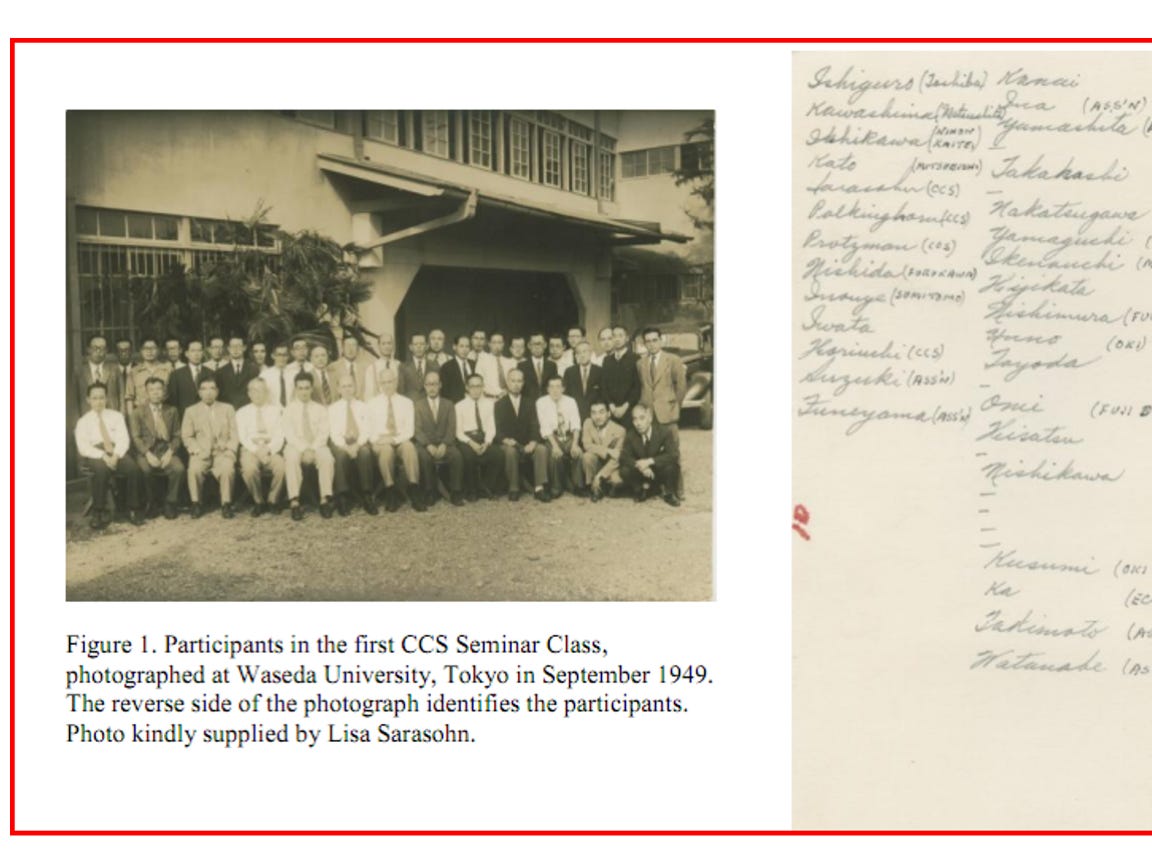
The Civil Communications Section (CCS), a U.S. military initiative led during the postwar occupation of Japan, played a foundational yet often overlooked role. The CCS, as highlighted by Charlie Protzman on No Way Out, introduced American management principles emphasizing:
Participative leadership and empowerment.
Scientific quality control inspired by Frederick Taylor and Frank Gilbreth.
Systemic improvement focused on external customer demands.
These teachings laid the groundwork for what Japanese companies, notably Toyota, later refined into TPS. While figures like W. Edwards Deming and Joseph Juran are often credited with bringing quality control to Japan, the CCS predated their efforts, embedding the seeds of Lean thinking—standardized work, bottom-up improvement, and a focus on quality—into the Japanese industrial mindset.
2. The Key Players: From Ohno to Shingo
TPS evolved through the ingenuity of Toyota’s engineers, particularly Taiichi Ohno and Shigeo Shingo:
Taiichi Ohno, often regarded as the father of TPS, developed the principles of Just-in-Time (JIT) and Jidoka (automation with a human touch). He observed that customer demand should dictate production flow, introducing Kanban to ensure parts arrived only when needed. Ohno’s focus on eliminating muda (waste) ensured that processes remained lean, adaptive, and responsive to change.
Shigeo Shingo provided crucial insights into process improvement, including the Poka-Yoke (mistake-proofing) concept and refined approaches to quality inspection.
The bottom-up culture fostered within TPS reflects Ohno’s philosophy: workers are empowered to improve processes in real-time, acting as the true locus of control. This stands in stark contrast to traditional top-down management approaches.
American influences like Frederick Taylor’s scientific management and the Gilbreths’ motion studies laid an early foundation. However, Toyota’s brilliance lay in transcending these static models. As John Boyd emphasizes, innovation arises by “stepping outside” existing paradigms and orienting to external realities, a principle central to Lean’s development.
3. How John Boyd Was Influenced by Lean and TPS
John Boyd, a visionary strategist and creator of the OODA Loop (Observe, Orient, Decide, Act), found profound inspiration in TPS and Lean principles. Boyd’s extensive marginalia on Lean texts reveals his deep respect for Toyota’s system of adaptive innovation and continuous improvement. He identified key lessons that informed his revolutionary thinking:
A. Bottom-Up Control and Adaptability
Boyd observed that TPS operated through a reversal of traditional control:
Control emerges bottom-up—workers identify problems, innovate solutions, and set standards.
External forces (customer demand) drive internal processes, ensuring alignment with real-world needs.
Boyd articulated this dynamic as outside-in and bottom-up, contrasting it with rigid, hierarchical models. He admired TPS’s ability to empower frontline workers, writing: “Workers set standards and cough up new ones… Control is not top-down but bottom-up.”
This emphasis on decentralized control directly parallels Boyd’s OODA Loop. Like Lean, the OODA Loop thrives on:
Rapid feedback and iteration to respond to change.
Eliminating waste (or friction in Boyd’s terminology) to operate faster and more effectively.
Dynamic learning to continually observe mismatches and reorient strategies.
B. Eliminating Friction: Lean and the OODA Loop
For Boyd, friction—a term borrowed from Clausewitz—represents anything that slows down decision-making and execution. Toyota’s relentless elimination of muda aligns perfectly with this principle. By reducing waste, TPS enables processes to flow with minimal friction, allowing for faster adaptation.
Boyd connected this to his concept of fast transients—the ability to shift tempo and rhythm more quickly than an adversary. TPS’s flexibility, achieved through Just-in-Time systems and empowered workers, mirrors Boyd’s vision of adaptability as a competitive advantage.
“Change of rhythm from normal rhythm suggests in a conflict situation we want to get inside our adversary’s tempo or rhythm.”
Lean systems, Boyd observed, achieved this through implicit communication and decentralized problem-solving, enabling organizations to “harmonize” their activities at high speed.
C. Learning Through Variety and Cross-Referencing
Boyd repeatedly emphasizes the importance of variety and multiple perspectives—a concept deeply embedded in Lean and Kaizen. Japanese companies, Boyd notes, thrive by incorporating diverse viewpoints and fostering situational adaptability:
“Uncover possibilities; expose pros and cons; identify trade-offs… Start with possibilities and work toward an appropriate solution.”
In Lean systems, cross-functional teams collaborate across silos to solve problems. This organic interplay—what Boyd calls “implicit connections”—ensures that individuals retain freedom of action within a shared, adaptive whole. Boyd ties this to the idea of “implicit trust,” which he sees as the glue enabling dynamic harmony.
4. Breaking Free: Lean, Boyd, and the Power of External Orientation
A key lesson Boyd draws from TPS is the necessity of reaching outside systems to observe and reorient. Lean organizations, he notes, remain attuned to the external environment—particularly customer needs. This outward focus drives constant improvement:
“You cannot determine the character/nature of a system within itself… Firms must step outside their own logic to adapt dynamically to external forces.”
This mirrors the Lean philosophy of market-in thinking, where customer demand pulls production forward. Boyd criticizes systems that focus inward, as such preoccupation undermines adaptability:
“Competition inside a system takes away time and effort to orient on the outside environment.”
By embracing external feedback, Lean and TPS transcend internal limitations, ensuring resilience in an uncertain, evolving world. Boyd’s OODA Loop operates on the same premise—continuously observing external mismatches to reorient and adapt faster than competitors.
Conclusion: Lean, TPS, and Boyd’s Legacy
The origins of Lean and the Toyota Production System reflect a synthesis of American management teachings and Japanese innovation. Influenced by the Civil Communications Section, engineers like Taiichi Ohno and Shigeo Shingo created a transformative system rooted in:
Bottom-up control and worker empowerment.
Continuous improvement (Kaizen).
External orientation driven by customer needs.
John Boyd, in his exploration of TPS, recognized its brilliance as a system of adaptive innovation. Lean principles—eliminating waste, fostering decentralized control, and embracing external feedback—deeply informed Boyd’s OODA Loop. His work reinforces that success lies not in static solutions but in the ability to observe, orient, and adapt dynamically to change.
Boyd’s legacy, like TPS, challenges us to break free of limits, embrace variety, and harmonize adaptability with collective purpose. As he concludes:
“Leapfrogging is the name of the game if you want to survive and grow in an evolving, competitive reality.”
The real origins of Lean, therefore, are not just about efficiency—they represent a philosophy of continuous evolution, resilience, and innovation, as relevant today as ever.
You can watch our episode with Charlie Protzman here: