


Originally published in The Whirl of ReOrientation on December 2, 2025.
There is a strong chance that you may take this as a nothing-burger, but let me be blunt: the market reflects our global consciousness. What looks like chaos is actually governed by attractors that follow fractal patterns rooted in sacred geometry. There, I said it!
With that context, let me build a few snowmobiles from the past 24 hours.
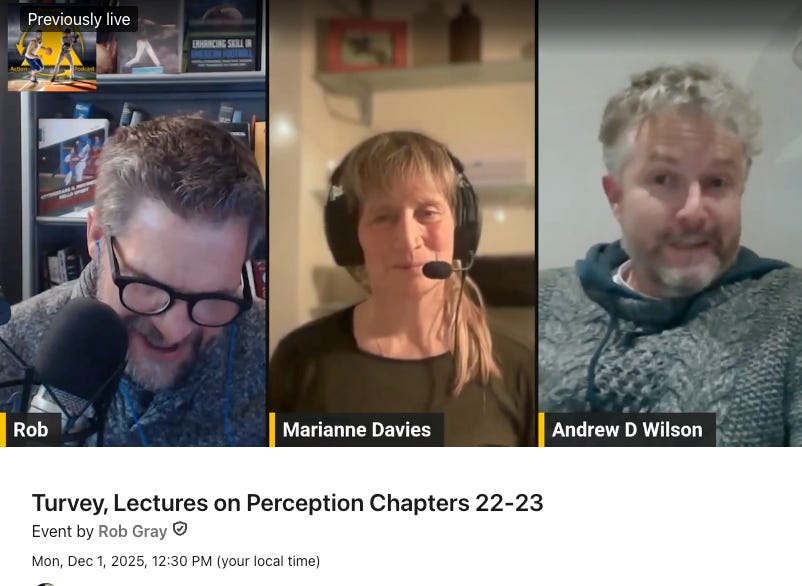
After a flurry of Thanksgiving conversations with James “Bart” Bartelloni and others on consciousness, attractors, affordances, chaos, harmonics, telepathy, and markets, I figured I’d slow down yesterday and just listen in on Rob Gray (NWO EP 134), Marianne Davies, and Andrew D. Wilson dissecting Turvey’s Lectures on Perception, Chapters 22–23. I had no idea they were going deep on affordances and attractors. That stream became the trigger for everything that followed.
I woke up this morning, did a quick BrainTap meditation, and decided to revisit the chapter on Bayes’ Theorem in Noah Giansiracusa’s Robin Hood Math. Bayes matters because our Orientation (our priors) literally shapes how we sense, perceive, decide, and act in the world. It is also how the TOPUN bros came up with the AIM-54 Beam-Defeat Matrix based on, wait for it, probabilities. And there’s a damn good chance the Cyber Monday notifications that have been hitting your inbox or feed over the past 24 hours are running on Bayes’ Theorem too…
Then I flipped open Angus Fletcher’s Primal Intelligence—and the past 24 hours went full Lorenz butterfly on me.
I landed on the chapter where Fletcher draws a clean line from Shakespeare → Clausewitz → Moltke → Steve Jobs. Brain short-circuit. We had Alan Green on No Way Out decoding Shakespeare as hidden sacred geometry—Metatron’s Cube, squaring the circle, Euler’s number, golden-ratio stagecraft, speed-of-light calculations, the whole cathedral of code. Fletcher just handed me the bridge I didn’t know I was missing: Shakespeare isn’t just poetry; he’s a strange attractor for decision-making under radical uncertainty. Clausewitz treated Shakespeare like a field manual. Moltke, Clausewitz’s intellectual heir, turned that insight into Auftragstaktik—Mission Command. Napoleon, who spent a night in the Great Pyramid (where some suspect Edward de Vere or John Dee encoded the same geometry), probably felt Shakespeare in his bones.
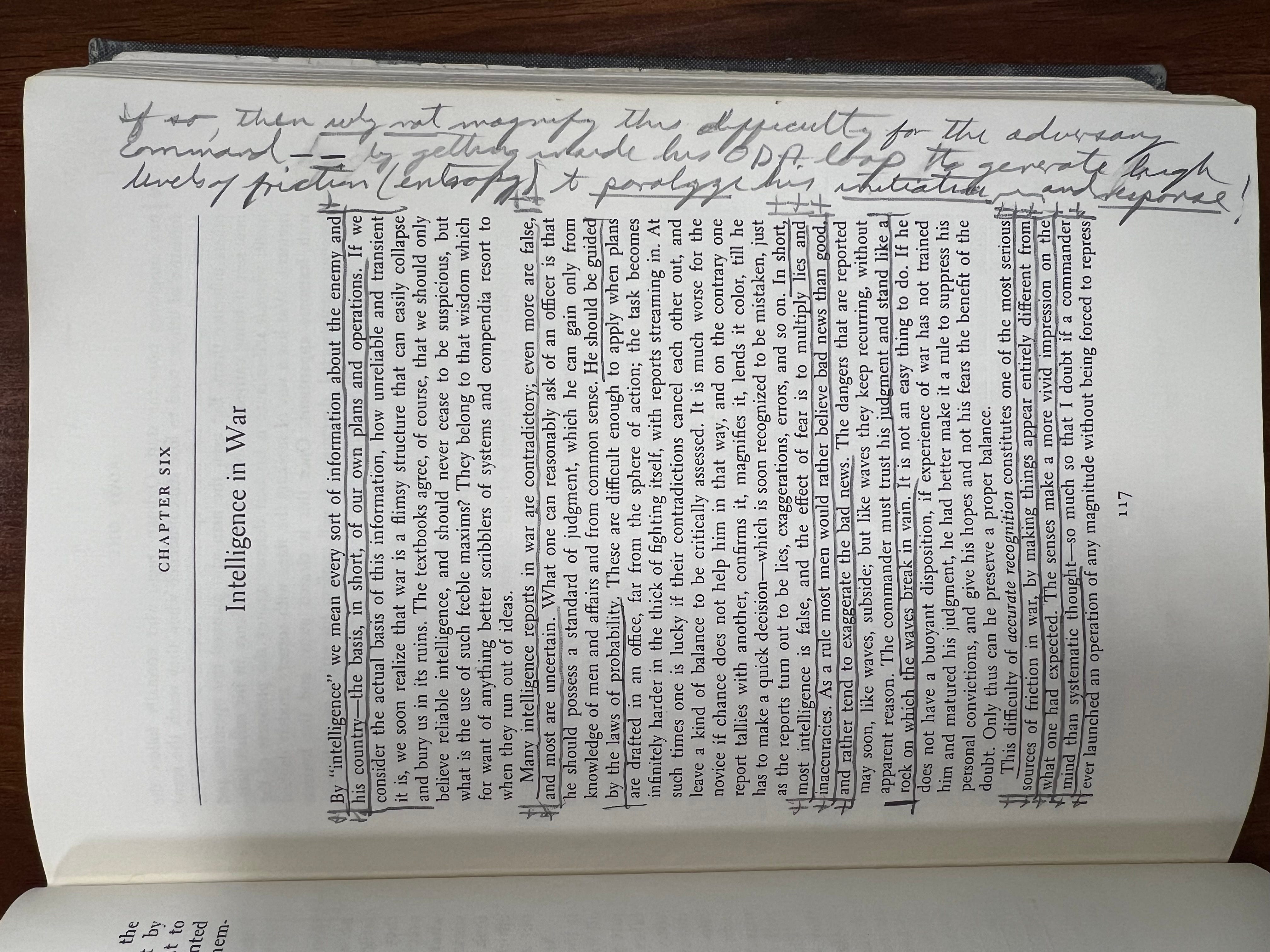
So I fired off a note to Angus (already booked for the show) with a photo of John Boyd’s marginalia in On War.
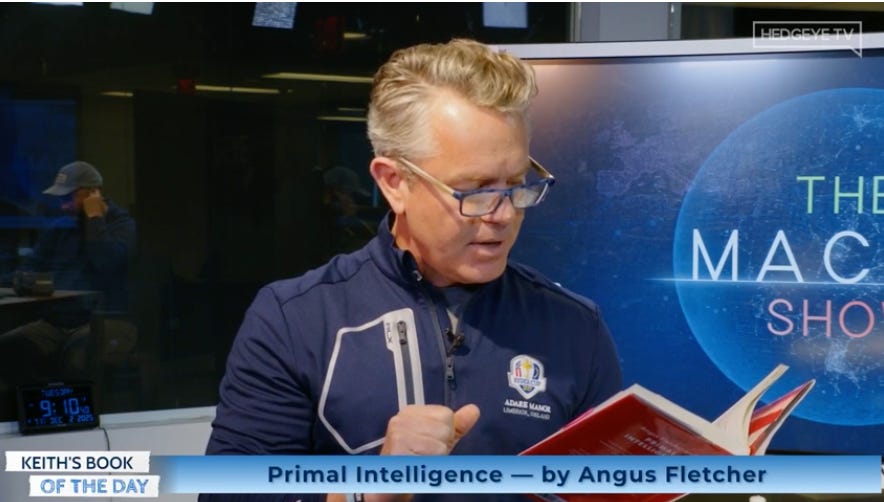
Next, I jump into Keith McCullough’s morning Hedgeye Macro Show. After Kieth’s Top Three Things of the day, Keith drops a shout-out to… Primal Intelligence by Angus Fletcher. He’s using it to hammer home why the act of planning beats the plan itself, and why relentlessly asking “why” is everything. Sound familiar? That’s the heartbeat of OODA, the Flow System, and our eternal war against rigid PowerPoint strategy decks.
While hunting for the exact Boyd marginalia JPEG, I [accidentally] open Franklin C. “Chuck” Spinney’s 1995 brief Anatomy of Decline. To be clear, the first image I open was the precise page where “Chuck”—one of the men who literally sketched the OODA loop with Boyd—defines adaptation:
“An alteration or adjustment in structure or habits by which a group or organization of individuals improves its condition in relationship to its environment.”
He then lists the only two ways organizations actually adapt:
Change internal structure to fit the environment (works).
Try to force the environment to fit internal structure (usually catastrophic).
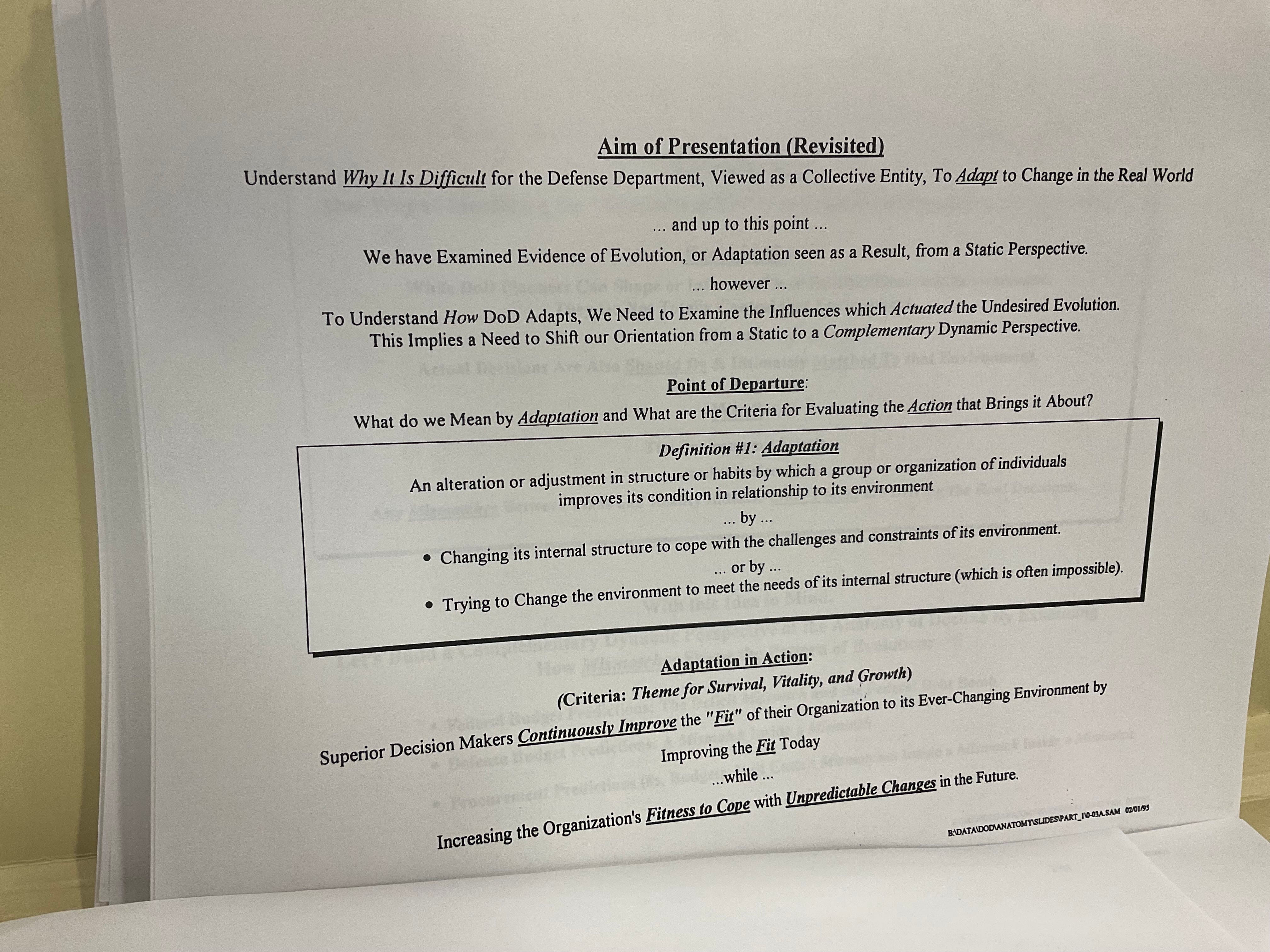
Twenty-nine years before Friston’s Free Energy Principle went mainstream, Boyd and Spinney already knew: reorient faster than reality, or reality will reorient you—permanently.
And then, because the universe has jokes, my LinkedIn Messaging pings.
Professor David Slater (NWO EP120)—a man who has gone “full Boyd”—sends me his brand-new, hot-off-the-press paper titled:
“Is Consciousness a Chaos Attractor and Thoughts Murmurations of the Mind?”
Dated 1 December 2025. Written yesterday.
Sixteen pages of pure dynamite.
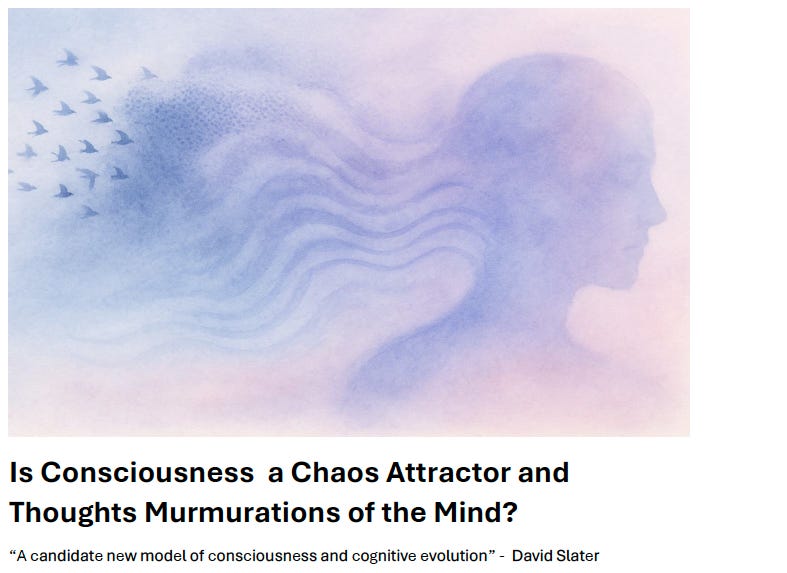
David argues consciousness wasn’t an accident; it was selected because it is the most efficient known mechanism for minimizing free-energy (surprise) in a chaotic universe. Using starling murmurations, Lorenz attractors, brain waves, and evolutionary thermodynamics, he ties together:
Thermodynamics
Chaos theory
Evolution
Predictive processing
Collective intelligence
…into one continuous unfolding pattern.
And the punchline?
He lands on the exact same insight Chuck Spinney nailed in 1995 and ecological dynamics nails today:
Order without central control.
Coherence from simple local rules.
Adaptation = continuously reshaping your internal “fit” faster than external chaos reshapes you.
I’m staring at my screen realizing the last 24 hours just handed me a real-time demonstration of what David is describing:
Rob Gray & crew on affordances and attractors in the perception-action loop
Angus Fletcher dropping the Shakespeare–Clausewitz connection and triggering the “Shakespeare = strange attractor” bomb
Keith McCullough quoting the same book on a market call
Chuck Spinney’s 30-year-old brief predicting active inference
Bart and I seeing market geometry as emergent consciousness
David Slater synthesizing the entire thing into a unified theory of mind
…all converging on my laptop in under one rotation of Earth.
This wasn’t coincidence. This was a murmuration.
Millions of individual agents—podcasters, professors, traders, dead strategists, living physicists—following simple local rules (“share what’s interesting,” “chase the pattern,” “help the tribe adapt”) and suddenly producing a visible, coherent macro-structure none of us centrally planned.
David has a line that stopped me cold:
“Order is a property of relationships, not of a controlling node.”
That’s Mission Command.
That’s what Mark “Slider” Keller said about “attachment” on the podcast last week.
That’s constraints-led coaching.
That’s why I keep telling my daughters basketball isn’t about set plays—it’s about learning to dance with the ever-shifting attractor landscape on the court.
And yes, it’s why Bart and I keep seeing the same harmonic geometry in markets that most people dismiss as random noise. The market is conscious the way a flock is conscious—distributed, subconscious, and far smarter than any single participant.
Shakespeare built 400-year-old attractor basins that still coordinate human behavior in fog and friction.
Clausewitz read them and forged doctrine.
Moltke operationalized them into Auftragstaktik.
Boyd and Spinney distilled them into OODA.
Fletcher is turning them into narrative technology.
Slater just proved they’re the same phenomenon that turned chemistry → biology → brains → culture → whatever we’re becoming next.
Here’s the punchline: If consciousness is a chaos attractor and thoughts are murmurations of the mind, then what I lived through in the past 24 hours wasn’t “information overload.”
It was the felt sense of my own attractor landscape being gently, persistently, irresistibly reshaped by a larger one.
And the wildest part? The universe is getting better at this.
We’re shifting from accidentally falling into attractor basins… to intentionally sculpting them.
That’s what No Way Out has always been about.
That’s what AGLX Consulting actually does with organizations.
That’s what The Whirl of Reorientation is for.
Once you see the pattern, you don’t get to unsee it.
You only get to decide: keep flapping in the old formation… or join the ones already writing the next strange attractor.
Continue your whirl,
-Ponch
P.S. David Slater’s full paper is available here on LinkedIn
P.P.S. Angus Fletcher is locked for 2026. It’s going to be ridiculous.
→ Subscribe to The Whirl of Reorientation
→ Listen to No Way Out Podcast
→ Work with AGLX if your organization is stuck in a dying attractor