


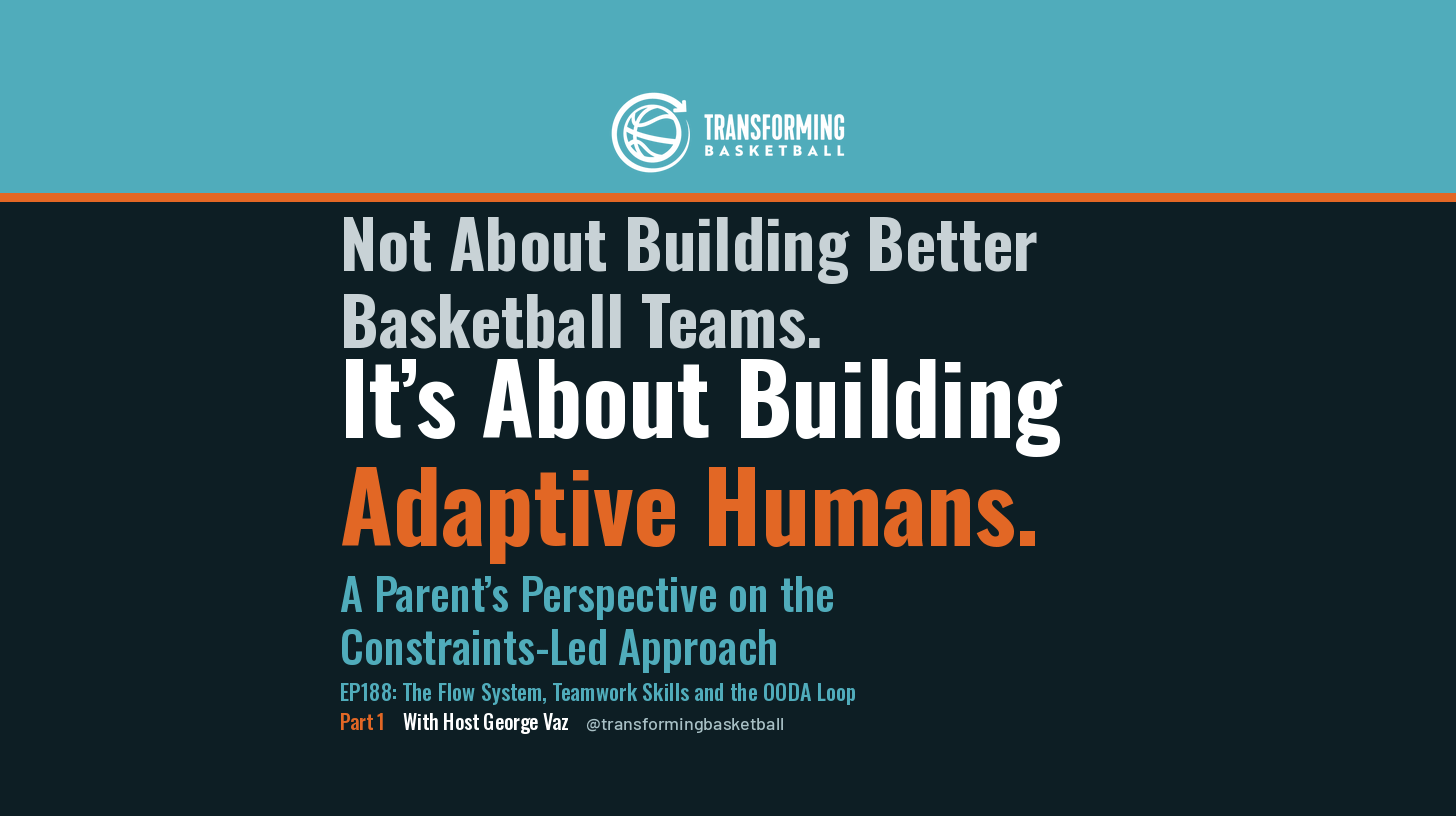
I'm the parent of two high school basketball players. The chance either of them plays D1, D2 or D3 basketball is less than 5%. The chance they'll have to adapt to a world that keeps changing is 100%.
They will work alongside AI, in a world that changes faster than humans were designed for. AI requires them to be more human: to work in teams, lead and adapt. In short, they have to become adaptive humans.
I made that case as a guest on The Transforming Basketball Podcast, hosted by George Vaz. The episode is EP188, Part 1: The Flow System, Teamwork Skills and the OODA Loop. It's out now on Apple Podcasts, Spotify and YouTube.
https://www.youtube.com/watch?v=eH37Z8inLpg
A Playbook Built for Certainty
Most of basketball still runs a playbook built for certainty. Coaches still talk about muscle memory and favor scripted plays over adaptive thinking. They run cone drills, Mikan drills and weaves that look good in practice. They tell you the game is where your kid gets experience. Sound familiar? We don't live in a world of certainty.
Basketball is a game of flow. Flow happens when players see what the game offers and act on it together, in the moment. That's the skill our kids will need for the rest of their lives.
What George and I Talked About
I spent 28 years in the U.S. Navy, 16 on active duty and 12 in the Reserve, and I retired as a Captain. When I left, it took me years to see what I actually brought: teaming skills, time in complex systems, and a foundation of team science, high reliability and team life cycles.
I came across the constraints-led approach (CLA) in 2019. After the USS Fitzgerald and USS McCain mishaps in 2017, I went back on active duty to study high-performing organizations. At a complexity conference in Washington, D.C., someone handed me a book by Dr. Keith Davids on CLA. In CLA, coaches shape the individual, the task and the environment so players learn by solving problems in the game. I assumed every coach already knew this work, and that the real job was to bring it to teamwork. I was wrong about the first part. A lot of sports coaches had never seen it.
On the episode I told George why it felt familiar. In fighter aviation we always had a red team. We were given problems we had to solve, and the problems got harder. "We trained harder than we ended up fighting."
The Flow System, which I co-authored with John Turner and Nigel Thurlow in 2020, builds on three things every organization needs: complexity thinking, team science and distributed leadership. It focuses on the non-technical skills: teaming, planning, communication, debriefing and psychological safety. When a team can do that work, what Keith Davids now calls skill adaptation speeds up. Every team goes through a life cycle. You plan, you execute and you assess. How you do that matters. All teams are complex adaptive systems. So are all humans.
George and I then got to John Boyd's OODA loop, Boyd's way of representing how living systems co-evolve with their environment. People often treat it as a linear four-step process. The loop Boyd sketched already holds a perception-action loop, the coupling of what we see and what we do, and an unfolding interaction with the environment. Then I put it this way: "CLA improves the quality of your OODA loops."
George had the basketball example that makes that line concrete. Younger players may never see the alley-oop. At those ages, no one is catching the ball in the air and finishing, so the pass doesn't even show up as an option. As players get older, and as their action capabilities change, they start to perceive that affordance. If they can't act on it yet, they often won't see it.
I connected it to what Keith Davids calls education of attention: learning, through experience, what to attune to. Orientation, at the center of Boyd's loop, is what allows us to see. It also acts as a filter. In a debrief after a flight, we looked at the intent and at what happened from more than one perspective. That's how you build attunement for the next time out. In a basketball debrief, the coach asks questions. "What did you see? What did you think?" Those questions also build psychological safety.
Rob Gray has written about the challenge-skills balance, and I've used that idea for years. You want the challenge of the environment a little above current skill. Too much, and people get upset. Too little, and they get bored.
George asked for a practical example from aviation. I gave him a daytime carrier landing. In the brief we set the intent, including a visual cue for when to turn: the wake of the ship, and a look through the third elevator. On downwind I asked the student what he saw to his left. He was overwhelmed by what was right in front of him. We flew the pass with what he needed in that moment, and we talked about the cue later, in the debrief, once he had the experience.
The same idea showed up closer to home. Around the time we recorded, I took one of my kids out for a first driving lesson. I took away the accelerator. We worked on braking and turning in a controlled environment, and the mistakes kept coming. There was no PowerPoint. I said making those mistakes is how we learn.
When I coach organizations, I use the same method. "When you coach teaming skills, my view is you manipulate the environment with constraints." A six-step planning process you talk through for an hour doesn't stick. In fighter aviation, debriefing was never a set process. As I said on the show, "It's implied. It's learned. It's part of the culture."
Keith also pointed us past the court. In business, there's often no pitch you can see. You have to build a map of the environment as you go. He called that weak anticipation. That's why CLA reaches past sports.
I see the same playbook in business. Today I work with leaders at hedge funds and Fortune 20 companies. What I've found is that business, like sports, is run by a dominant approach. Much of it is pseudoscience, the way people were taught twenty years ago. Leaders don't challenge their assumptions, and they don't look outside their own organizations. Most don't know there are first principles behind how teams actually work and how humans actually develop. We had a saying in the Navy for this. They just want to suck less than their competitors. Sports can't afford that.
General Stanley McChrystal has said that leaders need to lead like gardeners. They create the context, and the psychological safety, in which people can grow.
What Parents Should Demand This Week
If you're paying attention to what's happening around us, you can see the one place that's falling behind. It's youth sports. There are pockets doing this well, including the coaches George and Alex Sarama are already reaching. Most of youth sports isn't doing this work. To me, that's a crisis. We need to flip it, and coaches need to learn this. David Epstein writes about why people who learn this way do well in a changing world.
So here's my message to parents. Using constraints is not about building better basketball teams. It's about building adaptive humans.
Demand it. This week, go watch a practice. See whether the coach is directing every move or setting problems for the players to solve. Look for cone drills, Mikan drills and weaves that look clean. Then look for whether the kids are reading the game and deciding.
Ask the coach two questions. How do you use constraints so my kid learns to adapt in practice, in conditions that look like the game? When something breaks down, do you tell the players what they did wrong, or do you ask them what they saw and what they thought?
Ask the athletic director and the school administrators the same thing. If they aren't figuring this out, they're failing your kids, and you should find another place to play.
It won't be perfect. It will be messy and sloppy. That's what learning looks like.
And a better player comes along with it. So does a team that sees the court, gets into flow, competes and wins.
Listen to my conversation with George Vaz. EP188, Part 1, is on Apple Podcasts, Spotify and YouTube.
Anyone can poach. Few can coach.
If this conversation leaves you wanting more, I host No Way Out, where George has been a guest, and where I've talked with Keith Davids, Alex Sarama and Rob Gray. Listen on Apple Podcasts, Spotify and YouTube.