


Originally published in The Whirl of ReOrientation on June 28, 2026.
“The entire loop, not just orientation, is an ongoing many-sided implicit cross-referencing process of projection, empathy, correlation, and rejection.” — John Boyd, The Essence of Winning and Losing, 28 June 1995
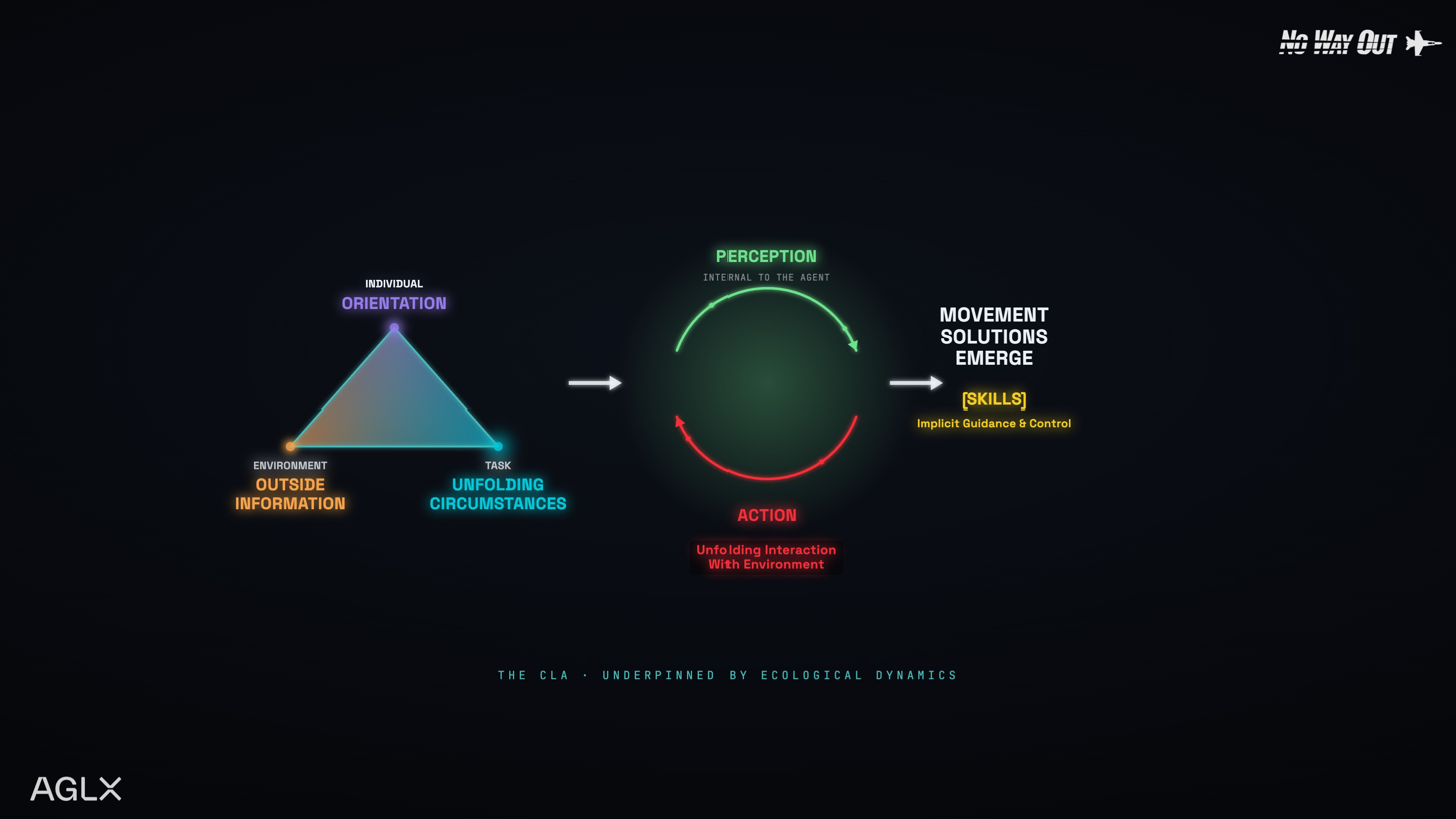
The thesis in one breath. The Constraints-Led Approach is not a coaching fad parked off to the side of decision science. Take the CLA informed by ecological dynamics, combine it with active inference and predictive processing, and you are looking at the same thing John Boyd drew. Not a metaphor for it. The CLA lives inside Boyd’s real OODA loop. It is one true way to see that loop, a single account of how an athlete perceives, orients, and acts inside a world that will not hold still. The loop is the larger container. The CLA is one accurate picture of what is happening within it.
You probably think these are three different things. Newell’s constraints. Boyd’s OODA. The brain’s predictive machinery. Watch them turn out to be one thing.
1. Why this matters
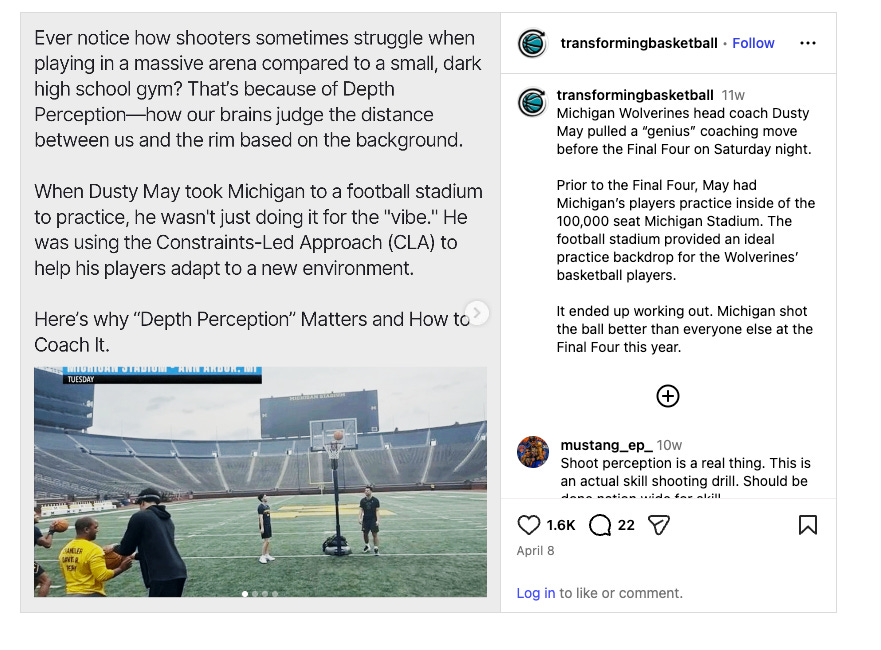
We are talking about elite sports organizations here, and something is shifting in them. The CLA is starting to reach coaches, and the best of them are using it to move past the dominant approach, the one built on centralized command and control and a belief in muscle memory. Now imagine what happens when that reaches the top. If front offices and the C-suite get the same update and buy in, a team can become genuinely elite, hiring the coaches and recruiting the players who fit a first-principles approach to performance. The leaders up there already talk about the OODA loop, name-dropped at cocktail parties and in annual reports. The trouble is, it usually shows up as a tidy four-box flowchart, misremembered as “make decisions faster than the other guy.”
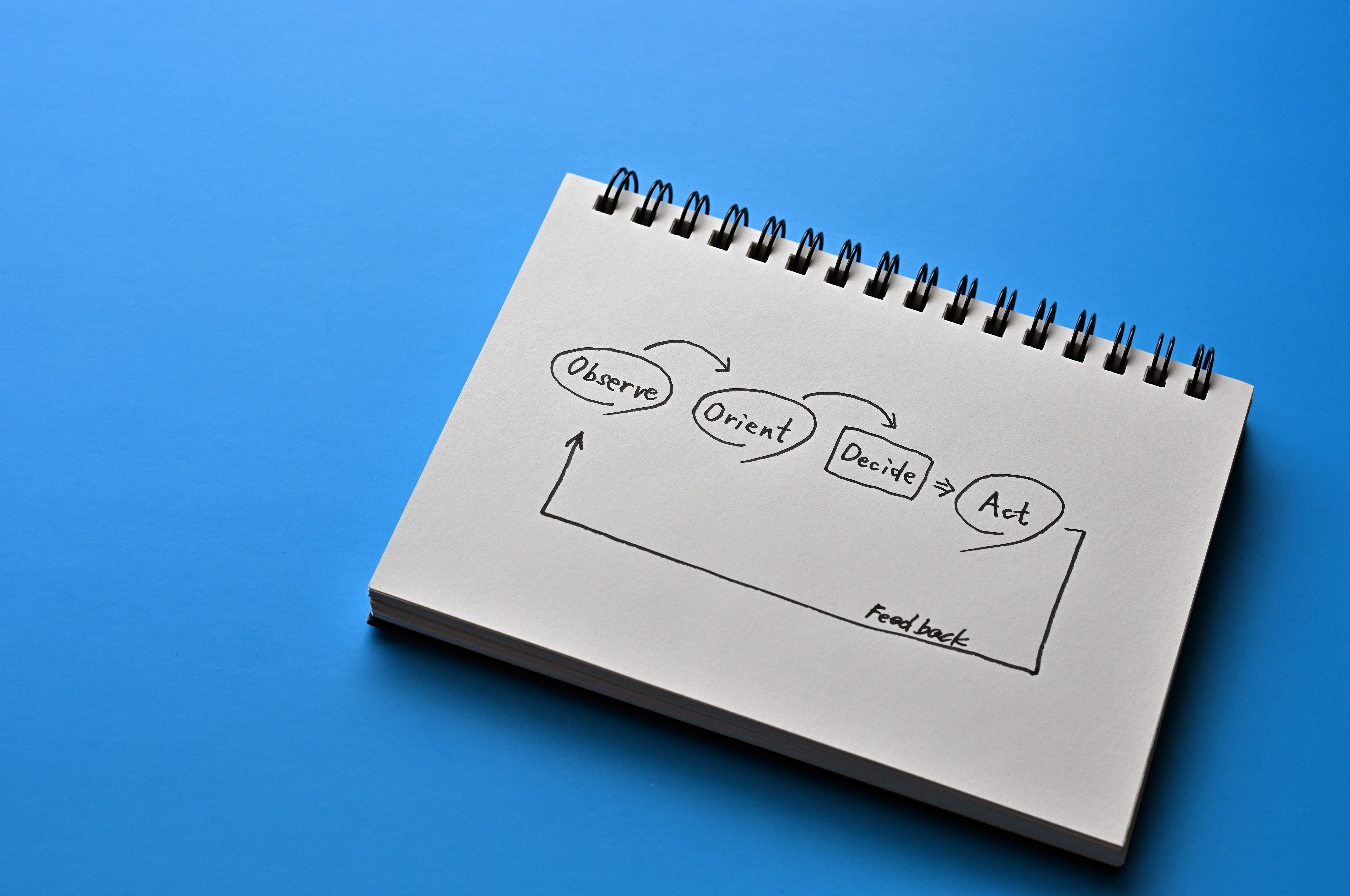
That flowchart is not the OODA loop. It is a cartoon of it. Presenting the loop as a four-step process is like describing a fractal as a simple shape. You get the outline and lose the complexity that unfolds at every scale.
A word on who discovered and sketched it. John Boyd was a fighter pilot who evolved into a polymath. In 1976 he wrote Destruction and Creation, and the title is the point: the paper is about destroying old, stale models of the world so you can create better ones. This matters more than it sounds. Without ongoing destruction and creation, our mental models go rigid, drift out of sync with reality, and we lose the ability to act on our own. Success comes from staying adaptable, from improving what Boyd called our capacity for independent action amid competition, uncertainty, and scarcity. That paper is the engine. Roughly nineteen years later, in his final brief, The Essence of Winning and Losing, dated 28 June 1995, he sketched the loop most people now recognize. He sketched it. He never formally published it. The sketch is influenced by cybernetics, complex adaptive systems, neuroscience, and psychology, along with the thinkers Boyd had spent decades reading: Gödel, Heisenberg, Popper, Polanyi, Darwin. At heart it is less a model of decision-making than an epistemological one. As Boyd put it, Orientation shapes the way we observe, the way we decide, and the way we act. Orientation is the main event, not a box you pass through.
Here is the part that should bother you. Athletes do not perform in tidy environments. They perform inside a volatile, uncertain, complex, and ambiguous world, full of novelty, the conditions we shorthand as VUCA. You cannot coach those features of the world away. There is no way out of them. You can only design for them. Boyd built a model for exactly that world. So did ecological dynamics. They used different words and never compared notes.
This piece, and the animation it rides with, is the comparison.
2. Start where it started: Newell, 1986
Karl Newell gave coaching its constraints model in 1986. Three categories shape every movement: the Individual, the Task, and the Environment. Rob Gray puts it as plainly as anyone: a constraint is something that takes away a solution you could otherwise use.
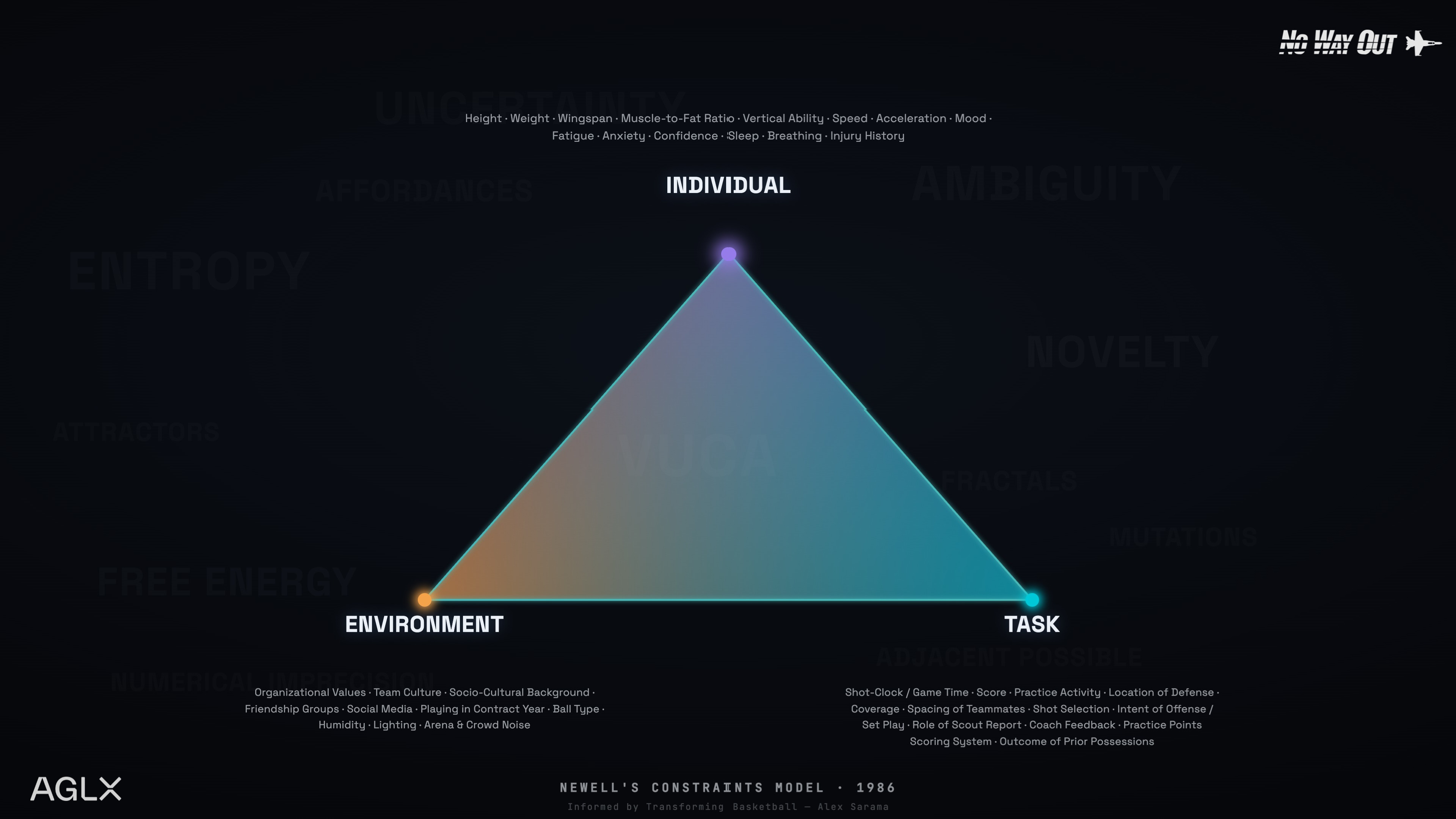
Use the canonical basketball example. The ten-foot rim is a task constraint. It removes the dunk as a scoring solution for most players. Drop it to six feet and the dunk comes back. Change the constraint, change the available solutions.
Individual constraints are what the athlete brings: height, weight, flexibility, fatigue, how they handle pressure. This is why we do not prescribe one perfect shooting technique. A solution that fits a six-foot guard does not fit a seven-foot center.
Task constraints are specific to the sport: the rules, the number of players, the equipment, the scoring system. A heavier ball, a shorter shot clock, a smaller court. These are the constraints a coach controls most directly.
Environmental constraints are the general ones that apply to anything: gravity, light, friction, surface, weather, crowd noise.
Credit where it is due. Alex Sarama’s Transforming Basketball does the hard work of putting these terms into the language of actual possessions, and Rob Gray’s research and podcast are the spine of the contemporary CLA conversation.
Now the move that unlocks the whole piece. Take Newell’s triangle and relabel the vertices in Boyd’s language. We have not drawn the OODA loop yet, so just hold onto these names. Soon you will find that Newell’s three constraints become specific, load-bearing parts of the loop:
Individual → Orientation. What the athlete brings is genetic heritage and previous experience, which is exactly what Boyd loads into Orientation.
Task → Unfolding Circumstances. The rules, the opponents, the shot clock, the live situation. These are the competing and collaborating loops you are reading in real time.
Environment → Outside Information. Gravity, light, surfaces, the dispositional properties of the world projected into the optic and acoustic arrays.
Same triangle. Different headings. Three constraints, three landing spots. You have already started drawing the OODA loop and you did not notice.
One honest caveat on that third arrow. Mapping the Environmental constraint cleanly onto Outside Information is a simplification, and I am making it on purpose to help people see the loop for what it is. In truth the environmental constraint travels with Unfolding Circumstances as much as with Outside Information. I will try to untangle that in section 6. For now, read Outside Information as your connection to the environment and keep moving.
3. The engine: the perception-action loop and the affordance
Ecological dynamics builds everything on one engine: perception and action, coupled, continuous, inseparable. Strip an athlete down to the irreducible thing and you get perception-action. As Rob Gray says, it makes little sense to claim memories control actions when better information is sitting right there in the environment. Skill is a relationship between the player and the world, not a filing cabinet of recalled patterns.
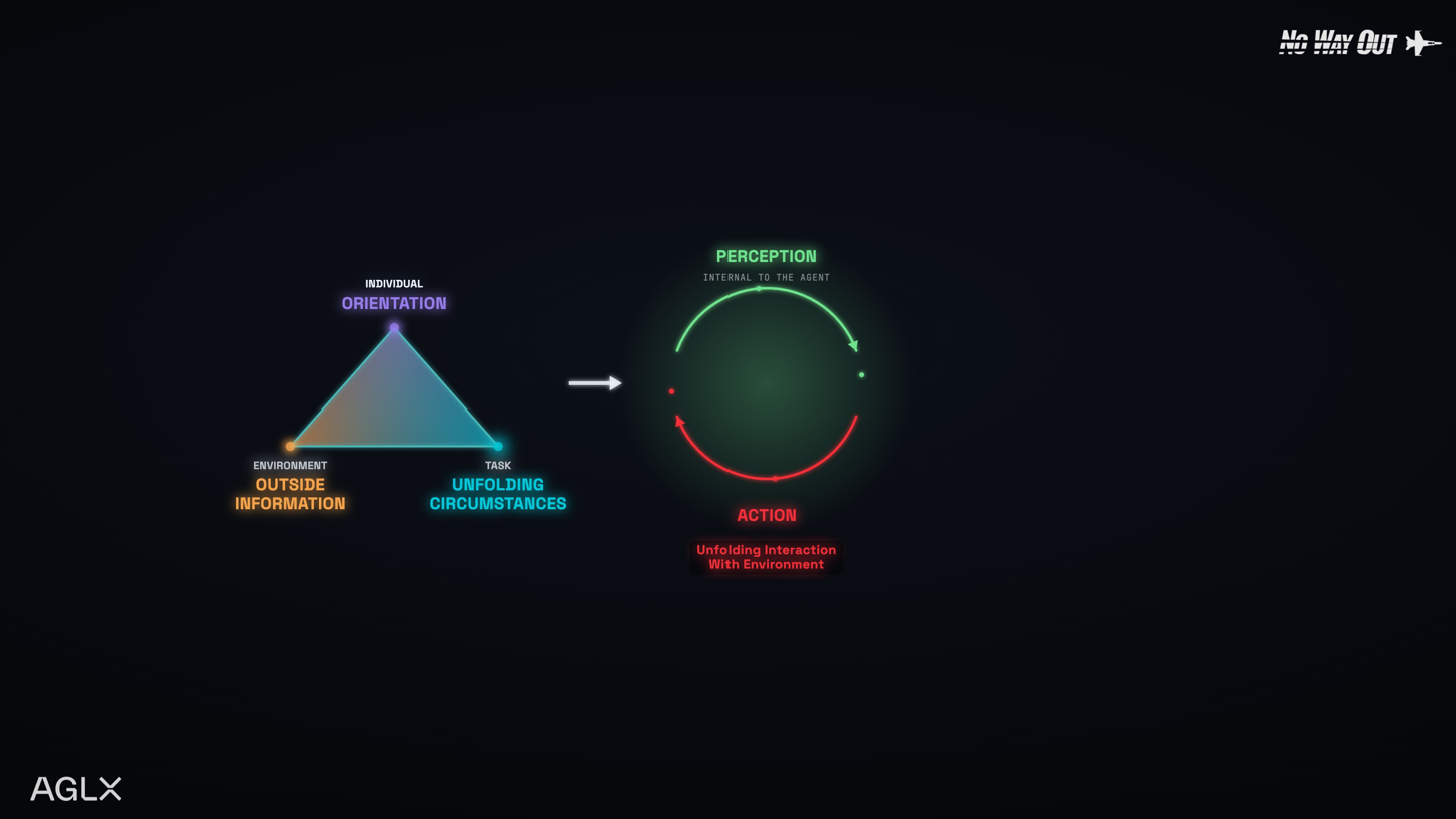
This is the engine. In the animation we set it apart on purpose, its own color, because everything else hangs off it.
And the engine runs on one central idea: the affordance. Gibson’s point was that we do not perceive raw physical properties and then compute what to do with them. We perceive what the environment offers us, directly, relative to our own body. A surface that is roughly flat, rigid, and large enough is not just a collection of measurements. It affords standing on, walking across, cutting off of. Turvey sharpened this by treating affordances as dispositions, real properties of the world that are there whether or not you are using them, the way salt is soluble before it ever meets water. The defender’s stance affords driving left. The closeout angle affords a shot. The gap affords a pass. Players perceive these directly through specifying information in the optic array and act on them. That is the Outside Information arrow feeding your loop, and it is the whole reason a coach designs the environment rather than narrating technique.
Note: Whirl Subscribers will be able to download the full CLA to OODA loop animation!!!
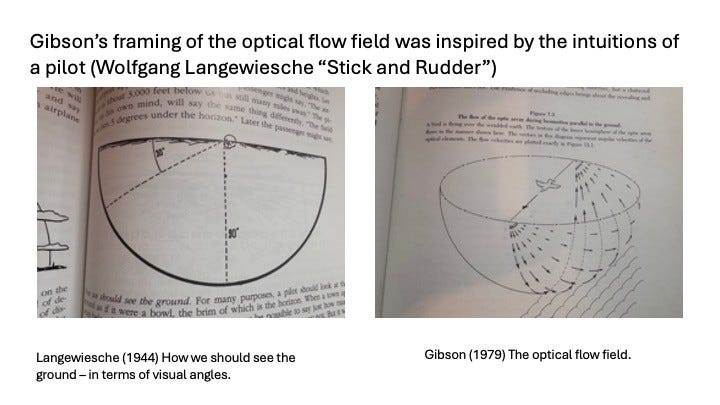
Here is the connection that should make any aviator sit up. The richest specifying information in that array is optic flow, the way the visual world streams and expands around you as you move through it. Gibson did not dream this up in a lab. He worked it out during World War II, studying how combat pilots land aircraft, watching the whole world rush outward from a single still point, the focus of expansion, which sits exactly where the aircraft is heading. He was reading pilots, too. Gibson drew on Wolfgang Langewiesche, whose 1944 classic Stick and Rudder had already named the very thing, the spot that does not move, the aim point an experienced pilot uses on final approach. As John Flach has shared with me, Gibson’s framing of the optic flow field was inspired by the intuition of a pilot. Pilots fly the flow. So the CLA is not borrowing loosely from aviation as an analogy. Its foundational concept was born in a cockpit. When a coach designs a rep so a player reads real optic flow instead of a frozen cue, they are doing the same thing a pilot does with a runway.
Now the turn the piece pivots on, and it is the one most people get backwards. Most of the time, the affordance is all you need. The athlete couples to it and the right action emerges with no forecast, no planning, no model of the future. Karl Friston, the most cited neuroscientist in the world, made this blunt on No Way Out. A skilled athlete is driving toward the fast, reflexive response that runs on variational free energy, not the heavy planning machinery. As he put it, “You don’t need expected free energy [EFE] here.” You do it fast and reflexively and efficiently. And flow is the purest version of it. In Friston’s words, “being in the flow means you’re not planning into the distant future.” You are choosing the very next thing to do, in the moment, like a skilled climber who is not thinking about which restaurant comes after the summit.
So be careful before you explain everything an athlete does with the full predictive apparatus. The deliberative, expected-free-energy side of active inference is the exception, not the rule. The default is direct, online, affordance-driven coupling.
When does the heavier machinery earn its keep? When the situation is novel, uncertain, or demands long-range forecasting. And here the half-internal nature of perception starts to matter. Carlo Rovelli says it well: when we look around, we are not purely observing. We are dreaming an image of the world based on what we already know, then quietly scanning for discrepancies to correct. Anil Seth calls perception a controlled hallucination. Action is the other half, and it points outward. Action is the unfolding interaction with the external environment, the way you perturb the world to actualize affordances, or in Friston’s language, to change the world until it matches your predictions.
Hold those two together. Perception lives inside. Action reaches outside. That split is the hinge for everything that follows. But keep the proportion straight: direct coupling is the default, deliberate prediction is the exception.
4. What it produces: movement solutions emerge, and that is skill
Here is where coaches usually get it wrong. Skills are not installed. You do not pour technique into an athlete. Skills emerge from the interaction of constraints. Set the constraints well and functional movement solutions self-organize. Make the movement conscious by over-instructing, telling a player exactly how to move their body, and you tend to break the very thing you were trying to build.
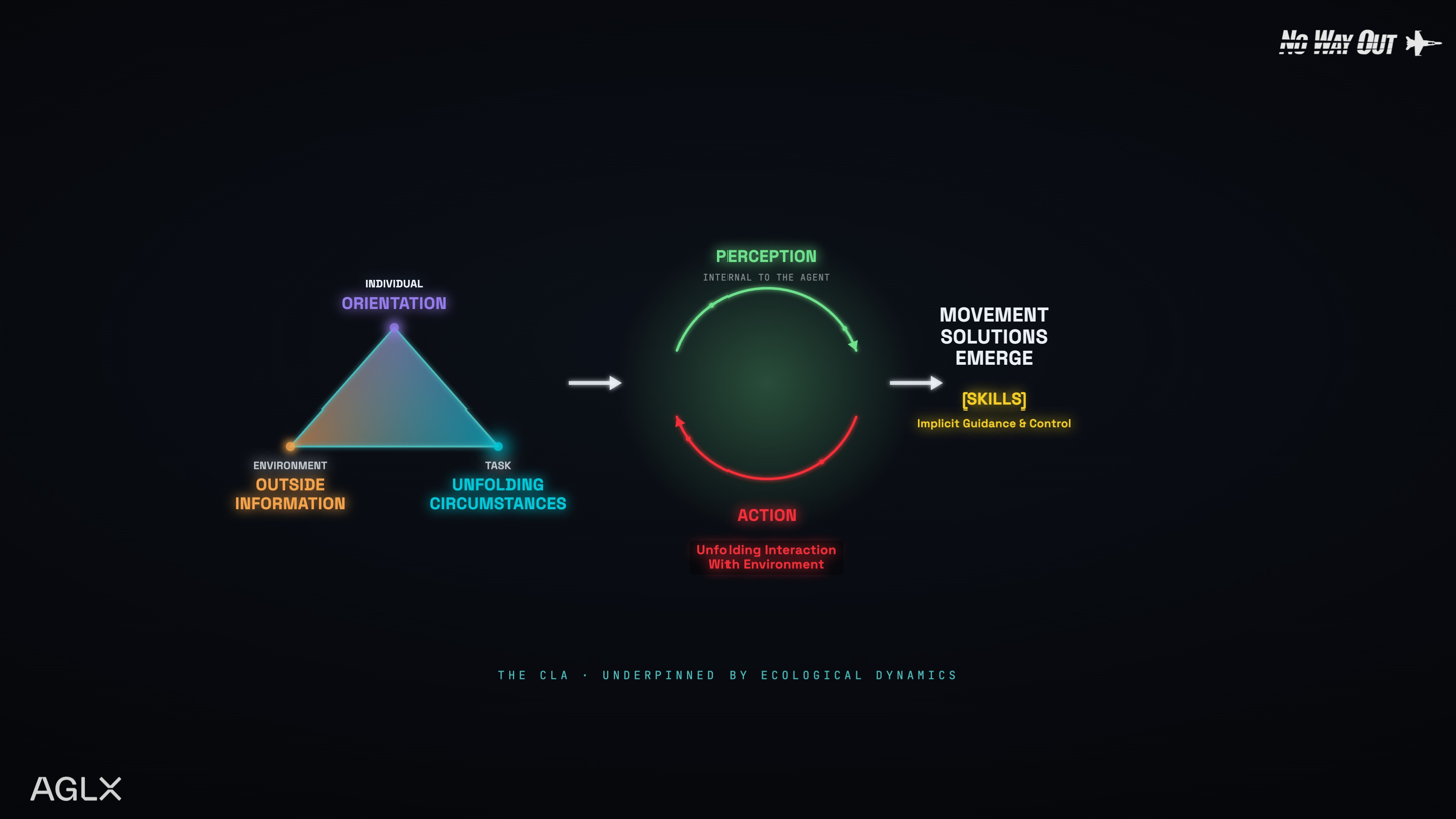
Boyd had a name for where that emergent skill shows up in his loop, and it is not an ecological-dynamics term. He called it Implicit Guidance and Control, the pathway that runs from Orientation straight to Act. The fingertip feeling. Fingerspitzengefühl. The IG&C pathway does not manufacture the skill. It represents it: the intuitive, automatic grasp that lets you adapt to a change in the environment without stopping to think your way through it.
So this is the CLA, fully assembled: constraints shape the interaction, the perception-action engine runs on directly perceived affordances and optic flow, skill emerges from that interaction, and in Boyd’s loop that skill is represented by the implicit guidance and control pathway. The CLA, underpinned by ecological dynamics. Done.
5. The reveal: it is all the real OODA loop
Pull back to the full loop. Observe, Orient, Decide, Act, with the feed-forward arrows, the feedback arrows, and the two implicit guidance and control pathways. The real one. Not the cartoon.
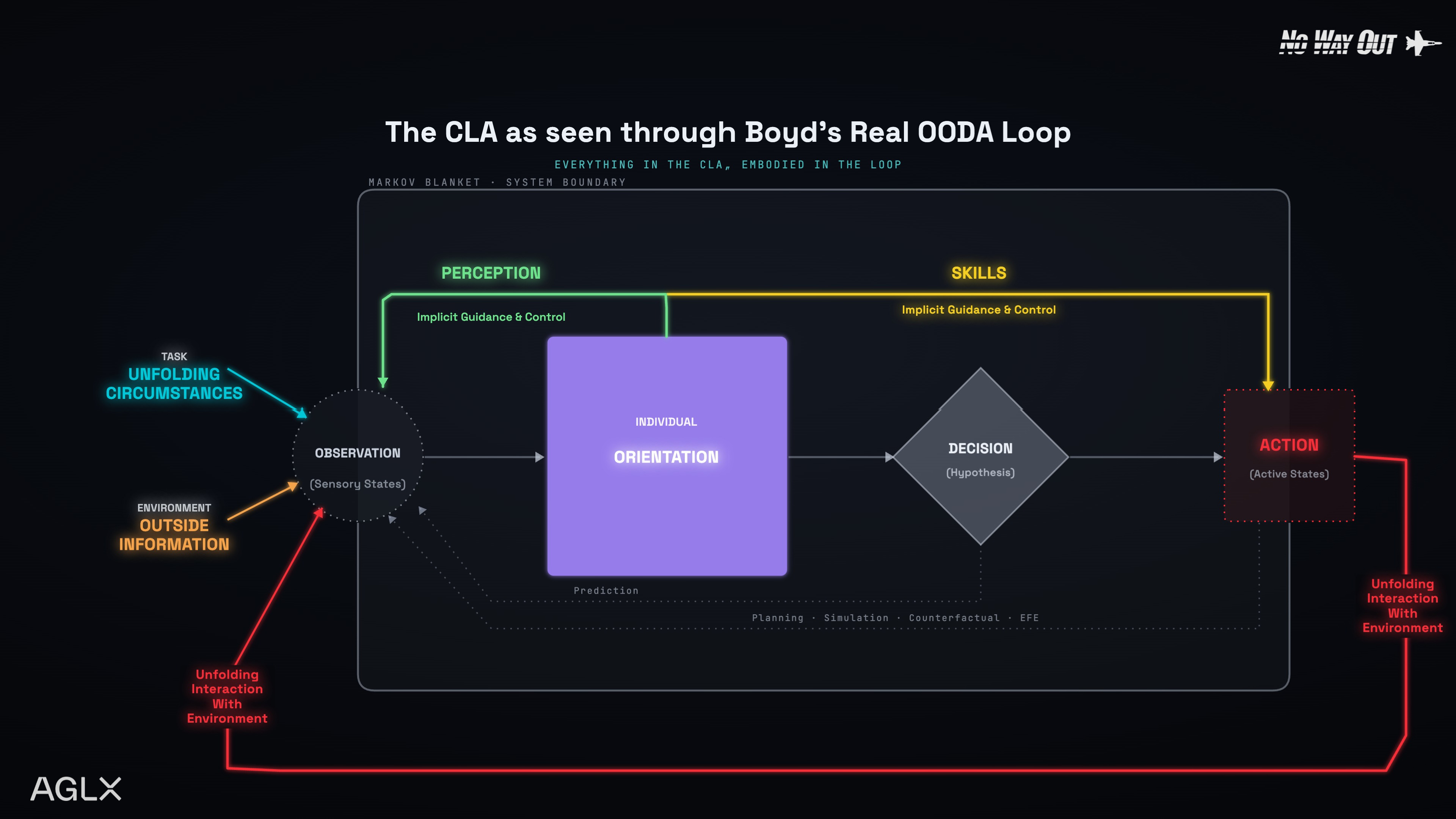
Now lay the CLA on top of it and watch the pieces land:
The constraints split across the boundary, one inside and two outside. The Individual constraint is internal. It loads into Orientation, inside the agent. The Task and Environmental constraints are external. They sit outside the boundary as Unfolding Circumstances and Outside Information. This is the real cut: the membrane separates the one constraint you carry with you from the two the world imposes on you.
Orientation is the world model. Genetic heritage, cultural traditions, previous experience, and incoming new information are integrated here, resolved through what Boyd called destruction and creation, discarding stale schemas and synthesizing new ones. This is the generative model, the mental model, the digital twin.
Perception is the implicit guidance and control pathway out of Orientation back to Observe. It steers what you attend to. In ecological terms it is the detection of specifying information that couples you to affordances.
Skill is the other implicit guidance and control pathway, Orientation straight to Act. This is the emergent movement solution. The intuition, the path-finding, the System 1 response. The exact thing the CLA is trying to grow.
The perception-action loop that ecological dynamics treats as the core is sitting right there inside the OODA loop. Strip away the other states and you can see it. What Boyd’s sketch adds, the piece the bare perception-action loop leaves out, is the layer in the middle: implicit guidance and control. That layer is the skill, and it is worth being precise about what skill is. It is habits of mind, intuition, the automatic and low-energy processing that Kotler and Friston both point to. Call it System 1. Call it Type 0 or Type 1 cognition. You do not build it by drilling muscle memory. You build it by attuning to the affordances in the environment, and not through repetition for its own sake. You build it through what Bernstein called repetition without repetition: you repeat the outcome, getting the ball in the basket, without ever repeating the exact movement.
Rob Gray’s favorite example is Steph Curry, who never takes the same shot twice yet keeps scoring. You attune, rep after varied rep, until the right response is simply there. This is what Boyd captured in his brief, Organic Design for Command and Control, and it is what Mission Command tells us. Build these habits of mind, not muscle memory, and you can find flow. Boyd called this feel Fingerspitzengefühl, the fingertip feeling, and the pathway it travels, the Skills, or Pathfinding, line from Orientation to Act, may be the single most important pathway in the entire OODA loop.
The mechanism that gets you there is the challenge-skills balance. Picture it as a graph, challenge on one axis and skill on the other, with a diagonal flow channel running up the middle. You want the challenge of the environment to sit a notch above your current skill, never matched, never crushing. Too much skill and not enough challenge, and you drift into boredom and complacency. Too much challenge for your skill, and you tip into anxiety and overwhelm. Stay in the channel and you find flow. Here is the key: developing the IG&C pathway, the Skills, is exactly what moves an athlete or team up and to the right, climbing the channel as challenge and skill rise together. Seen this way, the CLA is nothing more than building the skill to meet the challenge of the environment.
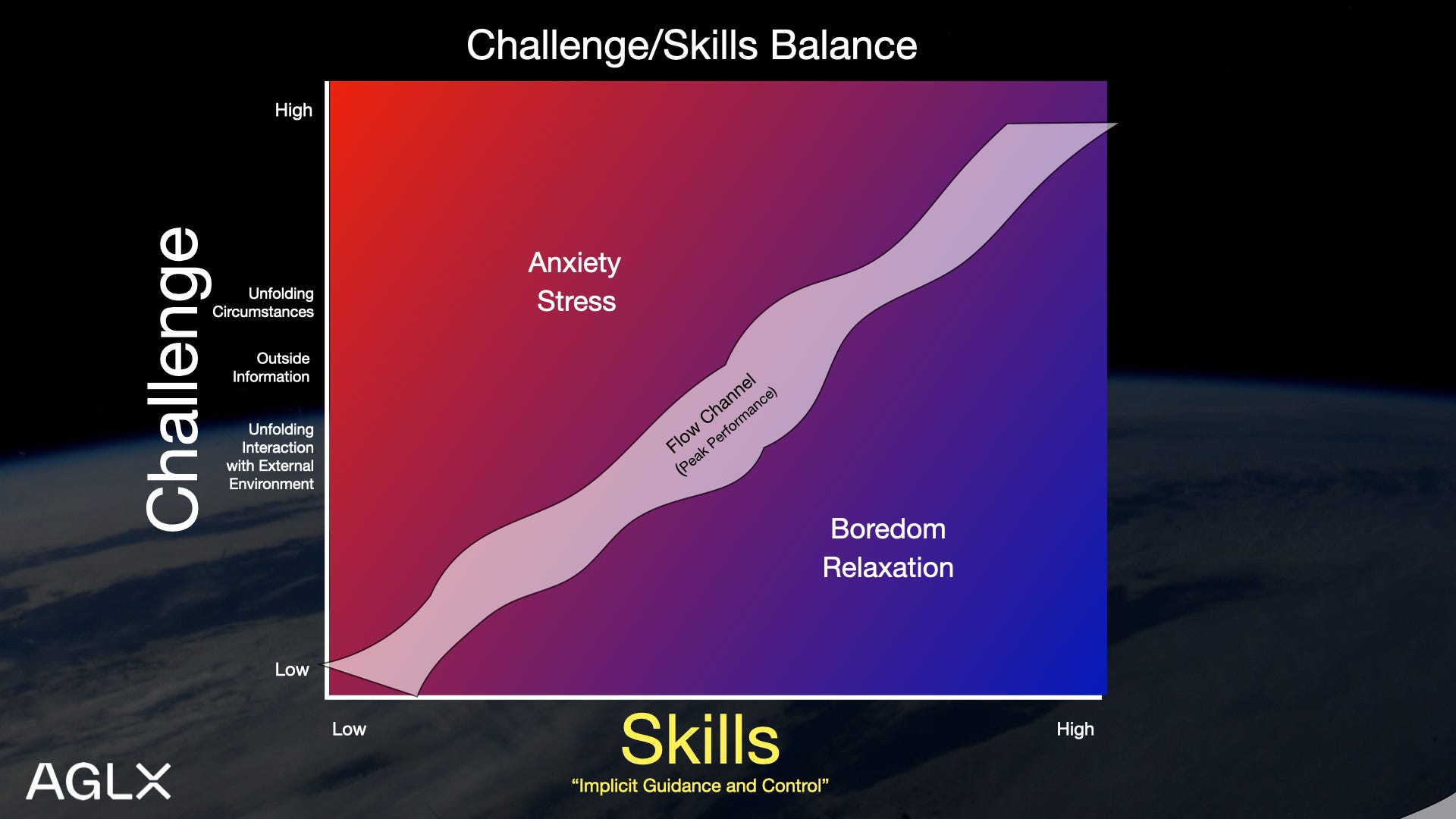
This is the point to be careful and generous. Rob Gray, Alex Sarama, and the ecological-dynamics community are not behind. They are building rigorous, practical, testable craft. The claim is not that anyone is reinventing a wheel they should have known about. The claim is convergence. Two serious traditions, working different problems, arrived at the same architecture. Boyd just happened to draw the whole thing on one page in 1995.
6. The boundary: an open system and a Markov blanket
Why does the membrane around the loop matter? Because athletes and teams are living, open systems, and open systems have structure that the cartoon erases.
For anything to exist, there has to be a boundary between that thing and everything else. From thermodynamics, an open system has inlets, an outlet, a boundary, and an environment outside it. The Constructal Law, Adrian Bejan’s first principle of physics, calls this a flow system: a current that flows and a design through which it flows, evolving so it provides greater access to its currents.
Draw Boyd’s four phases inside a boundary and the boundary cuts through Observe and Act. Observe becomes the inlet. Act becomes the outlet. Everything in section 3 now has a home:
Perception and skill live inside the boundary. They are internal states.
Interaction with the environment lives outside it.
Observation and Action are the boundary itself. Observation here is not the data, and not the act of observing. In Boyd’s loop it represents our sensory organs, our senses, the inlet through which the world reaches us. Action is the active states, the effectors that reach back out. Together, these sensory and active states are the only interface between the agent and the world.
Friston’s name for this interface is the Markov blanket. Sensory states carry surprise inward. Active states perturb the world outward. The athlete never touches the world directly. Everything crosses that blanket. Coaches who understand this stop trying to install behavior and start managing what flows across the boundary.
Now the distinction I promised in section 2. Once you draw the boundary, the truth gets simple: everything outside it is the environment. Full stop. And the environment is not empty. It is full of other living systems, teammates, opponents, the crowd, each one running its own loop. Those other loops are what generate your Unfolding Circumstances. Boyd said it plainly in his career interview. In a contest, “I am your environment, you are my environment.” The defender is not a fixed feature of the world like gravity. The defender is a competing loop, actively manufacturing circumstances designed to make you mismatch. That is why the environmental constraint and Unfolding Circumstances really belong together, and why the clean section-2 mapping was a teaching simplification rather than the whole truth.
Outside Information sits a little differently. It is what you couple to when you are wide open to the world, which is exactly what happens in flow. In flow the agent throws the door open to Outside Information, and Friston, along with his colleague Michael Levin, has connected this to something deeper still, a kind of platonic space the system resonates with rather than computes. Hold that thread loosely. It is one of the doors the next build walks through.
7. The OODA Loop’s Hidden Interior: The Four Ps and Decision
Open up the Decide node and you find the part most people skip. In the real loop, Decide is shaped like a diamond and annotated with one word: hypothesis. A decision is a test. It is also a prediction. As Friston framed it on our show, deciding what to do is “predicting your active states,” forecasting the move you are about to make. Act is how you run the test, and the result feeds back as information.
Here is a clean way I like to hold the whole interior of the loop. It has four internal pathways, and I label them with four words that happen to start with P: Perception, Pathfinding, Prediction, and Planning. Boyd did not name them this way. The labels are mine, and I borrowed Pathfinding from Steven Kotler and Karl Friston. Two of the four you have already met. Pathfinding is exactly the pathway we have been calling Skills, the implicit guidance and control line from Orientation to Act. So:
Perception is the IG&C pathway from Orientation back to Observe. It steers what you attend to.
Pathfinding, our Skills, is the IG&C pathway from Orientation to Act. It is intuition, the automatic response. Call it System 1. Call it Type 0 or Type 1 cognition.
Both are fast and reflexive, and we covered them across sections 3 through 5. They carry the overwhelming majority of skilled performance.
The other two Ps live in here, in the deliberative interior, and this is the minority case, not the default. Most reps never come in here. They run on Perception and Pathfinding. The interior comes online only for novelty, uncertainty, and time pressure, the moments the reflexive pathways cannot handle alone:
Prediction. The pathway from Decide back to Observe. Top-down expectations of what you are about to sense, generated to minimize prediction error.
Planning. The pathway from Act back to Observe. This is mental simulation: offline rehearsal of policies, running counterfactuals, selecting the action that minimizes expected free energy. It is the brain running its generative model with the world switched off, and dreaming belongs here too, the most untethered version of the same offline machinery. Expected free energy is just a precise word for risk, and notice it is already baked into the loop. You do not bolt a separate “risk” box onto OODA. It is in there, in the anticipatory machinery that keeps the whirl spinning.
There is a coaching payoff hiding in here, and Friston named it. You do not stay in this deliberative interior. You start there. The first time through a problem you think it out, weigh policies, rehearse the future. Do it again and again in the same situation and the response compiles down, from effortful system-two Prediction and Planning to fast system-one Pathfinding, our Skills. That is skill acquisition described from the inside. The whole point of good practice design is to move the athlete out of this interior and onto the reflexive Pathfinding, or Skills, pathway, where flow lives.
This machinery also behaves differently depending on the athlete’s state. In rigid, low-entropy states the simulation locks down. In higher-entropy states, including flow, it loosens, opens to novelty, and forges new connections. That is the bridge to the deeper Friston material, one that I often cover.
8. So what: Mission Command, coaches, and front offices
Before the practical list, the missing piece, and it is the one that turns this from a theory into a way to run an elite team. Boyd did not stop at how an individual adapts. He spent years on how an organization adapts, and he built his command philosophy on the German concept of Auftragstaktik, or Mission Command. Donald Vandergriff, the modern authority on it, describes Mission Command as a command culture and leadership style built on one rule: you tell people what to achieve and why, never how. You empower them to decide, take initiative, and act within the commander’s intent, and you back it with trust, education, and decentralization. Boyd leaned on Auftragstaktik, fingerspitzengefühl, decentralization, mutual trust, shared experience, and implicit communication so heavily that he threw out the words “command and control” altogether and replaced them with leadership and appreciation.
Two pieces matter for coaches. First, the Schwerpunkt, the focus or main effort, the thing everyone orients around. Second, the split between mission and intent: the mission is the what, the intent is the why. Boyd was deliberate that you sketch flexible plans, you do not finalize them, because plans that are too tight leave an athlete no freedom to exploit what the moment offers. Trust is the glue. With it, implicit communication carries the load and you save time in everyone’s loop. Without it, you are stuck writing detailed orders that arrive too late.
Sit with that for a second, because it is the same argument as the CLA. The coach is the higher command. You set the Schwerpunkt and you design the decision space, the constraints, the boundaries. Then you get out of the way and let the players read their environment and find solutions. Over-script the practice and you are issuing detailed orders to units that needed intent. Mission Command is not a military bolt-on to the CLA. It is the CLA, run at the level of the team.
From that frame, three practical consequences follow.
For practice design. When you set constraints, you are shaping the inputs that feed the internal states of the OODA loop, and through them you steer the whole thing. You are not teaching a movement. You are designing the conditions from which the movement emerges. That is the same job whether you call it nonlinear pedagogy, Mission Command, leading like a gardener, or getting inside the loop. And since most of what an athlete does runs on direct perception-action coupling, your job is to build rich, representative affordances, not to script decisions.
For talent and evaluation. Orientation is the real differentiator. Genetic heritage, previous experience, and the capacity for analysis and synthesis are what separate athletes, more than any single measurable skill. Evaluate the orientation, not just the output.
For performance and culture. You cannot coach the decision directly. There is no pathway for it. You coach the constraints, you set the intent, you build the trust, and you let the solution emerge. The athletes and teams who win are the ones who can reorient faster than the situation changes, and whose implicit guidance and control, and implicit communication, is rich enough to act before the rest of us have finished observing.
Note the discipline here, because it matters. We do not attack the athlete. We design the system around them.
9. Close: one loop
So here is where we land. Newell’s constraints, the ecological perception-action engine, the predictive and prospective machinery of the brain, and Boyd’s whirl of reorientation are not four frameworks competing for room on your whiteboard. They are one loop, described four times by people who never sat in the same room.
[VIDEO PLACEHOLDER: Substack-hosted video from the original post (mediaUploadId ca0245cf-02e8-4718-8326-5533149ebfce). Re-upload the video here before publishing, then delete this line.]
Everything in the CLA framework is already embodied in the real OODA loop. The Individual constraint sits inside as Orientation, while Task and Environment sit outside the boundary as Unfolding Circumstances and Outside Information. The perception-action engine, running on directly perceived affordances and optic flow, is the inner loop. Skill is the implicit guidance and control pathway between perception and action, built by attuning to affordances, not by drilling muscle memory. The boundary is the Markov blanket. The decision is a hypothesis you test by acting, with the predictive interior held in reserve for the moments that demand it. And the way you lead it, set the Schwerpunkt and the intent, then let solutions emerge, is Mission Command.
That is the loop Boyd sketched on one page in 1995, and it is the loop a good coach is running in every rep of a well-designed practice.
Here is the call to action, and it is aimed at the people at the top. The most important skill in any organization is not technical. It is teamwork, and teamwork is a skill, which means it can be developed the same way any other skill can: by designing constraints and letting solutions emerge. Now imagine pointing the CLA and the real OODA loop, everything we just walked through, at the non-technical skills that actually decide whether a team wins: teamwork, communication, trust, and decision-making under pressure. That is exactly what we have been doing at AGLX. This is where the C-suite comes in. The paradigm shift moving through coaching is not just for the skill-acquisition staff. Your job as a leader is to apply these same first principles to strategy, teamwork, and the way the whole organization adapts.
There is No Way Out!
-Ponch
Brian “Ponch” Rivera is a retired U.S. Navy Captain, co-founder of AGLX Consulting, co-creator of The Flow System, co-founder of The Flow Consortium, TEDx speaker, host and producer of the No Way Out podcast, and a recovering naval aviator.
References
Boyd and Boyd scholarship
Boyd, J. R. (1976). Destruction and creation [Unpublished essay, 3 September 1976]. Reprinted in G. T. Hammond (Ed.), A discourse on winning and losing (2018). Air University Press.
Boyd, J. R. (1977, January 28). Corona Ace oral history interview [Interview transcript]. United States Air Force, the Pentagon, Washington, DC.
Boyd, J. R. (1987). Organic design for command and control [Briefing]. In A discourse on winning and losing.
Boyd, J. R. (1992). Conceptual spiral [Briefing].
Boyd, J. R. (1995). The essence of winning and losing [Briefing, first edition dated 28 June 1995].
Hammond, G. T. (2001). The mind of war: John Boyd and American security. Smithsonian Institution Press.
Hammond, G. T. (Ed.). (2018). A discourse on winning and losing. Air University Press.
Osinga, F. P. B. (2007). Science, strategy and war: The strategic theory of John Boyd. Routledge.
Constraints, ecological dynamics, and the CLA
Bernstein, N. A. (1967). The co-ordination and regulation of movements. Pergamon Press.
Button, C., Seifert, L., Chow, J. Y., Araújo, D., & Davids, K. (2020). Dynamics of skill acquisition: An ecological dynamics approach (2nd ed.). Human Kinetics.
Davids, K., Button, C., & Bennett, S. J. (2008). Dynamics of skill acquisition: A constraints-led approach. Human Kinetics.
Gray, R. (2021). How we learn to move: A revolution in the way we coach & practice sports skills. Perception Action Consulting & Education.
Newell, K. M. (1986). Constraints on the development of coordination. In M. G. Wade & H. T. A. Whiting (Eds.), Motor development in children: Aspects of coordination and control (pp. 341–360). Martinus Nijhoff.
Renshaw, I., Davids, K., Newcombe, D., & Roberts, W. (2019). The constraints-led approach: Principles for sports coaching and practice design. Routledge.
Sarama, A. (2024). Transforming basketball: Changing how we think about basketball performance. Independently published.
Ecological psychology, perception, affordances, and optic flow
Gibson, J. J. (1947). Motion picture testing and research (Army Air Forces Aviation Psychology Program Research Reports, No. 7). U.S. Government Printing Office.
Gibson, J. J. (1950). The perception of the visual world. Houghton Mifflin.
Gibson, J. J. (1979). The ecological approach to visual perception. Houghton Mifflin.
Langewiesche, W. (1944). Stick and rudder: An explanation of the art of flying. McGraw-Hill.
Turvey, M. T. (1992). Affordances and prospective control: An outline of the ontology. Ecological Psychology, 4(3), 173–187.
Active inference, predictive processing, and the free-energy principle
Friston, K. (2010). The free-energy principle: A unified brain theory? Nature Reviews Neuroscience, 11(2), 127–138.
Friston, K. J., Levin, M., Sengupta, B., & Pezzulo, G. (2015). Knowing one’s place: A free-energy approach to pattern regulation. Journal of the Royal Society Interface, 12(105), 20141383.
Parr, T., Pezzulo, G., & Friston, K. J. (2022). Active inference: The free energy principle in mind, brain, and behavior. MIT Press.
Wilson, A. D., Buckingham, G., Dessing, J. C., Lappi, O., Friston, K., Hipólito, I., Ramstead, M., Mansell, W., & Gray, R. (2024). Predictive vs. prospective control: Clarifying the terms of the debate. PsyArXiv. https://doi.org/10.31234/osf.io/ce3zb
Consciousness and the construction of perception
Rovelli, C. (2021). Helgoland: Making sense of the quantum revolution (E. Segre & S. Carnell, Trans.). Riverhead Books.
Seth, A. (2021). Being you: A new science of consciousness. Faber & Faber.
Flow
Csikszentmihalyi, M. (1990). Flow: The psychology of optimal experience. Harper & Row.
Kotler, S. (2014). The rise of superman: Decoding the science of ultimate human performance. New Harvest.
Physics and the Constructal Law
Bejan, A. (2016). The physics of life: The evolution of everything. St. Martin’s Press.
Bejan, A., & Zane, J. P. (2012). Design in nature: How the constructal law governs evolution in biology, physics, technology, and social organization. Doubleday.
Mission Command
Vandergriff, D. E. (2019). Adopting mission command: Developing leaders for a superior command culture. Naval Institute Press.
Vandergriff, D. E., & Webber, S. (Eds.). (2017). Mission command: The who, what, where, when and why — An anthology. CreateSpace.