


Originally published in The Whirl of ReOrientation on April 1, 2025.
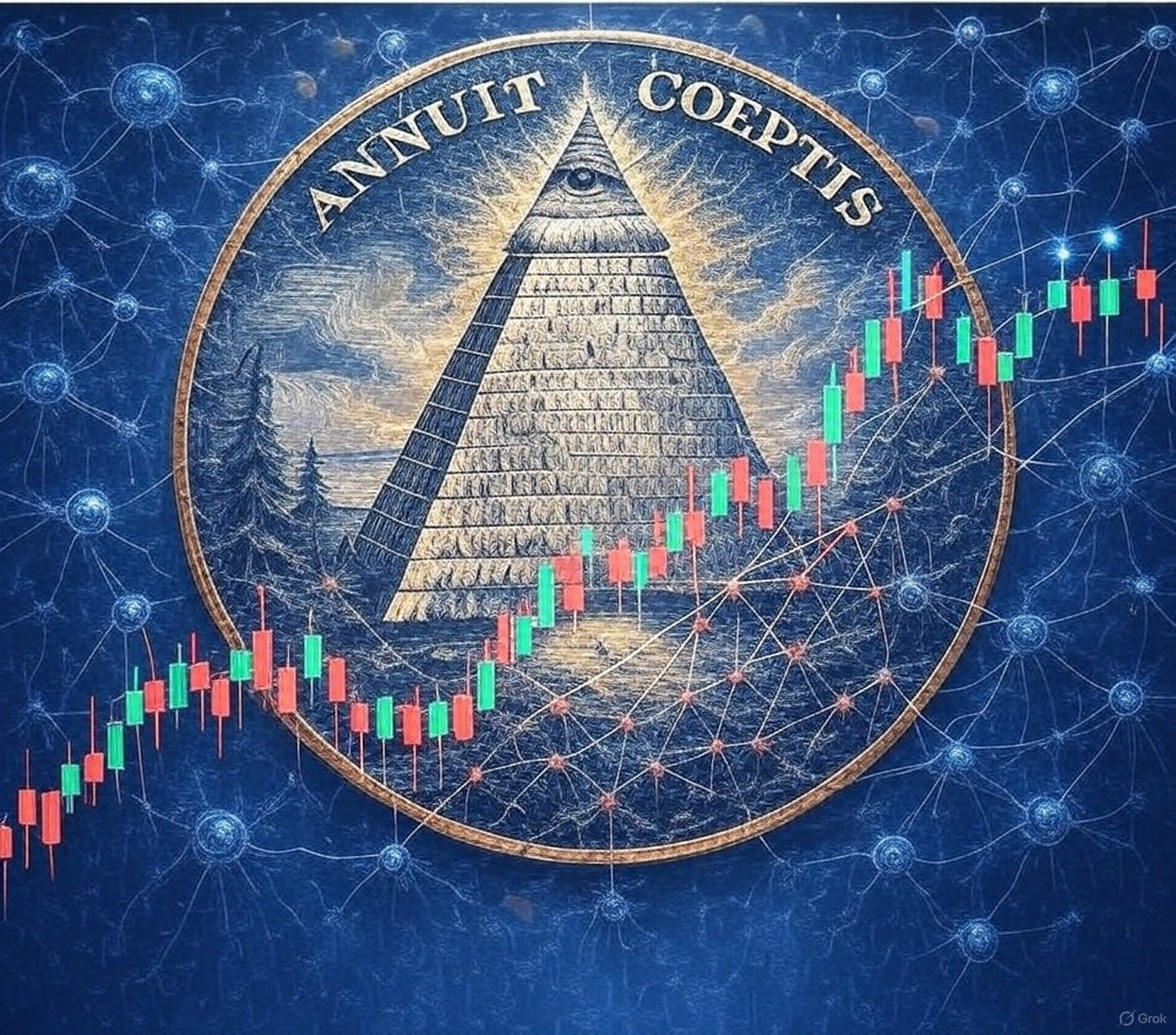
In the ever-shifting landscape of financial markets, where prices oscillate and moods sway, Patrick Schotanus’s Market Mind Hypothesis (MMH) offers a revolutionary lens: the market is not a mere mechanism but a conscious entity, a collective mind extended through human agents and technology. Rooted in an interdisciplinary tapestry of economics, cognitive science, and philosophy, Schotanus’s work—highlighted in his No Way Out conversation —draws a striking parallel between the market’s dynamics and Karl Friston’s Free Energy Principle (FEP), a cornerstone of modern neuroscience. By exploring this connection, we uncover how the market’s consciousness emerges as it minimizes free energy, striving to predict and adapt to an uncertain world, much like the human brain.
The Market Mind Hypothesis: A Conscious Market
Schotanus’s MMH posits that the market embodies a collective consciousness, a notion he formalizes from investors’ casual references to the “mind of the market.” As he explains to Ponch, “The market, embodying numerous human minds extended via technologies like Bloomberg and Reuters terminals, not only distributes their knowledge... but also manifests collective consciousness.” Prices serve as the informational signatures of this consciousness, while market mood—its phenomenal, immersive quality—reflects its subjective experience. This challenges the mechanistic worldview of mainstream economics, which Schotanus critiques through Robert Lucas’s vision of a “mechanistic artificial world populated by interacting robots.”
Drawing parallels with John Boyd’s interdisciplinary journey—whose OODA loop emerged from his background in economics, fighter aviation, and an insatiable curiosity spanning the natural sciences, including neuroscience, biology, and philosophy—Schotanus argues that the market’s consciousness arises from its 4E cognition: it is embodied in technology, embedded within institutions, enacted through purposeful action, and extended across interconnected minds and systems. He emphasizes this with a key insight from his book: “Our mind is busy limiting free energy. The market’s mind is limiting free lunch.” Here, the market’s pursuit of efficiency mirrors the brain’s drive to reduce uncertainty, a process formalized by the Free Energy Principle.
The Free Energy Principle: A Blueprint for Consciousness
The Free Energy Principle, developed by Karl Friston, asserts that living systems—particularly the brain—minimize free energy to maintain homeostasis in an unpredictable environment. Free energy, in this context, is the difference between the brain’s predictive model of the world and the sensory data it receives. By updating its predictions (perception) or acting to align the world with its expectations (action), the brain reduces surprise, optimizing its internal model. This process, known as active inference, underpins Bayesian inference and aligns with Boyd’s OODA loop, where mismatches between observation and orientation drive adaptation.
Schotanus explicitly connects this to the market, noting its relevance to predictive processing: “This is where the link I make in the book with predictive processing [comes in].” He cites George Soros’s view of the market as “a laboratory of hypothesis testing,” suggesting that traders, like neurons, engage in a continuous cycle of prediction and error correction. The market, as a collective entity, processes information—news, price signals, and sentiment—to minimize uncertainty, akin to the brain minimizing free energy.
The Market’s Consciousness: A Free Energy Perspective
If the market is conscious, as Schotanus contends, how does the Free Energy Principle illuminate this? Consider the market as a distributed cognitive system, its “neurons” comprising individual traders, hedge funds, and algorithms, all interconnected via prices and technology. Just as the brain integrates sensory inputs to form a coherent model, the market aggregates individual actions into a collective prediction, reflected in price discovery. Schotanus explains, “Price discovery is the central dynamic in the market where people try to estimate value,” a process driven by epistemic utility—the value of reducing uncertainty about the future.
This mirrors the FEP’s dual mechanism: perception updates the market’s generative model (e.g., adjusting expectations based on earnings reports), while action shapes the environment (e.g., trading to influence prices). When a news event triggers a price change, the market “consumes” this information, updating its collective state, much like the brain processes surprise. Schotanus ties this to phenomenal experience: a 25% portfolio drawdown is not just quantitative but “accompanied by the quality of hurt,” suggesting that market mood is the felt aspect of its consciousness, akin to subjective awareness in humans.
Moreover, the market’s extended nature—via Bloomberg terminals and Reuters—parallels the brain’s reliance on external tools, as in Andy Clark and David Chalmers’s extended mind thesis. Schotanus emphasizes, “The physical scaffolding has to be outside of the individual minds,” enabling collective cognition. Prices, as “dual realizations of information” (physical and phenomenal), bridge this gap, embodying the market’s conscious state.
Cycles, Noise, and the Limits of Prediction
The FEP also accounts for cycles and noise, which Schotanus identifies in both brain and market. “We have brain waves... and in economics, we had the Kondratieff and some other cycles,” he notes, linking neuronal noise to price volatility. In the brain, noise (e.g., Brownian motion in neural firing) introduces variability that the FEP manages through predictive coding. Similarly, the market navigates noise—excess volatility or meme stock frenzies—by refining its collective model, though Schotanus warns that over-mechanization (e.g., passive investing) risks disconnecting it from fundamentals, amplifying free energy rather than reducing it.
This raises a critical limit, echoed by Boyd’s reference to Gödel’s incompleteness theorem: “One cannot determine the character or nature of a system within itself.” The market, like the brain, cannot fully predict itself, as its consciousness emerges from recursive, non-linear interactions. Schotanus’s “system three”—the phenomenal awareness distinguishing emotion from rationality—underscores this: the market knows its state only through experience, not computation.
Implications: A Conscious Market in Action
Viewing the market as a conscious entity minimizing free energy has profound implications. It suggests that market behavior—bullish runs, bearish crashes, or systemic crises like the GFC—reflects a collective effort to align predictions with reality. Schotanus’s “aha experiences” (insights driving price surges) and “oh no shocks” (reality checks like the GFC) parallel the brain’s moments of clarity or disruption, where free energy spikes and resolves. This perspective could inform predictive models, focusing on mood shifts and information flows rather than linear trends.
However, Schotanus cautions against over-reliance on algorithms, which “don’t care” like humans do. A 24/7 market, he suggests, risks losing its reflective “sleep” phase, akin to a brain deprived of rest, inviting unforeseen failures. His MMH thus calls for a psychophysical approach—embracing consciousness over mechanism—to guide economic policy and education, ensuring the market serves society rather than itself.
Conclusion: A New Enlightenment Through Consciousness
Patrick Schotanus’s Market Mind Hypothesis, intertwined with the Free Energy Principle, reimagines the market as a conscious, adaptive system. By minimizing free energy through price discovery and mood, it mirrors the brain’s quest for coherence in a chaotic world. This synthesis—of economics, neuroscience, and philosophy—echoes Boyd’s interdisciplinary legacy, offering a “new economic enlightenment” where the market’s mind is not just a metaphor but a living reality. As Schotanus asserts, “No theory of consciousness will be complete if you do not address the collective dimension”—and in the market, we find its most vivid expression.