

Originally published in The Whirl of ReOrientation on February 18, 2026.
The content discussed in this episode of the No Way Out Podcast, including any references to markets, trading strategies, patterns, historical examples, or specific securities, is provided for educational and informational purposes only. It is not, and should not be construed as, financial, investment, trading, or legal advice of any kind.
Strategy begins with a map. All maps are wrong, some are useful. The question is: How do we map markets?
We can reach for tools such as DIMEFIL or PMESII, or generate 2×2 matrices to impose structure on the chaos. Here is a simpler idea. What if markets acted like music? Could we use an equity’s or index’s path or ‘seed’ to project its future trajectory, not through rigid forecasting, but through resonance and flow? What if we treat price action as a living flow system that connects to and reflects global consciousness? In a recent conversation on the No Way Out Podcast with legendary trader Larry Pesavento, we explored exactly that possibility. The discussion revealed how sacred geometry, fractal mathematics, and the principle of interconnectedness might explain why markets exhibit non-random, repeating patterns that traditional analysis often misses.
Markets are complex adaptive systems. Attempts to reduce them to constituent parts such as price-to-earnings-growth ratios, insider transactions, institutional holdings—inevitably fail because complexity cannot be fully understood through dissection. Synthesis, not analysis, uncovers the deeper structure. What if I told you the way we map markets is by looking for attractors? You can think of attractors as harmonics—yes, like music. Music is also based on geometry and fractal patterns, where proportional intervals create resonance. The more dissonance we have, the more disorder and lower probabilities; the more resonance, the higher the probability of alignment.
“Mandelbrot used a seed pattern as a constant. As the seed pattern grew, it manufactured the building blocks that became larger patterns, patterns that maintained the original shape of the seed. He’s telling you. Markets are fractal.”
Pesavento illustrated this through centuries-old principles rooted in Pythagoras, whom Einstein reportedly placed between God and ordinary humanity in intellectual stature. From the Sierpinski triangle (a fractal born from simple iterative rules) to the Fibonacci sequence appearing in mollusk shells, planetary orbits, and human proportions as depicted in Leonardo da Vinci’s Vitruvian Man, the same mathematical relationships recur across nature.

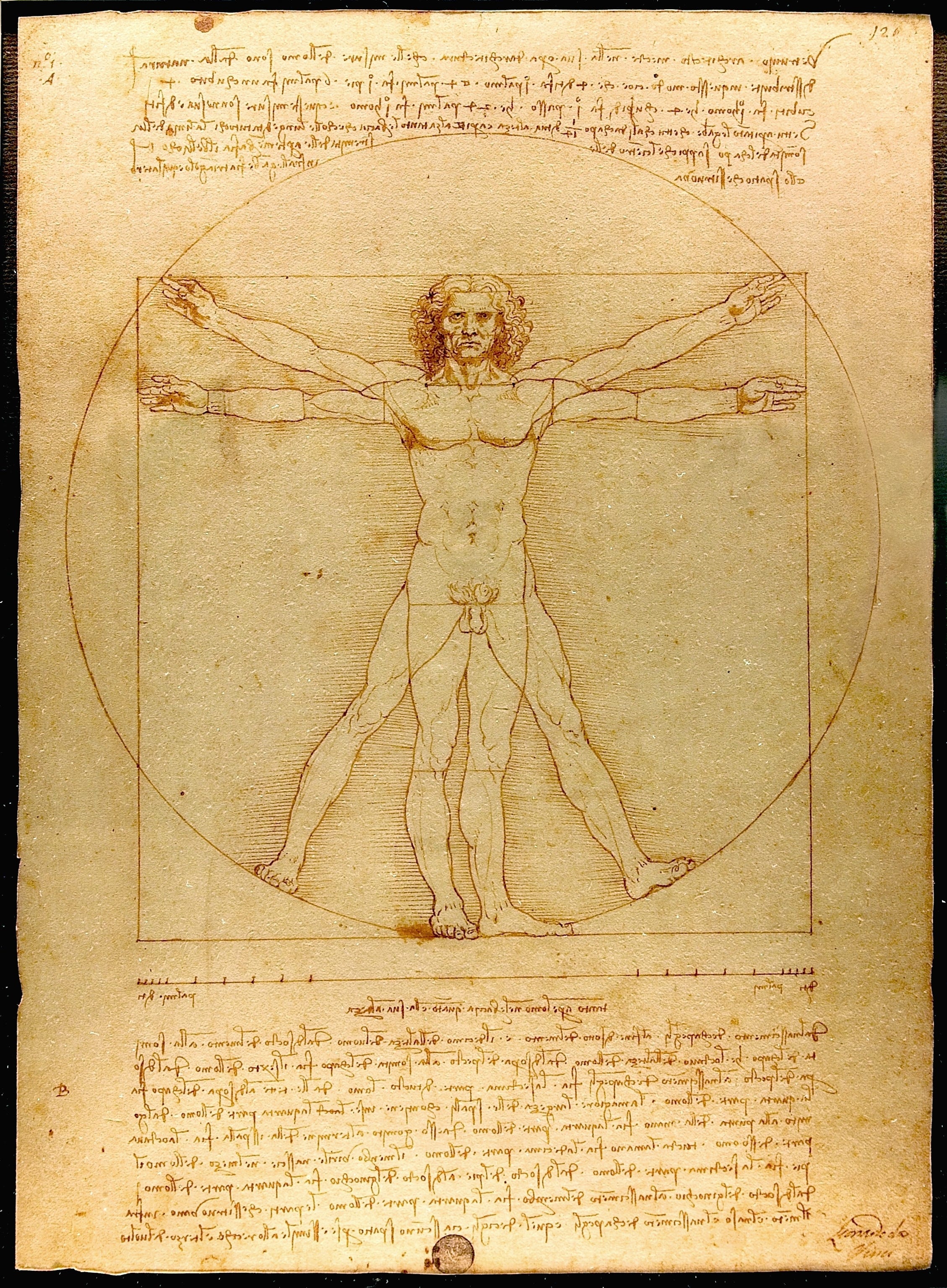
These are not coincidences. The golden ratio (approximately 0.618) and its derivatives (0.382, 0.786, 1.618) emerge in market price action with striking consistency. Pesavento demonstrated live examples: silver retracing precisely to Fibonacci levels following major news events, Bitcoin projecting future targets through AB=CD patterns, and broader indices showing fractal self-similarity across timeframes. Benoit Mandelbrot’s work on fractals in financial markets—where small “seed” patterns build into larger, structurally identical formations—provides the mathematical foundation. Jim Simons and other quant pioneers reportedly drew on similar non-linear insights to generate extraordinary returns.
If we accept that human beings are fundamentally connected—projecting collective emotions, expectations, and perceptions into the shared arena of markets—then price and time become a reflection of that unified consciousness. Fear and greed vibrate through the system like ripples from a pebble in a pond, creating harmonic attractors where price is drawn with probabilistic regularity. These harmonics tie directly to geometry: just as musical notes resonate in proportional intervals rooted in sacred shapes (like the pentagram in Fibonacci spirals), market movements echo these vibrational patterns. Geometry connects to harmonics through wave-like repetitions—think of planetary alignments forming pentagrams or DNA’s spiral conforming to 0.618 ratios—mirroring how living systems, per the OODA loop, represent interactions with the external world.
Pesavento’s approach strips away noise. No reliance on CNBC headlines, macroeconomic pronouncements, or analyst consensus. Instead, the charts speak in the language of nature: symmetry, proportion, repetition, and harmonic resonance. When a major cycle—such as the 92-year echo from the 1932 low—aligns with geometric completions across indices, the signal becomes impossible to ignore.
This perspective challenges conventional finance. Yet the evidence Larry claims accumulates: MIT-backed research confirming non-random walks, historical cycle alignments, and the quiet success of those who trade what they see rather than what they hear. In an era of unprecedented narrative overload, returning to first principles—geometry, fractals, harmonics, and the recognition of our shared consciousness—may offer the clearest path forward.
The market doesn’t just reflect reality. It reflects us.
This is not financial, investment, or trading advice. The Feb. 12, 2026 podcast episode recording with Larry Pesavento is for educational/entertainment purposes only. Markets are highly volatile; past patterns do not guarantee future results. Always do your own research, consult qualified professionals, and never risk more than you can afford to lose.