


Originally published in The Whirl of ReOrientation on October 13, 2025.
It is a VUCA world—from AI reshaping industries to geopolitical tensions threatening global trade—where the 2025 Nobel Memorial Prize in Economic Sciences arrives as a timely beacon. Awarded to Joel Mokyr, Philippe Aghion, and Peter Howitt for their groundbreaking work on innovation and sustained economic growth, the prize underscores the vital role of “creative destruction” in lifting societies out of stagnation. But this recognition isn’t just an academic pat on the back; it’s a clarion call to revisit the profound insights of military strategist John Boyd in his 1976 essay, Destruction and Creation.

Boyd’s D&C mirrors the very processes the laureates describe and is the Alpha and Omega for what Boyd would sketch 19 years later, the OODA loop. The Nobel laureates illuminate how innovation has transformed human history. For millennia, economic growth was fleeting: discoveries sparked brief progress, only to fizzle into stagnation. Then, over the past two centuries, something shifted. Mokyr, drawing on historical analysis, argues that sustained growth emerged when societies developed scientific explanations for why innovations work, allowing them to build cumulatively. Crucially, he emphasizes the need for cultural openness to new ideas, where resistance from entrenched interests could otherwise smother progress.
Aghion and Howitt complement this with their mathematical model of creative destruction—a term borrowed from economist Joseph Schumpeter. In their 1992 paper, they show how new technologies and products enter the market, outcompeting and displacing the old. This “creative” birth of the novel is inherently “destructive,” as outdated firms and methods are sidelined. Yet, this cycle fuels ongoing growth, improving living standards, health, and quality of life. As the prize committee noted, without managing the conflicts arising from this process—such as lobbying by incumbents to block newcomers—societies risk reverting to the historical norm of economic flatlining.
The laureates’ warnings resonate today. Amid AI’s potential to spark another boom, the threat of tribalism amplified by state and non-state actors using 5th Generation Warfare could hamper the flow of ideas and new snowmobiles (The Adjacent Possible). Mokyr himself expressed optimism about humanity’s ingenuity, citing advances in AI and genetic engineering as evidence of an “age of radical innovation.”
But sustaining this requires embracing disruption, not fearing it. Enter John Boyd whose ideas on strategy and how novelty is generated have influenced fields from business to warfare. In “Destruction and Creation,” Boyd argues that to survive and thrive in a changing environment, we must continually shatter and rebuild our mental models (Orientation)—our world models or conceptual frameworks for understanding reality. Drawing on Gödel’s incompleteness theorems, Heisenberg’s uncertainty principle, and the second law of thermodynamics, Boyd posits that rigid adherence to existing concepts leads to entropy: increasing disorder, mismatch with reality, and eventual collapse. The process Boyd describes is a “dialectic engine”:
Destruction: Break down old mental patterns into a “sea of anarchy,” freeing elements from outdated structures. This unstructuring reveals inconsistencies and opens the door to novelty.
Creation: From the chaos, synthesize new concepts by identifying common threads among the fragments, forming broader, more adaptive models.
This cycle isn’t optional; it’s essential for independent action and adaptation. As Boyd writes, “Over and over again, this cycle of Destruction and Creation is repeated until we demonstrate internal consistency and match-up with reality.” Without it, inward-focused refinement amplifies uncertainty, leading to chaos—or, in economic terms, stagnation.
The parallels to the Nobel winners’ work are striking. Boyd’s “destruction” echoes the laureates’ depiction of old technologies and outdated world models (Orientation) being outcompeted, while his “creation” aligns with the emergence of innovative breakthroughs. Mokyr’s call for scientific understanding and openness mirrors Boyd’s emphasis on testing new models against reality and avoiding closed systems.
Aghion and Howitt’s creative destruction is Boyd’s dialectic in action: disorder begets order, entropy fuels innovation. In both views, progress demands managing the tension between stability and change—lest vested interests (or rigid minds) block the path forward.
Why is this Nobel a wake-up call to read Boyd? Because in an era of accelerating disruption, economic theories alone aren’t enough. Boyd’s D&C, combined with his discourse on Winning and Losing which includes his OODA loop sketch, provides a meta-framework for how to think about innovation: not as a linear march, but as a relentless, entropy-driven cycle.
“Destruction and Creation” reminds us that we have to resist human nature and do hard things. To innovate and grow, we must seek surprise. Boyd’s Snowmobile metaphor is Stuart Kauffman’s Theory of the Adjacent Possible without the math.
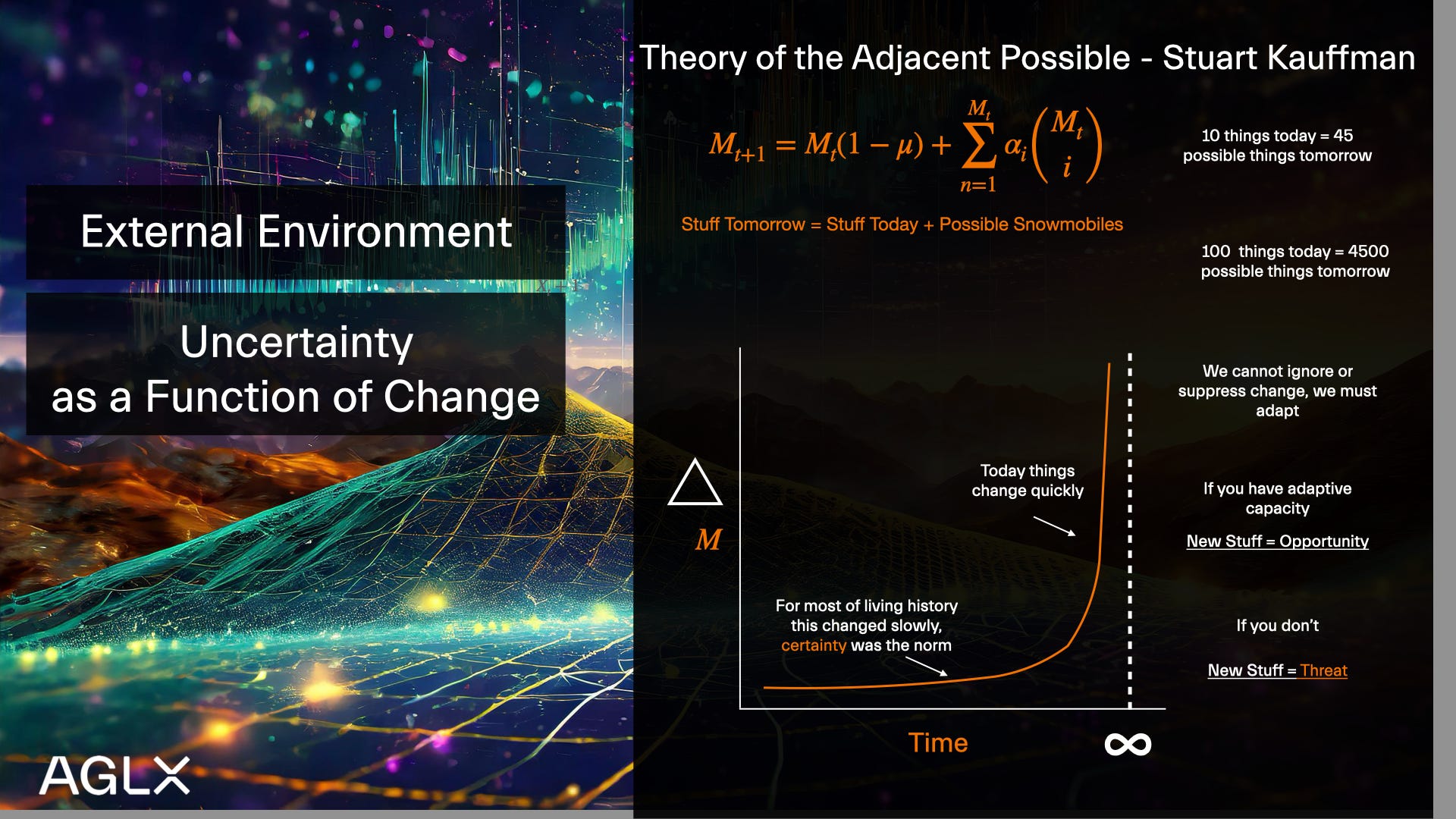
Policymakers, business leaders, and individuals must cultivate this Orientation to harness AI’s promise without falling into protectionist traps or intellectual silos. As the laureates warn, growth isn’t guaranteed; it requires upholding mechanisms that allow creative destruction to flourish.
Boyd’s D&C essay transcends disciplines. It’s a reminder that true progress stems from the courage to destroy the familiar and create anew. In honoring Mokyr, Aghion, and Howitt, the Nobel committee has inadvertently spotlighted Boyd’s timeless wisdom. Now is the moment to heed it—before stagnation creeps back in.
Note: John Boyd’s first degree was in economics.