


Originally published in The Whirl of ReOrientation on March 14, 2026.
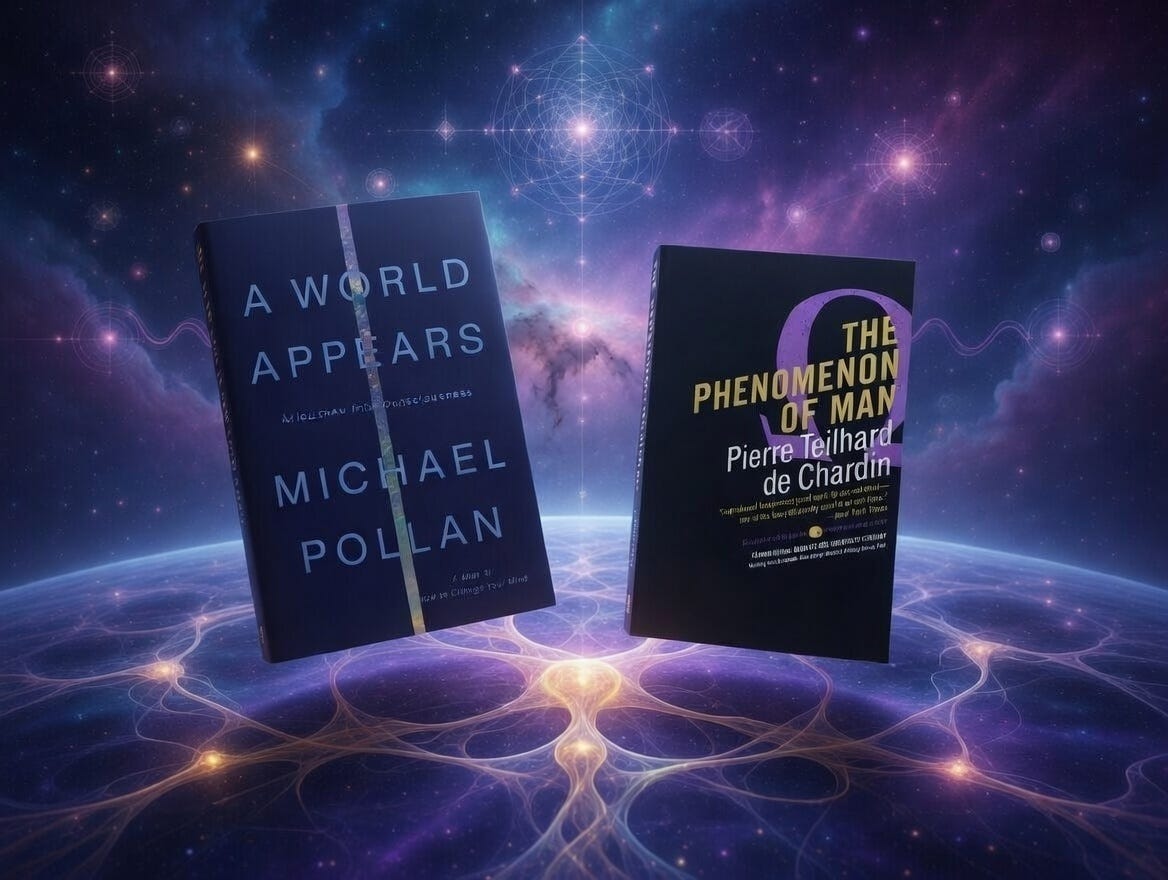
During a recent family ski trip to Park City, Utah, I found myself immersed in the quest for flow, both on the slopes and in the pages of two captivating books: Teilhard De Chardin’s The Phenomenon of Man and Michael Pollan’s latest work, A World Appears: A Journey into Consciousness, which my wife picked up at the airport and absolutely loved. Pollan’s ability to communicate complex ideas in an accessible and engaging manner has made his work a valuable resource for anyone interested in exploring consciousness and its relationship to the world around us.
“Nothing is constructed except at the price of an equivalent destruction.”
-Pierre Teilhard de Chardin, The Phenomenon of Man
As I read Pollan’s book, I couldn’t help but draw connections to the ongoing discussions surrounding consciousness, the Free Energy Principle, and the Platonic Space —the agent-environment relationship or what the real OODA loop represents. For those unfamiliar with Pollan’s work, I highly recommend checking out his recent appearance on the Joe Rogan Experience podcast, where he discusses the concept of flow and its relationship to consciousness.
Here is a short clip where Pollan talks about Flow:
[VIDEO PLACEHOLDER: Substack-hosted video from the original post (mediaUploadId ae1a83cb-1992-4d7d-8987-75f7bb5b17f8). Re-upload the video here before publishing, then delete this line.]
In the past, I’ve been hesitant to bring the OODA loop into the consciousness debate, which has touched on topics such as panpsychism and the Integrated Information Theory (IIT). However, Pollan’s previous book, How to Change Your Mind, introduced me to Friston’s Free Energy Principle via Ryan Carhart-Harris’s Reduced Beliefs Under Psychedelics (REBUS) and Entropic Brain Hypothesis. This connection led me to reconsider the OODA loop’s potential role in understanding consciousness.
The way I sketch the OODA loop, with an entropic boundary and no changes to the loop itself, aligns with Chuck Spinney’s view in his Evolutionary Epistemology brief. By introducing an explicit boundary, the OODA loop takes on new meaning and opens up possibilities for exploring concepts like Michael Levin’s Platonic Space as a direct connect to Boyd’s “Outside Information.”
[VIDEO PLACEHOLDER: Substack-hosted video from the original post (mediaUploadId c6dfdacf-2125-49d0-b525-6c3d6ab10117). Re-upload the video here before publishing, then delete this line.]
Clip: Michael Pollan discussing Michael Levin’s work on Xenobots and consciousness on the Joe Rogan Experience
On Rogan, Pollan highlights Levin’s suggestion that to truly understand consciousness, one must change oneself and experience it directly. This participatory requirement mirrors John Boyd’s position found in his Organic Design for Command and Control and Strategic Game briefs, which invoke Gödel’s Incompleteness Theorems, Heisenberg’s Uncertainty Principle, and the Second Law of Thermodynamics to demonstrate that no system can determine its own character from within itself. Inward focus, Boyd argues, breeds confusion, entropy, and friction because “the environment intrudes.”
This realization has led me to consider the three types of OODA loop understanding and how we can guide people from their current perspective to a deeper comprehension of how things may work. This post is an invitation to the academic and “Merchants of Certainty” communities to explore Boyd’s work, to look beyond the apparent lack of papers and instead follow the breadcrumbs he left behind.
In the following sections, I will explore the three types of OODA loops and their implications for understanding consciousness, cognition, and the nature of reality itself. By synthesizing insights from Pollan, Levin, Friston, and Boyd, I hope to shed new light on these profound questions and inspire further exploration and debate. As Pollan’s work demonstrates, the path to understanding consciousness is one that requires both rigorous scientific inquiry and a willingness to embrace the transformative power of direct experience.
John Boyd’s OODA loop sketch, the capstone of one man’s desire to understand the nature of creativity, has far-reaching implications for understanding how living systems interact with their environment. Recent advancements in neuroscience and theoretical biology, particularly the Free Energy Principle (FEP), have shed new light on the profound insights embedded in Boyd’s simple yet powerful sketch.
The Closed System Loop and Agents of Chaos
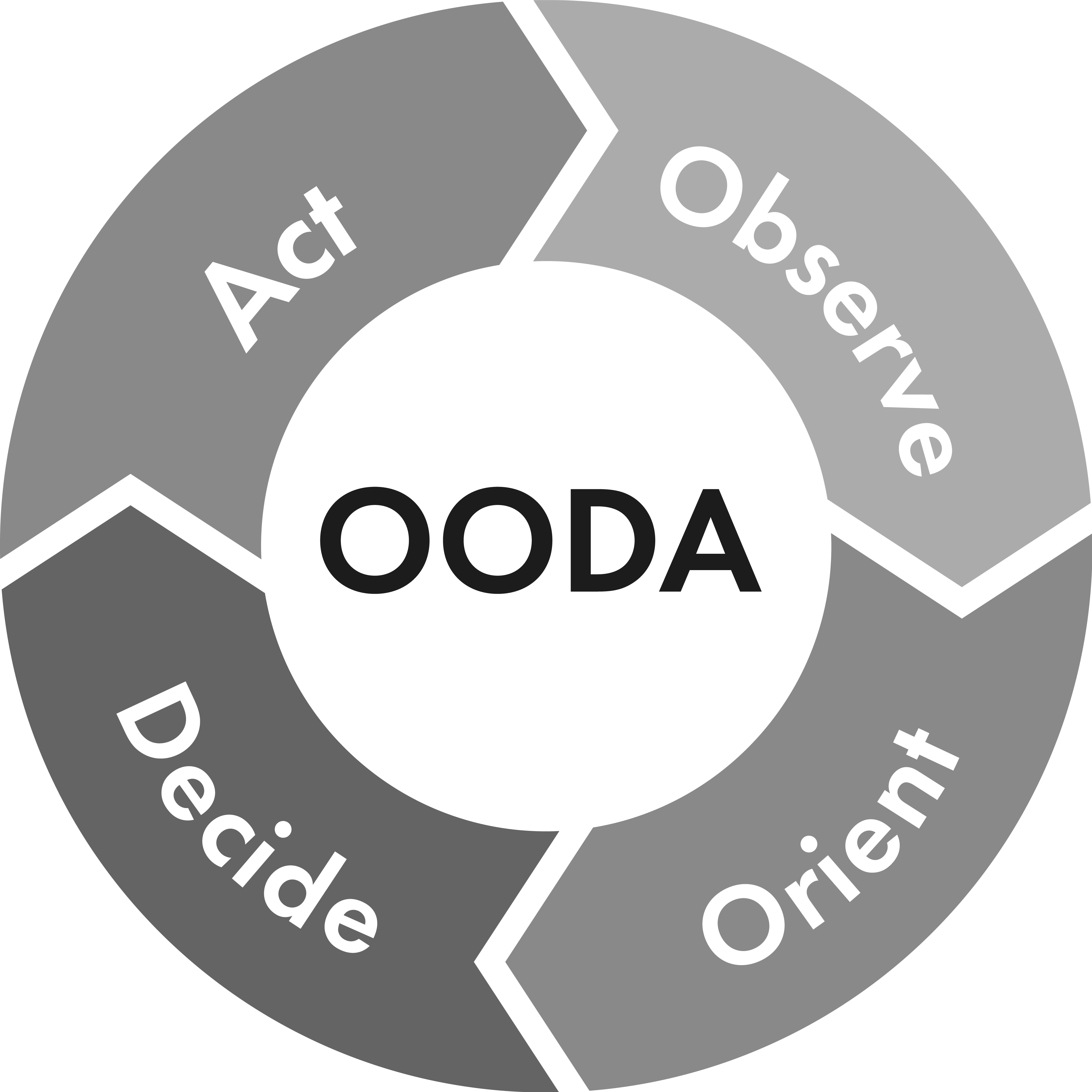
The most common representation of the OODA loop is a closed circuit: Observe, Orient, Decide, Act, and repeat. However, this depiction fails to capture the crucial aspect of Boyd’s original conception - the interaction between the agent and its environment. This closed loop model, lacking any feedback from the external world, aligns with the notion of “Agents of Chaos” - artificial intelligence systems that operate solely on vast datasets without the capacity for learning or adaptation.
The Sentient Loop: Guardians of Decay and Merchants of Certainty
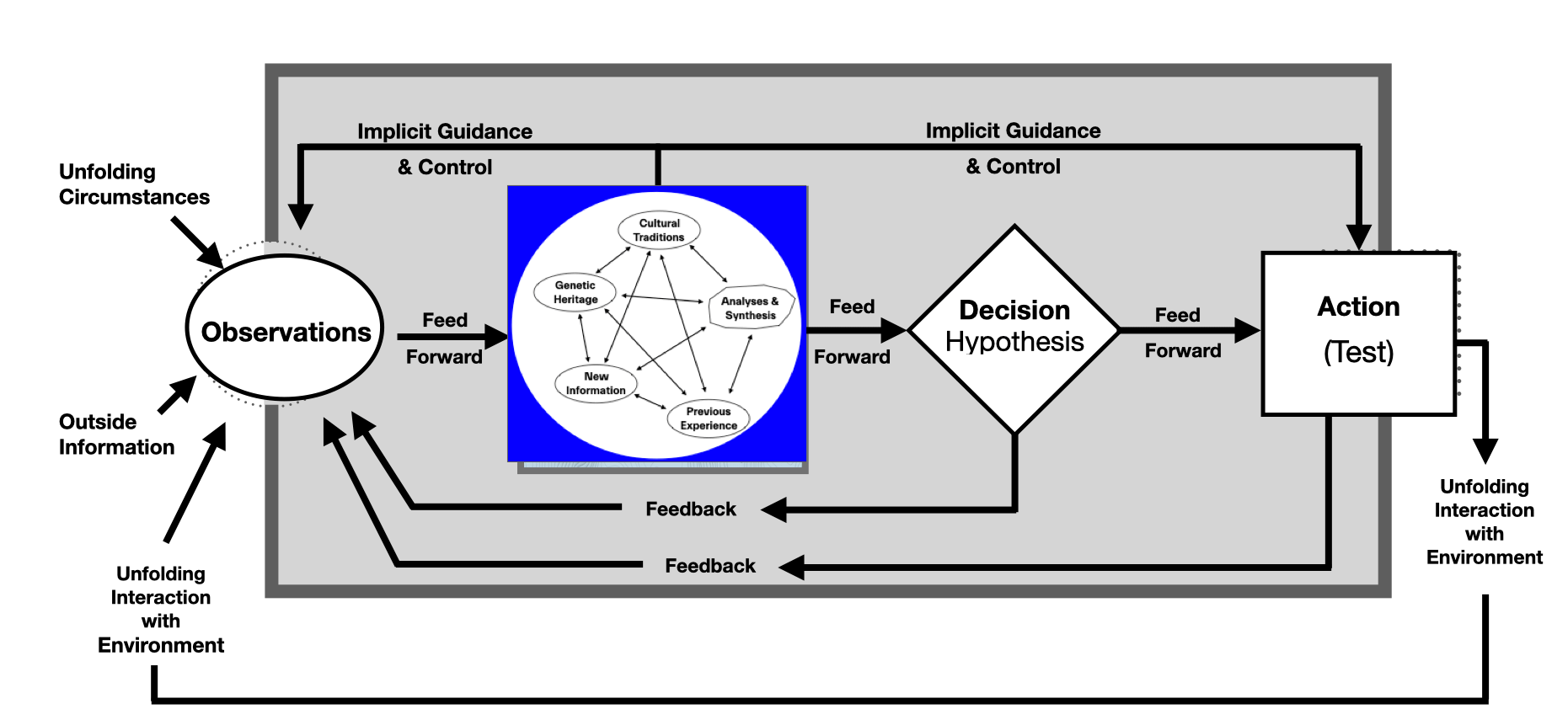
A more accurate representation of the OODA loop is a left-to-right flow with a feedback loop connecting the Act phase back to Observe. This representation includes an implied boundary separating the agent from its environment, allowing for a basic level of interaction and responsiveness. This sentient loop aligns with the concepts of “Guardians of Decay” and “Merchants of Certainty” - agents or systems that exhibit a rudimentary form of awareness and responsiveness to their surroundings but remain rigid in the face of environmental changes.
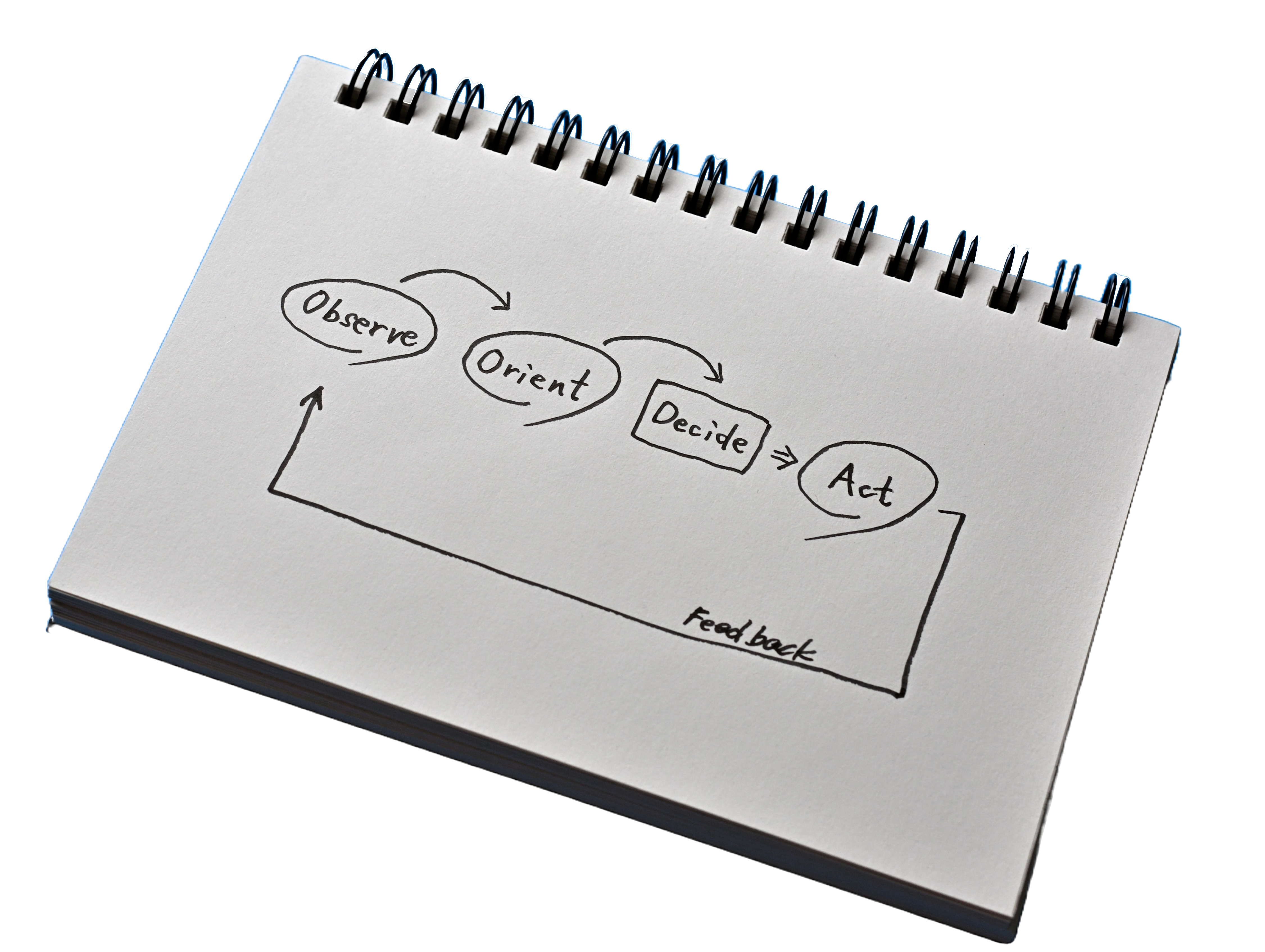
In A World Appears: A Journey into Consciousness, Michael Pollan defines sentience as the elemental form of consciousness - a precursor to the full-fledged consciousness exhibited by higher animals. Sentient beings, per Pollan, lack the more advanced aspects of consciousness such as a sense of self, emotion, reasoning, and self-reflection. The sentient OODA loop, with its implied boundary and simple feedback, captures this basic level of awareness.
Merchants of Certainty, exemplified by large consultancies and linear OODA loop pushers often hiding behind their Weapons School Patch or military rank, often project their rigid views onto others, failing to adapt to the complexities and uncertainties of the environment. This rigidity is a hallmark of the sentient loop, where the agent’s internal models remain fixed and inflexible.
The “Conscious” Loop: Boyd’s Original Insight
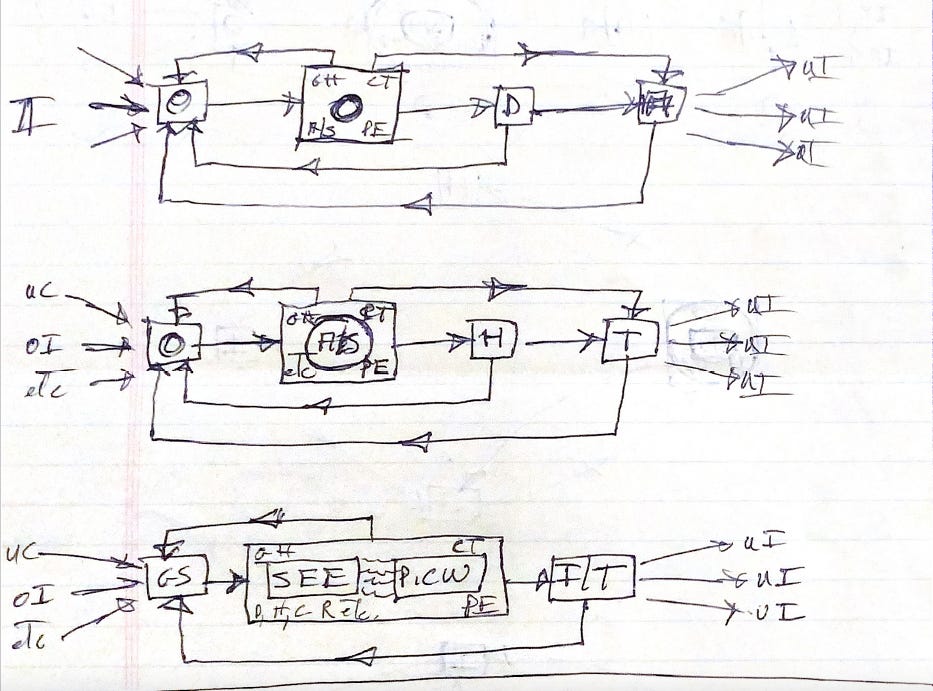
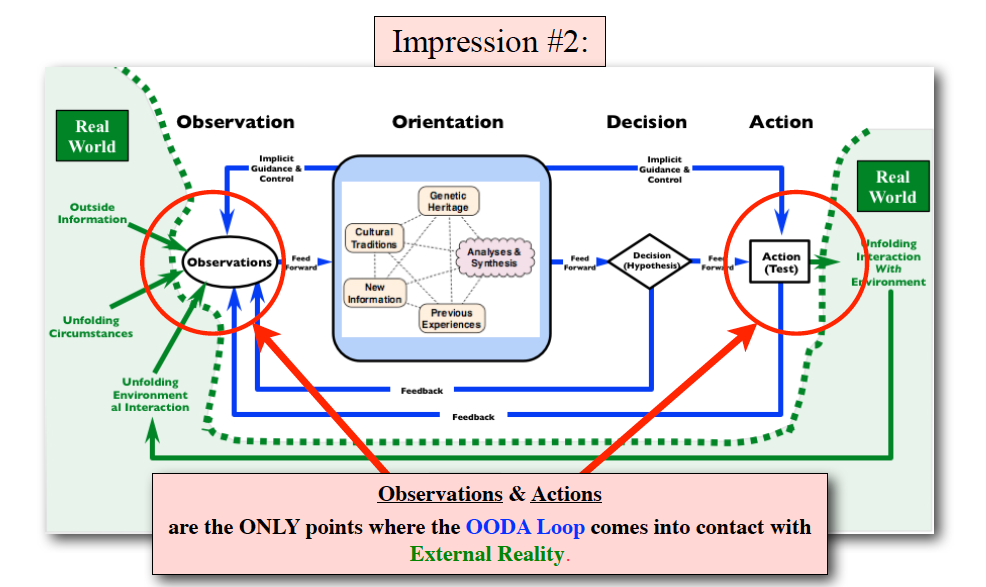
Boyd’s original OODA sketch features an implied boundary between the agent and the environment. As highlighted in Chuck Spinney’s Evolutionary Epistemology brief, we can make this boundary explicit by adding a Markov blanket to Boyd’s sketch. The sensory (Observe) and action states reside on this boundary, serving as the interface between the agent and the external world. Crucially, Orientation in Boyd’s sketch represents the agent’s generative model - its internal representation of the world and itself.
This “conscious” OODA loop features rich feedback and feedforward pathways, enabling the higher-order awareness and self-modeling associated with consciousness. These complex information flows allow the agent to adapt and learn from its interactions with the environment.
Mismatches and Surprises: Connecting Boyd and the FEP
A key concept in Boyd’s theory is the idea of mismatches between the agent’s internal model and the actual state of the environment. These mismatches parallel the notion of surprises or prediction errors in the Free Energy Principle. According to the FEP, all living systems are driven to minimize free energy - a measure of these surprises or mismatches.
The process of minimizing free energy, known as active inference, underlies perception, cognition, and action. Agents continually update their generative models to better predict and adapt to their environment. The OODA loop, with its iterative process of perception, prediction, planning, (re)orienting, learning, adapting, deciding, and acting, can be seen as a high-level manifestation of active inference, where agents strive to reduce mismatches between their internal models and the external world.
The OODA Loop as a Simple Representation of Conscious Systems
At its core, the OODA loop represents a simple yet profound sketch of how living, conscious systems interact with their environment. By mapping the concepts of sentience and consciousness onto the different levels of OODA loops, we can gain new insights into the nature of awareness, cognition, and adaptation.
The conscious OODA loop, with its explicit Markov blanket boundary and rich feedback pathways, captures the essential dynamics of how conscious agents navigate the complexities of their environment. The iterative process of updating internal models based on sensory input and taking actions to minimize mismatches or surprises lies at the heart of adaptive behavior.
John Boyd’s OODA loop, when properly understood and augmented with insights from the Free Energy Principle, provides a powerful framework for understanding the emergence of sentience and consciousness. By connecting Boyd’s concepts of mismatches with the FEP’s notion of surprises, we can see how the drive to minimize prediction errors propels the evolution of adaptive, conscious systems.
This synthesis of the OODA loop and the FEP offers a unifying perspective on the nature of mind and cognition, with implications spanning neuroscience, artificial intelligence, and the study of adaptation and decision-making. As we continue to explore the profound questions surrounding consciousness and its origins, Boyd’s simple sketch serves as a guiding light, illuminating the path towards a deeper understanding of how living systems engage with the ever-changing tapestry of their environment.
OODA Loop Mapped: Internal Functions
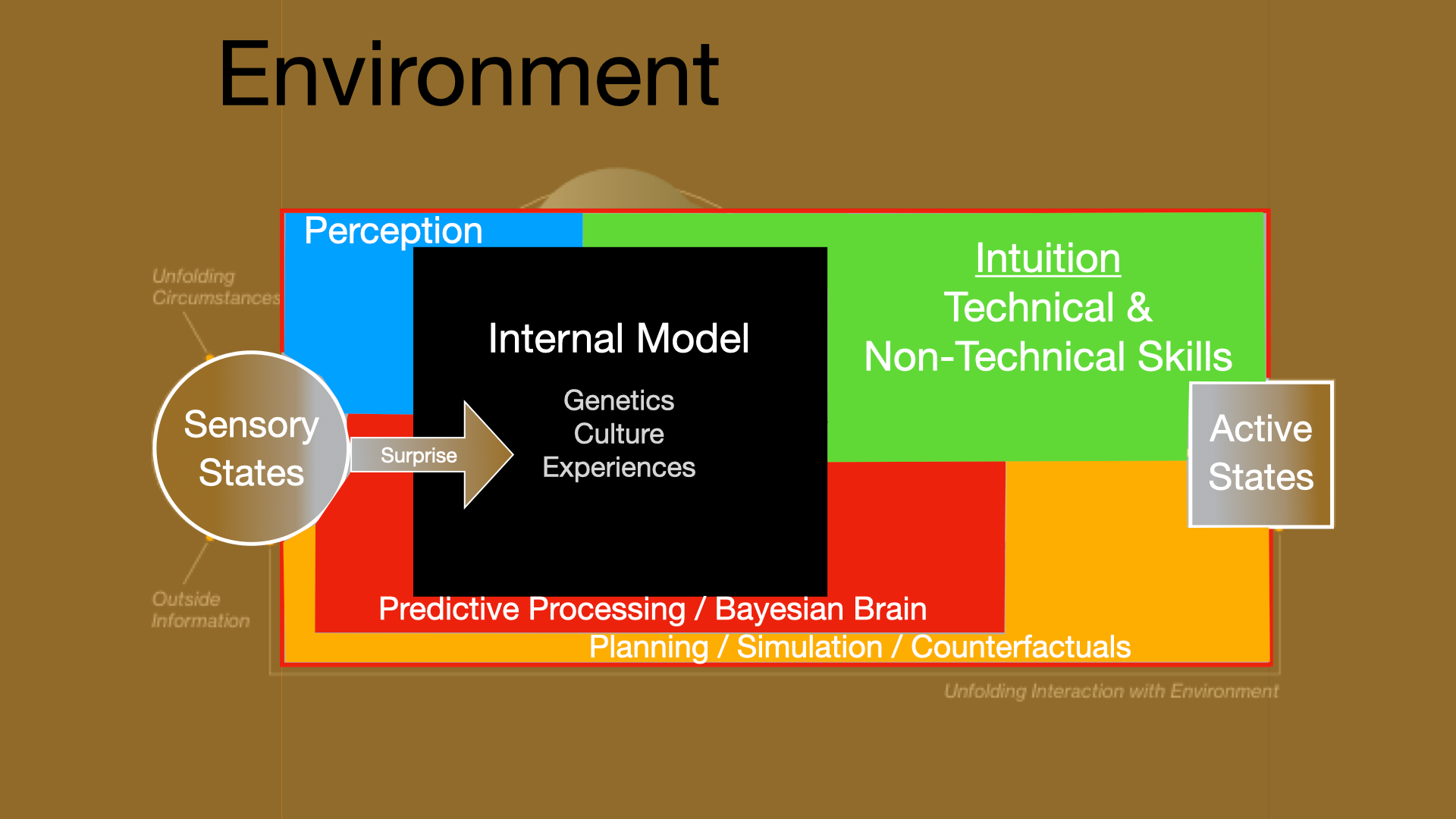
As we continue to explore the various concepts and theories discussed on No Way Out, such as ecological dynamics, Constructal Law, Constructor Theory, Platonic Space, Perceptual Control Theory, Adaptive Resonance Theory, Active Inference, and predictive processing, it becomes increasingly clear that researchers and academics are on the cusp of discovering the true essence of the OODA loop. The version of the OODA loop shared above aims to highlight the importance of the internal pathways within Boyd’s sketch, which are just as crucial as the sensory states (Observation), active states (Action), and generative model (Orientation) components.
It is both fascinating and somewhat unnerving to witness the apparent divide between the ecological dynamics community that is behind the powerful Constraint-Led Approach in sports and the Free Energy Principle (FEP) community that explains the power of psychedelic-assisted therapies, peak performance (flow), and the next generation of AI. While these two groups may seem to be at odds with one another, I propose that they are, in fact, examining different aspects of the same proverbial elephant – the OODA loop.
By recognizing the OODA loop as a unifying framework that encompasses the various theories and approaches to understanding consciousness, cognition, and the nature of reality, we can begin to bridge the gap between seemingly disparate schools of thought. The OODA loop provides a common language and conceptual foundation upon which researchers from diverse backgrounds can build, collaborate, and push the boundaries of our understanding.
As we move forward in our exploration of these profound questions, it is essential that we remain open to the insights and contributions of all those who are dedicated to unraveling the mysteries of the mind and the world around us. By embracing the OODA loop as a guiding framework, we can foster a more inclusive, interdisciplinary approach to the study of consciousness and cognition, one that acknowledges the validity and value of multiple perspectives.
In the spirit of John Boyd’s legacy, I invite the academic community to engage with the OODA loop, to follow the breadcrumbs John Boyd left behind, and to contribute to the ongoing dialogue surrounding these fundamental questions. As we continue to refine our understanding of the OODA loop and its implications, we may find ourselves on the precipice of a truly revolutionary shift in our understanding of the mind, the world, and our place within it.
It is time to bring the science to the people. There is No Way Out!
-Ponch