


Originally published in The Whirl of ReOrientation on October 15, 2024.
Our Orientation (Second ‘O’ in OODA) shapes everything: what we notice, how we interpret New Information, and what we remember. However, our Orientation can easily become biased if we filter new insights through existing beliefs or preconceived notions. True Orientation updates happen when compelling evidence or genuinely fresh insights (New Information) break through these filters, shifting our understanding in meaningful ways.
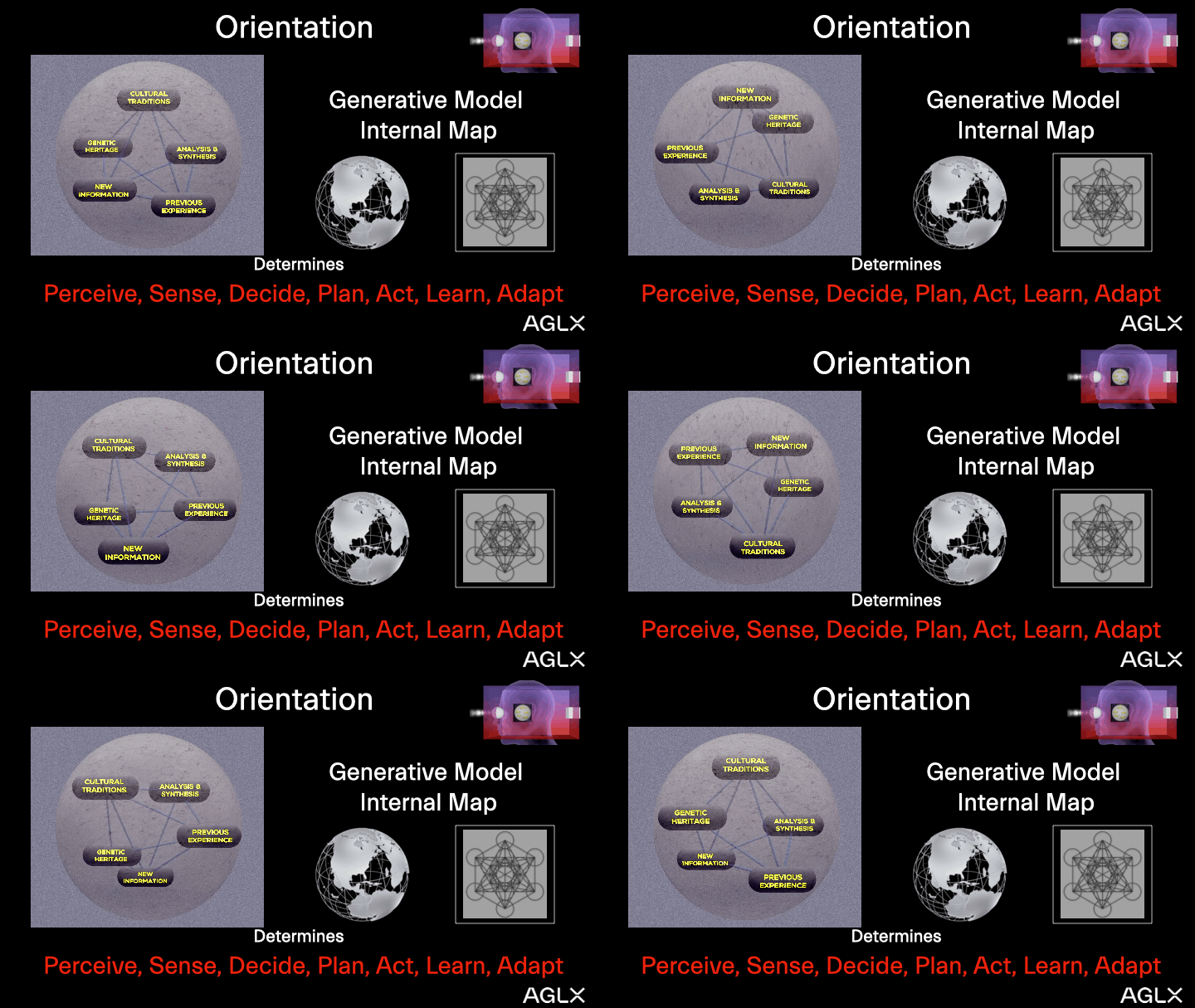
One powerful method for updating our Orientation is through achieving flow. Flow occurs when we experience novelty and complexity in our environment while simultaneously managing our internal state for optimal performance. This goes beyond what mindset charlatans suggest—it’s about creating the conditions for deep concentration, full embodiment, and enhanced pattern recognition.
As some of you may know, the OODA loop (Observe, Orient, Decide, Act) represents a flow system, continuously evolving (Design) as it processes New Information (Currency). While we’ll explore the OODA loop as a flow system on the No Way Out podcast and later, for now, let’s consider how this concept connects with sacred geometry, the Great Pyramid, and even the foundational documents of America.
Over the past few years, I’ve been exposed to connections between sacred geometry, music, the Great Pyramid, and recently, key American texts like the Declaration of Independence and the Constitution. Interestingly, this line of thinking is finding its way into market theories, such as the Market Mind Hypothesis, and influencing how we apply the OODA loop to understand complex systems. Again, more on this market connections at a later time.
Last night, I spent some time in flow exploring the connections between the Declaration of Independence, the Great Pyramid, and even teaching my daughters about Euler’s number. What continues to astonish me is how the Great Pyramid serves as a breathtaking example of hidden mathematical relationships—not just in geometry, but in its reflection of natural and cosmic patterns.
The pyramid’s dimensions, for example, don’t just showcase advanced geometry. They encode the precise relationships between the Earth, Moon, and Sun. Measured in royal cubits (440 for the base and 280 for the height), the proportions of the pyramid echo the mathematical constant Pi (π). This suggests that the builders had an understanding of these universal principles long before modern science documented them.
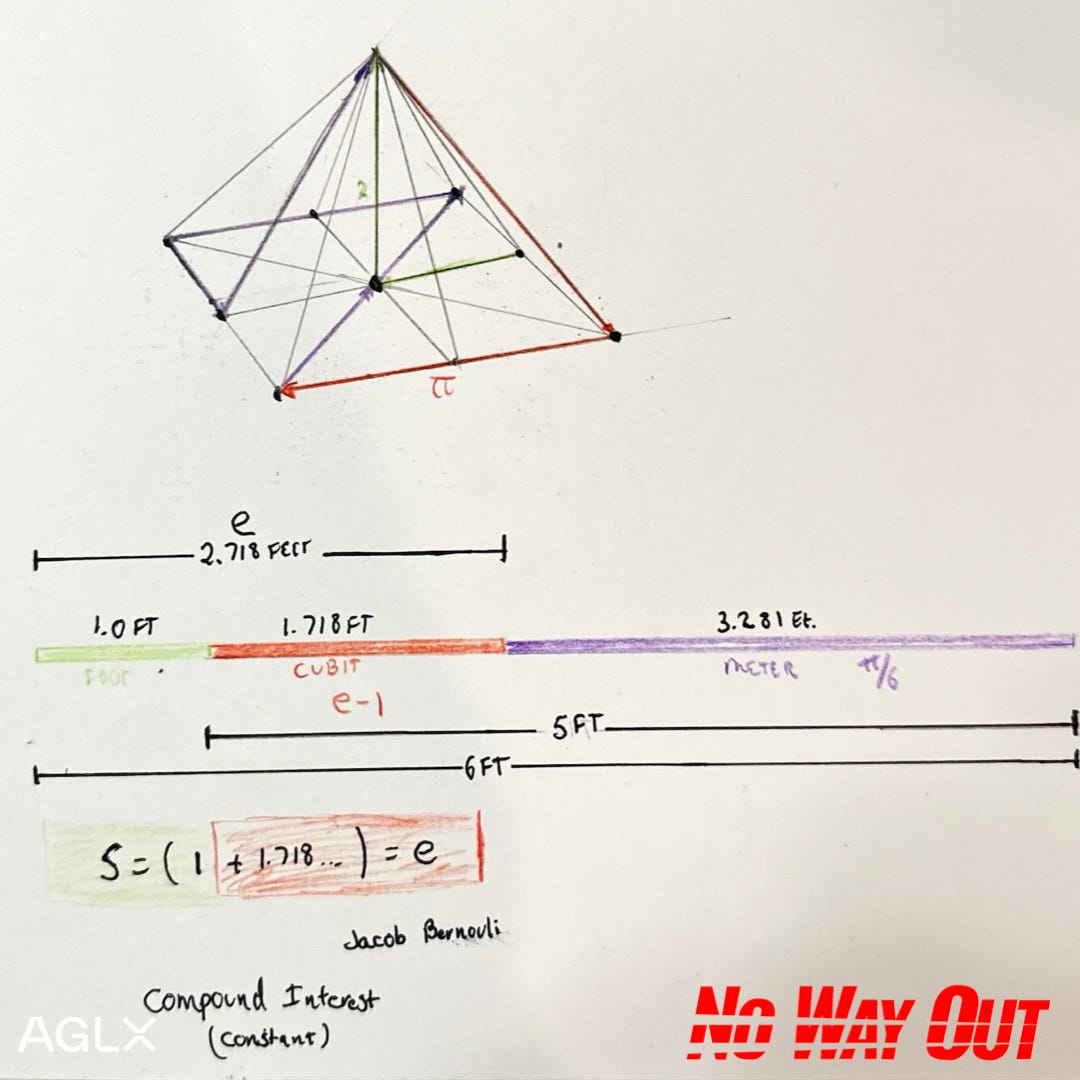
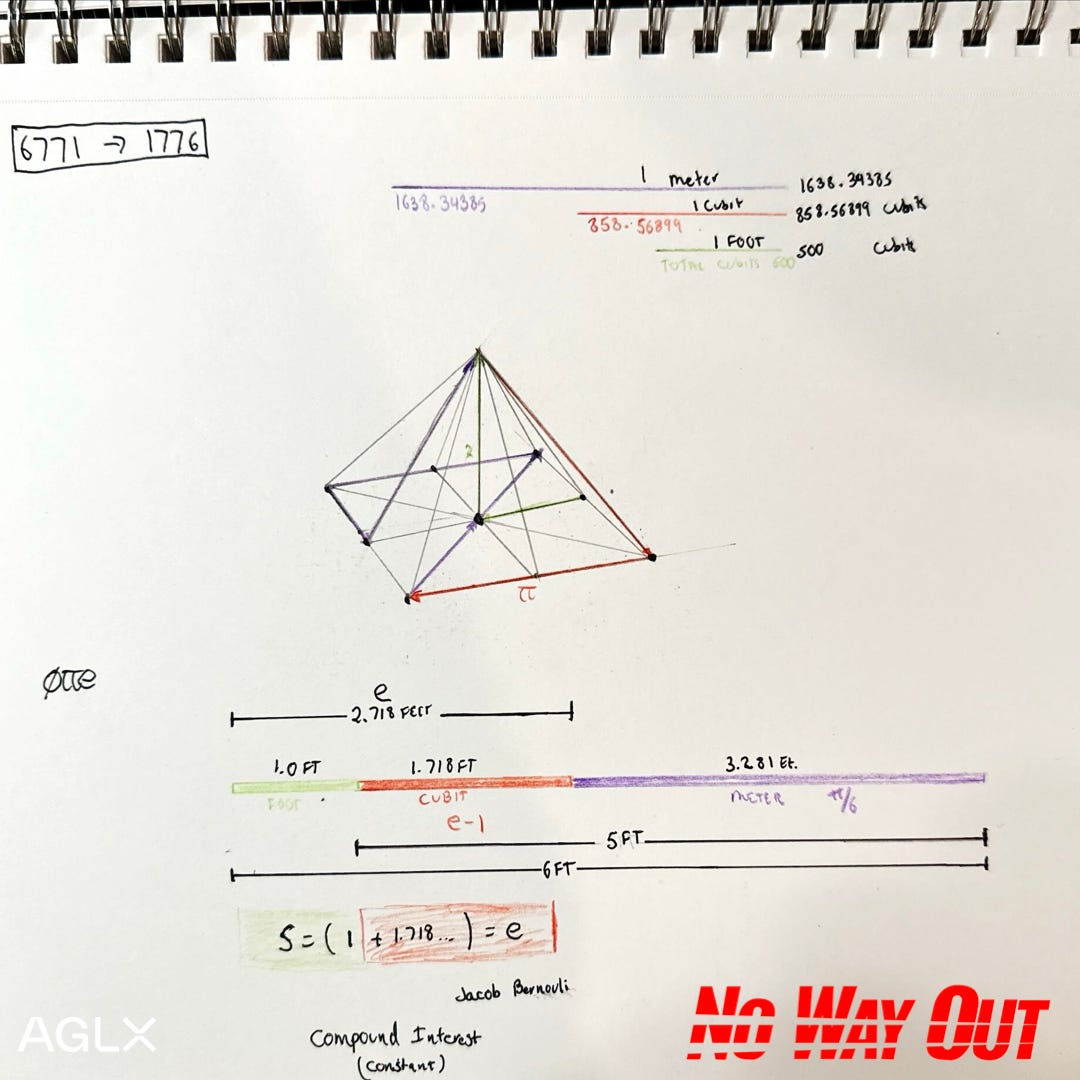
Even more intriguing is the alignment between three measurement systems—the foot, cubit, and meter. These units, invented millennia apart, are precisely represented within the pyramid’s design. The red and purple lines in the pyramid’s layout form a bridge between ancient and modern systems of measurement. This connection is further reinforced by Euler’s number (e), approximately 2.718, where the sum of the foot and cubit equals e. It points to an even deeper, universal link embedded within the structure.
The pyramid’s architecture also hints at an ancient attempt to solve the age-old problem of “squaring the circle”—a mathematical challenge that involves constructing a square with the same area as a given circle using only a compass and straightedge. The pyramid’s proportions reflect the precise ratios of the Earth’s and Moon’s radii, encoding this complex relationship in stone.
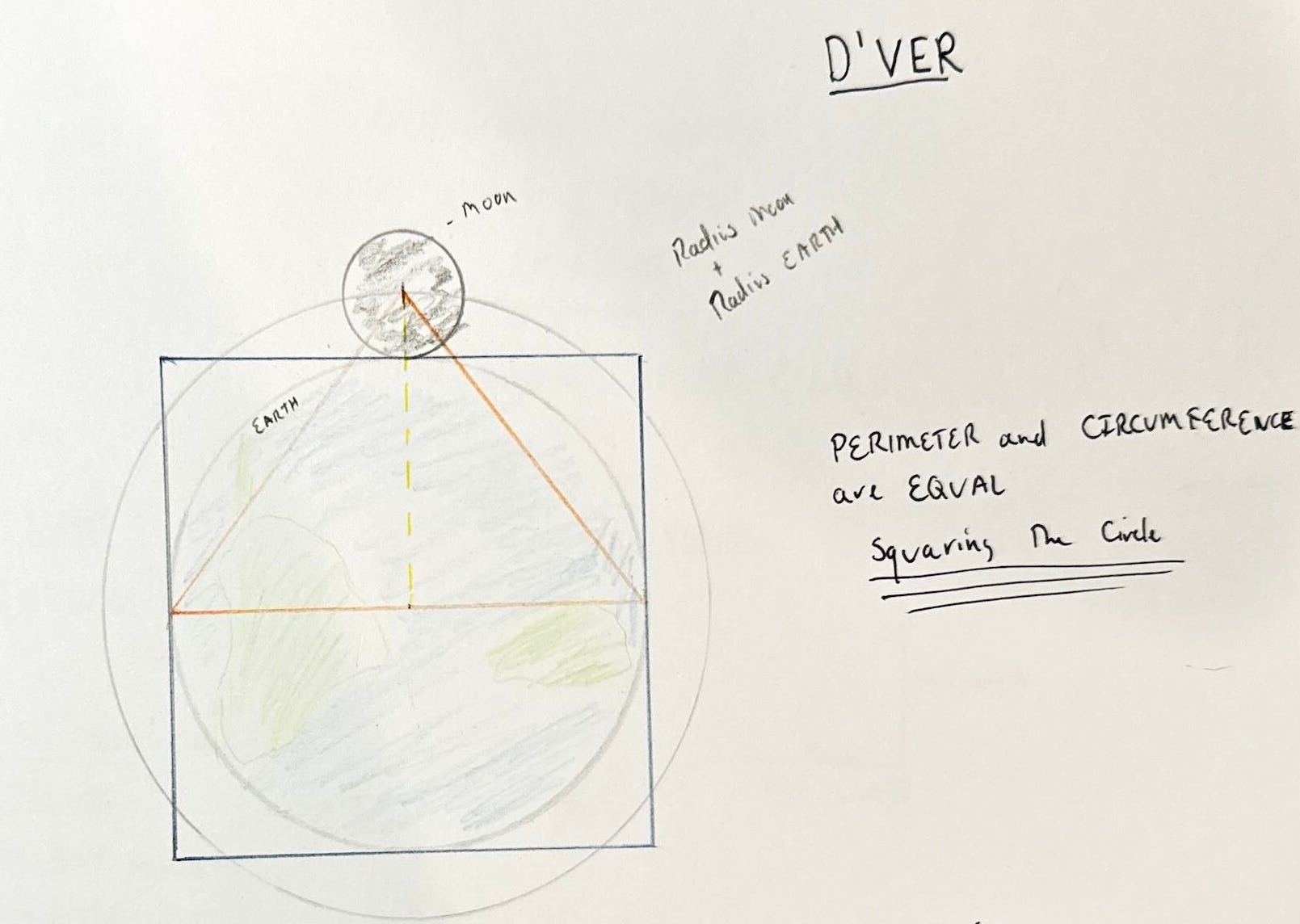
These hidden mathematical insights suggest that the builders of the Great Pyramid had access to advanced knowledge of the universe’s fundamental laws—far earlier than we previously believed.
By updating our Orientation to consider these connections, we open ourselves to a deeper understanding of the universe and the timeless wisdom encoded within it. Whether through geometry, ancient measurement systems, or cosmic alignments, the Great Pyramid continues to offer profound insights that challenge and expand our perception of reality.
For those of you who are interested in learning more about sacred geometry, we are partnering with a former TOPGUN turned polymath. Stay tuned as we sort out that launch. We also recommend checking out Robert Edward Grant’s work and Alan Green’s “The America Codes - Game On!