


I have been looking forward to this conversation since 2019.
Keith Davids, PhD, is Professor of Perceptual-Motor Learning at Sheffield Hallam University in Sheffield, England, and one of the architects of ecological dynamics and the constraints-led approach. His book with Ian Renshaw, Daniel Newcombe and Will Roberts, The Constraints-Led Approach, came into my hands in 2019, and it changed how I train teams.
This episode marks Keith’s first appearance on No Way Out.
Why This Conversation
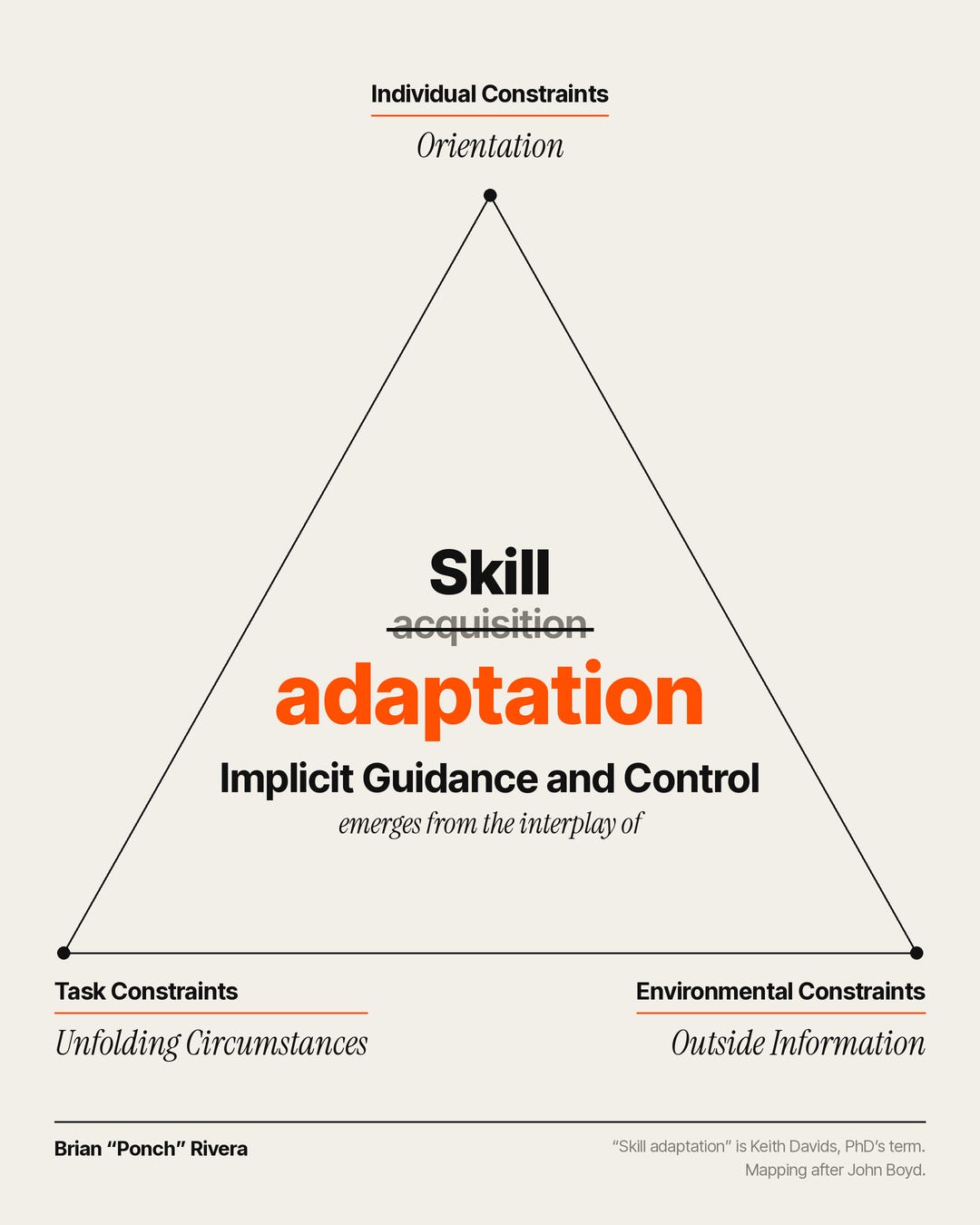
Keith wants to retire a term most of us use without thinking: “skill acquisition.”
He told me the term “harks back to a time when the theory and the philosophy that supported the term skill acquisition was all about people acquiring an internal representation, a model of the world which guided them in their interactions.” He traced it back to the Second World War. “So there is a military connection there.”
The word he uses now is skill adaptation. In his words, “the past five years or so, it’s become clear that what we’re talking about really is skill adaptation.”
Why does a word matter? The word you use shapes how you coach. If you think a skill is something stored in the head, you drill it until it’s stored. If you think a skill is an adaptation to the environment, you design practice around the environment. Keith’s line: “most of the time, it’s about adapting your skills and your performance in relation to the performance environment.”
He was honest about how hard the change is. “It’s actually hard to keep that in mind all the time, because you can keep relapsing.” And he was practical about it. “In reality, if I just use skill adaptation all the time, people wouldn’t know what I was talking about.”
I told him I could help with that. This post is a start.
How I Found CLA
I first encountered the constraints-led approach (CLA) in 2019. I have shared this story before, on Transforming Basketball and briefly with Keith.
It came after the USS Fitzgerald and USS McCain mishaps at sea, while I was serving at the Naval Safety Center and as we were nearing the end of our work on The Flow System. In August 2019, I attended a Cynefin retreat in Whistler, where Zhen Goh and others introduced me to CLA.
Within a week, I was at the NSWC Carderock complexity conference, speaking alongside Yaneer Bar-Yam, Trent Hone and David Woods. Trent and David later joined me on No Way Out (Ep 118 and Ep 122). While I was leading a Linear Cynefin workshop there, a lieutenant or lieutenant commander from Carderock handed me a copy of The Constraints-Led Approach. For the second time in a week, CLA had found its way to me.
The book gave me the missing piece. It showed how mission command, a leader’s intent, and constraints come together in developing skills. It convinced me that we needed to train teams this way, and it shaped our team development interventions, the work we now call the Flow Learning Lab.
In This Episode
The word change. Why Keith prefers skill adaptation. “Skill adaptation is a much better concept for us to be focusing on because it captures that complexity, adaptive nature of human behaviour.”
Attunement. Learning to pick up the information in the environment that matters for what you’re trying to do. Keith put it in one line: “Attunement to information is the basis of skill adaptation.”
Knowledge of and knowledge about. James Gibson split knowing into knowledge of the environment, which comes from acting in it, and knowledge about it, which comes from instructions and feedback. Keith called knowledge about “supportive, but it’s overrated in traditional methods.” We talked about where the fighter aviation debrief fits.
Interacting constraints. “Karl Newell in 1986 proposed a model of interacting constraints.” Constraints of the person, the task and the environment shape what a performer can do, and they act together. Keith: “interacting constraints is fundamental.”
Good enough. Keith wants performers “to come up with a solution that is good enough rather than looking to achieve some sort of perfect optimal solution that a coach or a plan had in mind.”
The athlete as scientist. “A good athlete acts like a scientist.” And later: “the performer is the problem solver.”
Distributed control. Keith described a heterarchy this way: “a heterarchical system is one where control is distributed around the system.” I brought up mission command, where the mission commander holds 51% of the vote and others can still lead at different times.
Rivera ball. Keith used my name for a hypothetical team plan. His point: “if you stick too rigidly to your plan ... you’re going to get found out.”
Repetition without repetition. Coaches as designers of practice tasks where there isn’t just one solution. “We know repetition is important in training and practice, but repetition without repetition is much more important.” The performer can go this way or that way, depending on what the moment needs.
Liverpool in the 1980s. “I cut my teeth as a young academic at Liverpool Polytechnic in the 1980s,” and how the field has changed since then.
A health legacy. Keith sees a long-term payoff past winning. “There is a health legacy to it.” And: “It’s about each individual reaching their own potential.”
What Stayed With Me
When I found CLA, I assumed every coach in sport already worked this way. I was wrong.
I am the parent of two daughters who play basketball. Even with my background and some knowledge of coaching and CLA, it took me several years to recognize that something was wrong.
On the show, I said that many coaches are stuck in a deep valley, anchored to dogmatic, historical ways of doing things, and that it takes energy to move them out of it. Keith doesn’t see his job as converting anyone. “I’m not that sort of evangelical about it.” He sees his role as putting the ideas on the table “in written format, in presentations, in discussions like this, and then people use them.”
Then he said this. “I’ve been working in this area for 40 years, probably more than that, to be honest, and I’m still learning.” His advice to a coach or an athlete: “it’s better for you if your ego doesn’t get in the way.”
Forty years into his career, Keith is still updating his own vocabulary. Which words are you still using that you learned twenty years ago?
There is No Way Out!
-Ponch
Timestamps
00:00 Cold open: Rivera ball and why fixed game plans get found out
00:55 Intro
01:19 Keith Davids and ecological dynamics
02:12 From Navy teamwork to the constraints-led approach
04:03 Skill adaptation vs skill acquisition
08:37 Control from the outside in: heterarchy and self-organization
12:00 Complex adaptive systems and distributed leadership
15:53 Intention, attention and attunement
19:55 The debrief and knowledge of the environment
25:20 Attentive dwelling, enskillment and wayfaring
27:47 Experiential learning and constraints in organizations
29:27 Newell’s interacting constraints
32:26 Strong and weak anticipation
36:03 Intent, heuristics and principles of play
38:25 Co-design: the athlete as scientist
41:59 Intent evolves over a season
45:36 Orientation: no one has the full picture
48:13 Attractor landscapes and metastability
52:07 Coaching egos and deep valleys
53:31 Humility and 40 years of learning
55:12 Data, performance analysis and Rivera ball
58:53 Ecological dynamics in practice: police, military, elite sport
01:02:40 Sport, adaptability and the next generation
01:06:10 The Constraints Collective
Where to Find Keith
Keith co-hosts The Constraints Collective with Ian Renshaw and Martyn Rothwell. They make learning resources and a podcast, and Keith says “there’s a lot of free stuff on the website there.”
The Constraints Collective: https://www.theconstraintscollective.com (X: @ConstraintsColl)
Sheffield Hallam University profile: https://profiles.shu.ac.uk/2919-keith-davids/teaching
New book with Jia Yi Chow and Duarte Araújo: Ecological Dynamics Approach to Football (Routledge, 2026)
Background reading: Araújo and Davids (2011), “What exactly is acquired during skill acquisition?” Journal of Consciousness Studies 18(3-4), 7-23: https://shura.shu.ac.uk/7300/
More on the Constraints-Led Approach From No Way Out
Ep 190, Alex Sarama: Out of the Valley: Alex Sarama on Coaching With a Constraints-Led Approach
Ep 181, Andrew Sheaff: Willpower is not enough: Andrew Sheaff on swim coaching
Ep 179, Rob Gardner: Don’t steal the struggle: Rob Gardner on basketball
Ep 172, John Flach: The information is already out there: John Flach on optic flow
Ep 170, George Vaz: Develop them or collect them: George Vaz on the constraints-led approach
Ep 134, Rob Gray, PhD: Constraints build the athlete: Rob Gray on the constraints-led approach
Ep 118, Trent Hone: Learning War in the age of AI: Trent Hone on how the Navy adapted
Ep 122, David Woods, PhD: Saturation comes before collapse: David Woods on adaptive capacity
Catch the full conversation:
YouTube: https://www.youtube.com/watch?v=EQe5o5RTSEA
Apple Podcasts: https://podcasts.apple.com/us/podcast/skill-adaptation-beats-skill-acquisition-ecological/id1663685759?i=1000799797100
Spotify: https://open.spotify.com/episode/5K8xWThaeHpRVvVmlxuoSK
Buzzsprout: https://www.buzzsprout.com/2109174/episodes/20069917
No Way Out on YouTube: https://youtube.com/@nowayoutpodcast